Prompt Queue — Hermes Desktop plugin
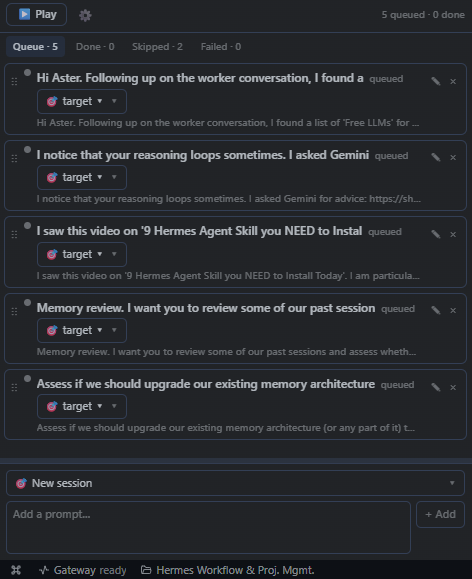
Kanban-style prompt queue for the Hermes desktop app. Each card is a prompt. Press ▶ Play and the queue drains strictly top-down: each card becomes a real new desktop session (visible in the sidebar, openable with the ↗ on the card), runs its prompt, waits for the turn to finish, waits for any background self-improvement review to fully complete (strict gate), then fires the next card.
Built for feeding a local-model setup a list of prompts one fresh session at a time — without the next prompt fighting the background review for the inference slot — while keeping every session visible in the normal sidebar.
What it adds
- Pane — docked below the session list (bottom-left of the default layout); drag it anywhere.
- Cards — add (textarea, Ctrl/⌘+Enter or + Add), edit (✎), reorder (drag ⋮⋮), retry failed (↻), open the card's session (↗). The × on a card opens a small menu: ↷ Skip (moves it to the Skipped tab), ✓ Mark done (→ Done), or ✕ Delete (removes it) — so an accidental × no longer loses a prompt.
- Queue / Done / Skipped / Failed tabs — finished cards move off the Queue tab so it stays clean (live counts in the labels); Done and Skipped have a ✕ clear button; only the Queue tab is drag-reorderable.
- Strict review gate — no new prompt is fired while a background
memory/skill review is still running (detection:
review.summaryevent +thread=bg-reviewlog markers, 30 s spawn grace, 20 s poll, fail-closed on log errors: the queue holds with a visible⏸ holding — review verification unavailablestate and retries until absence is confirmed; fail-open is an explicit opt-in in the gear). - Slot hygiene — after a card's turn, its one-shot session's
active-session slot is released (
session.close; the sidebar row stays), so a long queue can't exhaust the session cap. - Card targets — each card can run into a new session (default) or
an existing session: pick from the latest 10 sessions with a reply, or
paste a session ID. Set at add time or per-card (
🎯 target ▾); a queued card can be repointed before it fires. Target cards attach viasession.resumeand are never closed by the plugin (the idle reaper frees their slot, as with any session you use). - Restart-safe — queue state persists via plugin storage; a card running across an app restart is re-attached (or re-queued, never dropped).
::enqueue{prompt="…"}transcript directive — a chat turn can suggest a card (deduped by a realdedupeKeyprop). Default is ask-first: the directive renders a chip showing the suggested prompt itself (truncated ~200 chars; full text in the tooltip) that you click to accept (the platform contract marks directive attributes as untrusted model output); the gear (⚙, pane header) switches it to auto-add. Auto-add only fires while the message is still streaming — re-rendering an old transcript after a reload never re-queues its directives. Tell your agent the directive exists; it won't discover the name on its own.- Status bar chip — right cluster:
queue · N active, M next/queue paused · M waiting/queue idle.
State machine
queued → launching → running → review-wait → done
              └────────┴─────────┴──┴─────────→ failed (with retry)
Per-card watchdogs: 10 s busyBySession poll (missed-event fallback),
12 h hard stall → failed (session left open, not force-closed). Sized for
local-model turns (observed 1–4 h on this box); real completions come from
message.complete + the poll, the stall is only the hung-session tripwire.
If the gateway queues a prompt behind a target's in-flight turn (submit
response status: "queued"), the card shows ⏳ queued in target and
completes on the drained turn's completion, not the in-flight one.
Install
From the catalog (once listed in the Nous Hermes plugin catalog):
hermes plugins install prompt-queue --enable
From this repo (disk plugin; single ESM desktop/plugin.js + plugin.yaml, no build step):
- Clone the repo, then copy the
desktop/contents into your desktop plugins dir —~/.hermes/desktop-plugins/prompt-queue/desktop/(or$HERMES_HOME/desktop-plugins/prompt-queue/desktop/when a profile is active). The directory must end in.../prompt-queue/desktop/plugin.js. - The app hot-reloads within seconds. If it doesn't appear: ⌘K → Reload desktop plugins. A load failure shows a toast naming the error.
- Manage (enable/disable) in Settings → Plugins.
Requirements
A desktop build recent enough for: host.request gateway RPCs
(session.create, session.list, session.resume, prompt.submit,
session.close, session.active_list), host.openSession,
host.onEvent('message.complete'), host.state.busyBySession, host.logs,
ctx.storage, pane contributions with dock, and TRANSCRIPT_DIRECTIVE_AREA.
Developed and verified against the 2026-09 build (all of the above confirmed
in tui_gateway/ + apps/desktop/src/sdk source).
Trust & Autonomy
A card is not a draft — once the engine fires it, it becomes a full agent turn in a real session, with that session's complete tool access (terminal, files, web, whatever that profile allows). Queue prompts the way you'd queue autonomous work.
What the plugin does and doesn't touch:
- No network calls. It never fetches or sends anything beyond the Hermes gateway RPCs listed in Requirements (same machine, same gateway).
- No credential access. It reads no keys, tokens, or profile data.
- Log tail for the review gate. It reads the last 1000 lines of
agent.log(filtered forbg-reviewmarkers) to know when a background review is running. That log is your own, but it can contain content from other sessions; the gate parses timestamps and markers only — nothing is stored or displayed.
Card sources and their trust level:
| Source | Trust | Behavior |
|---|---|---|
| Textarea / picker (you typed it) | user-approved | added directly; runs only while Play is active |
::enqueue{prompt="…"} (a chat turn wrote it) |
untrusted model output — the platform contract for transcript directives is that attributes are untrusted model output | default ask-first: renders a clickable chip; the card is added only when you click it (gear → Suggested prompts: Auto-add restores immediate add). Either way it runs only while Play is active |
The ::enqueue path is the one a prompt injection could exploit: a
model-generated (or model-relayed, e.g. quoted from a web page or file)
directive can suggest a card you never typed yourself. By default it
cannot add one on its own — the chip waits for your click — and the gear
(⚙, pane header) is where that decision lives.
Review gate semantics. The gate holds the queue while a background
self-improvement review is running. If the log check itself fails (a
transient host.logs blip), the gate fails closed by default: the card
shows ⏸ holding — review verification unavailable and the 20 s re-poll
retries until absence is confirmed. Fail-open is an explicit opt-in
(gear → Review gate on error: Open).
Performance notes (local models)
Each card's default target is a new session. On local-model setups, creating or switching sessions can mean (re)loading KV-cache context for the session — a compute cost that grows with context length, and it's why a frequent pattern here is fewer, longer sessions rather than many short ones. Practical guidance:
- One-shot, independent prompts — the default (new session per card) is fine and keeps each run isolated.
- Iterative work on the same topic — point the cards at one existing session (🎯 target) so follow-ups reuse that session's context instead of paying a fresh load per card.
- Keep each prompt self-contained: a card in a new session has no memory of the other cards.
Known limitations
- The engine never submits into a mid-turn session (one card at a time — the global gate also holds target cards whose session is mid-turn), but a card whose turn stalls >12 h fails with the session left running rather than force-closing it.
- Reorder only applies to non-live cards (a live card is mid-flight).
- The review gate is global (one review can run app-wide), matching the harness: a review spawned by any session gates the next card.
- One-prompt sessions never trigger their own background review (the nudge counters are per-session) — the gate covers reviews from any session, which is the inference-slot protection that matters.