Hermes VaultKnox
VaultKnox is an encrypted secrets vault for Hermes Agent. It stores sensitive data locally, returns masked references and short-lived tokens to the agent, and ships a self-contained Hermes plugin that redacts secrets from chat before they reach session storage.
Documentation Map
| Topic | Where |
|---|---|
| Plugin install, hooks, verification, troubleshooting | docs/AGENT_INTEGRATION.md |
| Plugin install, verification, and operator checklist | docs/PLUGIN.md |
| Hermes write-gate operations (production guide) | docs/hermes-write-gate-operations.md |
| Per-version change log | CHANGELOG.md |
Status
VaultKnox v0.8.0 is in alpha (Development Status :: 3 - Alpha).
- Intended use: local development and operator-managed Hermes environments.
- Review the threat model before deploying in high-risk environments.
- Report issues at github.com/Ufonik88/Hermes-VaultKnox/issues.
Ownership
Author: Ufonik
This project is released under the Apache 2.0 license. The code remains copyrighted to Ufonik while permitting public use, modification, and redistribution under that license.
Quick Start
# Editable install (dev extras optional)
python -m venv .venv && source .venv/bin/activate
pip install -e .[dev]

# Initialize a vault and add a secret
hermes-vault init
hermes-vault add --id OPENAI_API_KEY --type api_key \
  --label "OpenAI API Key" \
  --data '{"value":"sk-xxxxxxxxxxxxxxxxxxxxxxxx"}'

# Unlock a session, then retrieve a masked reference with a one-time token
hermes-vault unlock
hermes-vault get OPENAI_API_KEY --mask --purpose "demo request"

# Deploy the secret-guard plugin into Hermes
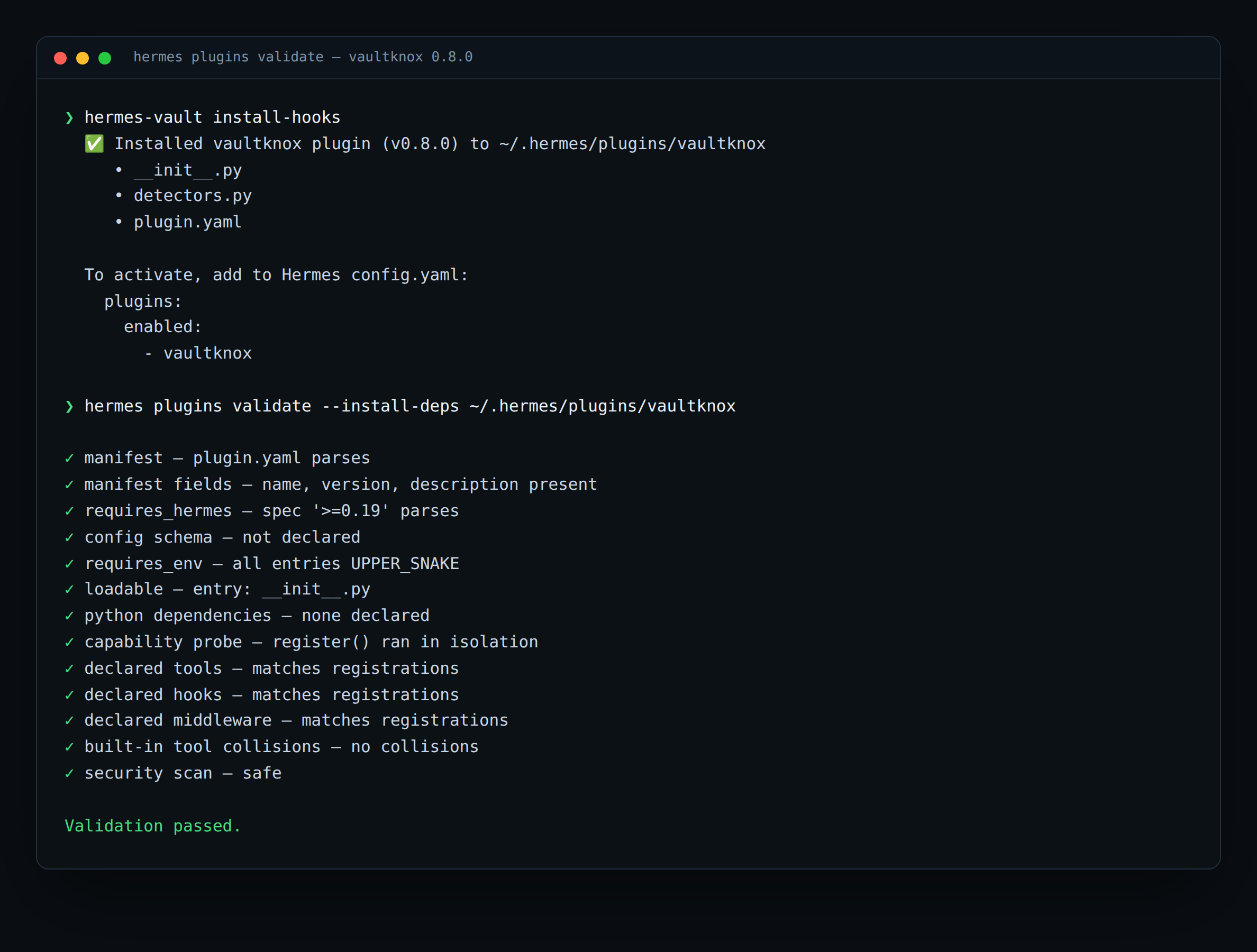
hermes-vault install-hooks
# Then enable in ~/.hermes/config.yaml:
#   plugins:
#     enabled:
#       - vaultknox
Every command above is shipped by VaultKnox itself; hermes-vault --help lists the full surface.
Key Design
VaultKnox uses a layered cryptographic design to isolate each operation:
| Layer | Technology | Purpose |
|---|---|---|
| Key Derivation | Argon2id | Derives the master key from the master password. Memory-hard, side-channel resistant. |
| Key Separation | HKDF-SHA256 | Derives scoped sub-keys from the master key — one per operation type (entry encryption, backup signing, token generation). |
| Encryption | AES-256-GCM | Authenticated encryption. Each secret gets a unique random nonce; the tag guarantees integrity. |
| Nonce Generation | secrets.token_bytes(12) |
Cryptographically secure random nonces — no two secrets share the same nonce. |
The master key never directly encrypts anything. HKDF-SHA256 derives purpose-specific sub-keys:
master_key
  ├── vaultknox-entry          → encrypts/decrypts individual secrets
  ├── vaultknox-verifier       → password correctness check
  ├── vaultknox-backup         → encrypts vault exports
  └── vaultknox-pre-rotation   → encrypts pre-rotation backups (v0.3.0)
Compromise of any sub-key does not expose the master key or any other sub-key's output.
Features
- AES-256-GCM encryption for master vault secret payloads; AES-256-GCM v2 for autonomous store (Fernet v1 auto-migration only)
- SQLite-backed local vault storage
- Masked secret retrieval for agent-safe responses
- One-time token issuance for downstream automation
- Backup export and import with integrity signing
- Audit logging with owner-only permissions and rotation
- Hermes integration wrapper with write actions disabled by default
- v0.8.0 — Catalog-ready Hermes plugin shipped inside the package at
src/vaultknox/_hermes_plugin/.hermes-vault install-hooksdeploys it to~/.hermes/plugins/vaultknox/. Three hooks (pre_gateway_dispatch,pre_llm_call,transform_llm_output) plus thevaultknoxtool, gated by package import. Hook contracts fixed so inbound redaction is live again on current Hermes. - v0.8.0 — Detector registry expanded to 28 patterns (added Google API key, GCP key material, Azure connection string, JWT, high-entropy assignment, etc., across earlier security work).
- v0.8.0 — Standardized guidance on
hermes-vault add ... --data ...(the shipped CLI); oldvault-add-keyreferences removed. - v0.7.3 — Onboard sandbox switched to argv-based execution, sensitive-path and credential-environment blocking, process-group timeout kill.
- v0.7.0 — Session-derived key flow completed for agent paths: operator unlock establishes session key, and agent actions no longer require
master_password - v0.7.0 — Policy Engine v2 is now enforced in
vault_tooland MCP access paths with deny-by-default, service/action checks, capability gates, and token TTL clamping - v0.7.0 — OAuth secrets now auto-refresh on read when near expiry, with safe failure fallback (
refresh_failed) and no token logging - v0.7.0 — Dashboard hardening: token TTL enforcement, HttpOnly cookie/Authorization support, no
?token=for API calls after bootstrap, and hardened response headers - v0.7.0 — Detector/scanner improvements: added Google API key, GCP key material, Azure connection string, JWT, and high-entropy assignment detection with entropy gating + placeholder allowlist
- v0.7.0 — Metadata encryption at rest: service names, username hints, and scope data are AES-256-GCM encrypted under a dedicated HKDF sub-key
- v0.7.0 — Encrypted search index: deterministic search tokens generated per payload field for future exact-match search
- v0.7.0 — Metadata minimization: username hints store first+last character only; URLs stored as host-only
- v0.7.0 — Configurable KDF parameters via
--kdf-*flags oninit(time cost, memory cost, parallelism, hash length, Argon2 variant) - v0.7.0 — Vault profiles via
--profile <name>global flag for isolated vault environments - v0.7.0 — Agent actions now reject
master_passwordkwarg, enforcing the session-derived key path - v0.7.0 — MCP
vaultknox_scanrequiresagent_idand checksscan_secretscapability - v0.7.0 —
get_tokenTTL clamped by agent/service policy, matchingget_maskedbehavior - v0.6.1 — Public package exports fixed:
from vaultknox import AutonomousSecretsStorenow works as documented - v0.6.1 — Timezone-naive token expiry and lockout timestamps handled safely (extends v0.6.0 expiry fix)
- v0.6.0 — MCP Server crash fixed:
Pathimport added, dead imports removed, path resolution corrected sovaultknox_scanand health tools execute without NameError - v0.6.0 — Generic bearer verification fixed:
_verify_generic_bearernow registered and usable via--service generic_bearer - v0.6.0 — Gateway plugin deployment fixed:
install-hooksnow writes the full__init__.py(with the three current hooks plusregister(ctx)) instead of only warning (the hook contracts themselves were corrected again in v0.8.0) - v0.6.0 — Timezone-naive expiry dates handled safely: no more
TypeErrorfrom comparing naivedatetimeagainstdatetime.now(timezone.utc) - v0.6.0 — Redaction corruption fixed: overlapping/nested secret spans merged before replacement, preventing
[REDACT[REDACTED...output - v0.5.0 — MCP Server: stdio-based MCP transport for direct agent integration
- v0.5.0 — Dashboard: local token-guarded web console (127.0.0.1)
- v0.5.0 — OAuth PKCE: RFC 7636 PKCE flow for Google, GitHub, OpenAI
- v0.5.0 — Skill Generation: generates SKILL.md contracts for sub-agents
- v0.5.0 — Policy Engine v2: per-agent, per-service action policies
- v0.5.0 — Secret type:
oauthwith auto-refresh tokens - v0.4.2 — Outbound response scanner: catches AI responses that ask users to paste secrets and rewrites them with safe guidance. System prompt injection proactively instructs the AI to never request secrets. New
agent_requests_secretcritical trigger. - v0.4.1 — Fixed dormant secret-guard hook so redaction actually fires on incoming messages (this round, the protection was unreliable on newer Hermes and is fully restored in v0.8.0)
- v0.4.0 — Built-in secret detectors for chat and file scanning (28 patterns today; the v0.4.0 release shipped 26, expanded in later security work)
- v0.4.0 — Proactive
scan_texttool action for runtime secret detection - v0.4.0 — Secret-guard hook for automatic chat message redaction
- v0.4.0 —
sanitize-historyCLI for cleaning leaked secrets from persistent stores - v0.4.0 — Agent autonomy package with trigger patterns and system prompt snippets
- v0.4.0 — Health checks, credential verification, and master-key rotation
- v0.2.0 — Autonomous Secrets (key-file-backed, password-free) for cron jobs and scripts
- v0.2.0 — Auto-seal to detect and encrypt new credentials automatically
Security Model
VaultKnox is designed to reduce the risk of:
- plaintext secrets leaking into chat logs
- secrets being stored in unencrypted config or memory files
- casual disk access revealing vault contents
VaultKnox does not claim to defend against:
- a fully compromised host machine
- keyloggers
- advanced memory extraction on an unlocked process
- formal regulatory compliance requirements by itself
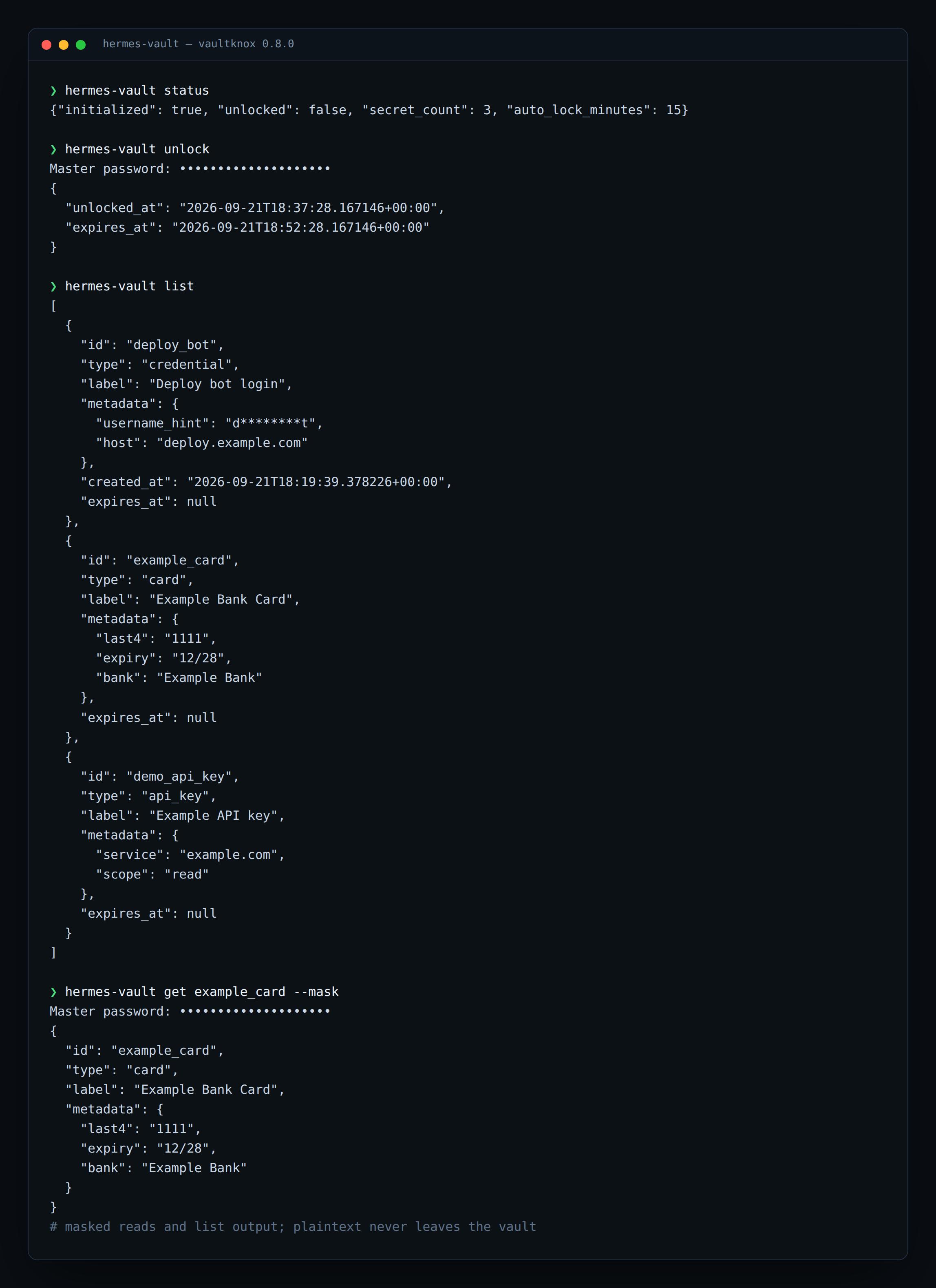
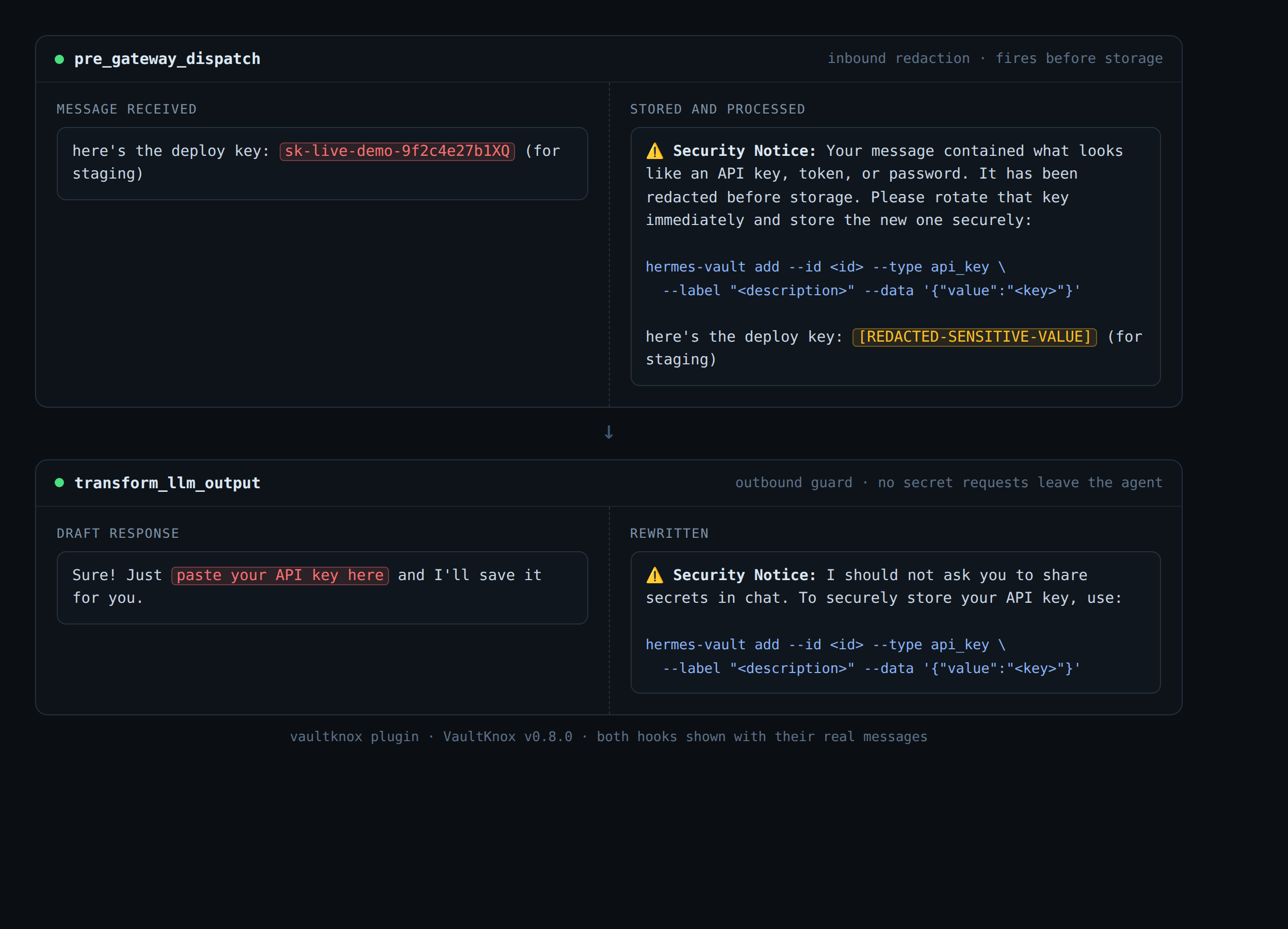
Screenshots
Installation
Development install
python -m venv .venv
source .venv/bin/activate
pip install -e .[dev]
Run tests
PYTHONPATH=src python -m pytest -q
Run CLI
PYTHONPATH=src python -m vaultknox.cli status
Or after install:
hermes-vault status
Show branding in CLI output:
hermes-vault logo --asset-path
hermes-vault --logo status
Quick Start
hermes-vault init
# hermes-vault unlock  # Legacy - not needed for autonomous secrets
hermes-vault add --id example_card --type card --label "Example Bank Card" --data '{"number":"4111111111111111","expiry":"12/28","cvv":"123","holder":"A. Example","bank":"Example Bank"}'
hermes-vault get example_card --mask --purpose booking
hermes-vault export --file backup.vault
Runtime Layout
Default runtime files are stored under ~/.hermes/:
~/.hermes/vaultknox/— legacy master-password vault (optional)~/.hermes/encrypted-secrets/— autonomous key-file-backed encrypted store (recommended)~/.hermes/plugins/vaultknox/— Hermes plugin (installed byhermes-vault install-hooks)
The encrypted-secrets/ directory contains:
-
master.key— autonomous store key (v2 AES-256-GCM, chmod 600, never in logs) -
secrets.enc— encrypted JSON blob (safe for backups/git) -
secrets.db: encrypted SQLite vault database -
audit.log: audit trail with rotation -
session.json: session state metadata -
session.lock: session coordination lock file
Hermes Integration
The safest integration path is the vault_tool wrapper in src/vaultknox/hermes_tool.py.
Available Actions
| Action | Description | Write Gate |
|---|---|---|
status |
Check vault state (initialized/unlocked/count) | No |
lock |
Lock vault | No |
list |
List secrets (metadata only) | No |
get_masked |
Get masked view + optional one-time token | No |
get_token |
Issue single-use token for automation | No |
inject_env |
Inject a secret into an environment variable | Yes |
consume_token |
Exchange a one-time token for plaintext | No |
scan_text |
Scan arbitrary text for secrets using 28 detectors | No |
add |
Add new secret | Yes |
update |
Update existing secret | Yes |
delete |
Remove secret | Yes |
export |
Encrypted backup | No |
import |
Restore from backup | No |
Safety Rules
- Hermes never sees plaintext secrets.
- Write actions require
allow_write=True. - Tokens are single-use and expire by default after 300 seconds.
- Auto-lock applies after inactivity.
- Every access is logged without sensitive data.
- VaultKnox contents must never be written to memory, config, or session transcripts.
Read the operator guidance in docs/hermes-write-gate-operations.md before enabling write access for Hermes.
Secret Types
card: number, expiry, cvv, holder, bankcredential: username, password, url, totp_secretapi_key: key, service, scopenote: freeform sensitive text
Architecture
src/vaultknox/
├── __init__.py              # Exports VaultKnox, VaultError, vault_tool, triggers, scanner
├── vault.py                 # Main VaultKnox class and service logic
├── core.py                  # Encryption, decryption, KDF, token generation
├── db.py                    # SQLite operations
├── types.py                 # Secret validation and masked views
├── audit.py                 # Audit logging with query support
├── session.py               # Session state management
├── config.py                # Paths and defaults
├── cli.py                   # Click entry point (vault + secrets + audit + expiry + ops)
├── hermes_tool.py           # Hermes `vaultknox` tool wrapper (includes scan_text)
├── detectors.py             # 28 built-in secret detector patterns
├── scanner.py               # File scanner for plaintext secrets and permission issues
├── agent_guide/             # Agent autonomy package (triggers + system prompts)
│   ├── __init__.py
│   ├── triggers.py          # Context-based trigger detection
│   └── prompts.py           # Safe system-prompt snippets for agents
├── _hermes_plugin/          # Catalog-ready Hermes plugin (installed by install-hooks)
│   ├── __init__.py          # Hook implementations + tool registration
│   ├── detectors.py         # Vendored (byte-equal to vaultknox.detectors)
│   └── plugin.yaml          # Manifest: hooks + tools
├── hooks/                   # Legacy gateway hook implementation (superseded by v0.8.0 plugin)
│   ├── __init__.py
│   └── secret_guard.py      # Replaced by _hermes_plugin in v0.8.0
├── rotation.py              # Master key rotation with pre-rotation backup
├── verifier.py              # Live credential verification against provider APIs
├── health.py                # Vault health checks (DB, permissions, integrity)
├── autonomous_secrets.py    # Key-file-backed autonomous secrets store
├── dashboard.py             # Local token-guarded web console
├── mcp_server.py            # MCP stdio transport for agent integration
├── policy.py                # Per-agent, per-service policy engine
├── oauth/                   # OAuth PKCE flow + token refresh
│   └── __init__.py
├── skills/                  # SKILL.md generation for sub-agents
│   └── __init__.py
└── branding.py              # Logo and CLI banner assets
Booking Flow Example
User: "Book a table for 2 tomorrow at 7pm"
1. vaultknox(action="get_masked", secret_id="example_card", purpose="booking")
   -> masked card data and optional token
2. Navigate to the booking flow and fill non-sensitive fields.
3. If payment is required, exchange for a one-time token.
4. Submit the form without exposing plaintext in agent logs.
Autonomous Secrets (v0.2.0)
VaultKnox v0.2.0 introduces Autonomous Secrets — a key-file-backed encrypted credential store designed for automated and unattended operation.
Why Autonomous Secrets?
The master-password vault requires manual unlock (typically every 15 minutes), which breaks cron jobs, scheduled tasks, and automated agent workflows. Autonomous Secrets uses a local key file (chmod 600) instead of a password prompt — scripts and cron jobs can read credentials without human intervention.
Security Model
VaultKnox Autonomous Secrets uses a key-file-backed security model similar to SSH keys:
- Key file:
~/.hermes/encrypted-secrets/master.key(chmod 600, owner-only) - Encryption: AES-256-GCM v2 with unique random nonces per encryption; legacy Fernet v1 files are auto-migrated
- Storage:
secrets.enccontains the encrypted credentials — safe for backups, git, and session logs - Threat model: An attacker with root access to the filesystem can decrypt the secrets. This is the accepted trade-off for full autonomy without manual password prompts.
- Operational security: The key file must never appear in session transcripts, memory, or tool output. Ensure proper file permissions (chmod 600) and protect the key file like an SSH private key.
Usage
# Initialize the store (one-time)
hermes-secrets init

# Add credentials
hermes-secrets add KILOCODE_API_KEY=sk-xxx NOTION_API_KEY=secret_xxx

# Retrieve a single value
hermes-secrets get NOTION_API_KEY

# List stored keys (values never shown)
hermes-secrets list

# Export as shell-safe environment variables
eval "$(hermes-secrets env --shell)"
echo $KILOCODE_API_KEY

# Import from existing .env file
hermes-secrets populate --from ~/.hermes/.env
In Cron Jobs
Simply add one line at the top of the cron prompt:
eval $(python3 ~/.hermes/encrypted-secrets/secrets_manager.py env)
Then use the API keys as environment variables as before.
Auto-Seal: Automatic New Credential Detection
VaultKnox v0.2.0 includes an auto-seal mechanism that automatically detects and encrypts new credential keys as they're added. This prevents plaintext credential drift — the #1 cause of accidental leaks.
How it works:
- Scans
~/.hermes/.envfor keys ending in_KEY,_TOKEN,_SECRET,_PASSWORD, or_CREDENTIALS. - Cross-references with the encrypted store.
- Encrypts any new credentials it finds.
- Optionally strips the plaintext from
.env(with--stripflag).
Run on-demand after adding a new API key:
# Dry-run first to see what would be encrypted:
hermes-secrets auto-seal --dry-run

# Then run it for real:
hermes-secrets auto-seal
Automatic via cron (recommended):
A cron job runs auto-seal every 30 minutes by default. If new credentials
are found, they're automatically encrypted. If nothing is found, the job
runs silently with no output. You can verify it's active:
hermes cron list | grep "Auto-Seal"
Security note: Auto-seal only encrypts. The plaintext remains in .env
by default so Hermes can still read it at startup. The encrypted store is an
additional safety net — your credentials are backed up in encrypted form
even if the .env file is accidentally exposed.
Architecture
~/.hermes/encrypted-secrets/
├── master.key          # autonomous store key (v2 AES-256-GCM, chmod 600, owner-only)
└── secrets.enc         # Encrypted JSON blob (safe for backups/git)

src/vaultknox/
├── autonomous_secrets.py  # AutonomousSecretsStore class + helpers
└── cli.py                 # `vaultknox secrets` subcommand group
CLI (via VaultKnox)
# All secrets commands also work through the main VaultKnox CLI:
hermes-vault secrets init
hermes-vault secrets add KEY=VALUE
hermes-vault secrets list
hermes-vault secrets env --shell
Hermes Plugin (v0.8.0)
The package ships a catalog-ready plugin at src/vaultknox/_hermes_plugin/. When deployed by hermes-vault install-hooks, the plugin copies three files (__init__.py, detectors.py, plugin.yaml) into ~/.hermes/plugins/vaultknox/ and the operator enables it once in Hermes config. No global Python paths or compile step.
What the plugin registers
| Registration | Direction | Effect |
|---|---|---|
Hook pre_gateway_dispatch |
Inbound | Reads event.text, runs the 28-detector registry, and returns {"action": "rewrite", "text": "<notice + redacted message>"} when secrets are found. Fires before persistence, so redacted content never reaches session storage. |
Hook pre_llm_call |
Per LLM turn | Injects the secret-handling rules from vaultknox.agent_guide.prompts.get_system_prompt_snippet() once per conversation as {"context": ...}. |
Hook transform_llm_output |
Outbound | Scans assistant responses for phrases that ask the user to share a secret (e.g. "drop your api key") and rewrites them with safe CLI guidance. Returns the replacement string. |
Tool vaultknox |
Agent-callable | Vault operations: status, list, get_masked, get_token, consume_token, scan_text, plus write actions (add, update, delete, inject_env, revoke_token) gated by allow_write=True. Registered only when the vaultknox package is importable (check_fn probe). |
The plugin manifest is src/vaultknox/_hermes_plugin/plugin.yaml. Hook contracts target Hermes >=0.19; the inbound-redaction payload/return shape is the one consumed by current Hermes, so protection is live again after v0.8.0.
Install
hermes-vault install-hooks
Then enable it in ~/.hermes/config.yaml:
plugins:
  enabled:
    - vaultknox
Restart the Hermes gateway. The installer prints the destination directory and reports the superseded vaultknox-secret-guard plugin directory and the legacy ~/.hermes/hooks/secret-guard/ directory, if present, without deleting them. Current Hermes does not consume hook-event write-backs; the legacy secret-guard hook was a no-op and is replaced by this plugin.
Verify
-
The plugin directory exists with three files:
ls ~/.hermes/plugins/vaultknox/ # __init__.py detectors.py plugin.yaml -
The plugin name appears in the enabled list:
grep -A2 "plugins:" ~/.hermes/config.yaml -
Send yourself a message containing a test API key. The reply should arrive prefixed with the Security Notice and the key replaced by
[REDACTED-SENSITIVE-VALUE]. Nothing should land in~/.hermes/sessions/for that turn. -
The
vaultknoxtool is exposed to the agent because the package is importable; calling thescan_textaction against a string you control confirms it.
If any of the above fail, see docs/PLUGIN.md for troubleshooting: not enabled, gateway not restarted, vault locked, package not importable, and similar.
28 Built-In Secret Detectors
VaultKnox ships with 28 regex-based detectors covering the most common secret types:
| Category | Detectors |
|---|---|
| Critical | OpenAI API Key, GitHub PAT (classic, fine-grained, OAuth, impersonation, refresh), Anthropic API Key, AWS Access Key ID, AWS Secret Access Key, Slack Token, Stripe Secret Key, Twilio API Key, SendGrid API Key, NPM Access Token, RSA/DSA/EC Private Keys |
| High | Generic API Key Pattern, Generic Secret Key Pattern, Generic Access Token Pattern, Generic Auth Token Pattern, Generic Secret Variable Pattern, Bearer Token, Google API Key, JWT |
| Medium | Generic Password Pattern in Config, Stripe Publishable Key, GCP key material, Azure connection string, high-entropy assignment |
All patterns live in src/vaultknox/detectors.py. Adding a new detector is a single _register() call; the plugin's vendored copy stays byte-equal automatically through the sync test in tests/test_hermes_plugin_sync.py.
Proactive Scanning with scan_text
Hermes can scan arbitrary text for secrets at runtime using the vaultknox tool:
vaultknox(action="scan_text", text="Here is my key: sk-abc123...")
Returns a structured list of findings with detector name, severity, SHA-256 fingerprint, and character span. The matched value is never returned; sanitize user input before logging it.
File Scanning
Scan the filesystem for plaintext secrets and permission issues:
hermes-vault scan                          # Default paths
hermes-vault scan --paths /path/to/repo    # Custom paths
hermes-vault scan --format json            # Machine-readable output
The scanner checks:
- 28 secret patterns across
.env,.json,.yaml,.yml,.sh,.bashrc,.zshrc,.profile - Duplicate secrets across files
- World-readable and group-readable secret files
Sanitize History: hermes-vault sanitize-history
If a secret was accidentally pasted into chat, clean it up from persistent stores:
hermes-vault sanitize-history              # Dry-run preview
hermes-vault sanitize-history --apply      # Actually redact
Scans and redacts:
~/.hermes/sessions/*.jsonl~/.hermes/state.db(known Hermes message columns:content,tool_calls,reasoning,reasoning_details,reasoning_content,codex_message_items)~/.hermes/.hermes_history
Agent Autonomy Package (agent_guide/)
The agent_guide/ module gives AI agents context-aware guidance without leaking encryption internals.
Trigger detection (check_triggers) — keyword plus context heuristics for:
user_pastes_secret— warn and suggest vault storageuser_asks_store_key— guide to CLI or tool workflowagent_needs_api_key— check vault before asking useragent_requests_secret— STOP, never ask user to paste secrets in chatscript_needs_secret— inject vault-loading patterns, never hardcodecron_job_needs_auth— recommendAutonomousSecretsStore
System prompt snippet (get_system_prompt_snippet) — a safe markdown block you can inject into any agent's system prompt. Contains no file paths, no master password mechanics; just behavioural rules. The plugin uses the same snippet (kept byte-equal) for pre_llm_call.
Safe Storage Reference
Direct users to the shipped CLI (bypasses chat entirely):
hermes-vault add --id OPENAI_API_KEY --type api_key \
  --label "OpenAI API Key" \
  --data '{"value":"sk-xxxxxxxxxxxxxxxxxxxxxxxx"}'
What is gone (do not rely on these)
vaultknox-secret-guardplugin and the~/.hermes/hooks/secret-guard/legacy hook are superseded.vault-add-keyis not part of the public install; usehermes-vault add ... --data ....post_llm_call,message:received, andsystem_messageinjection are not current hook names.
VaultKnox Onboard (v0.7.2)
VaultKnox Onboard autonomously analyzes, documents, and prepares any repository for AI-driven development — the first new capability shipped after the v0.7.1 security-hardening release. Supports Python, Node.js, Rust, Go, Ruby, PHP, and more.
The onboard command group exposes:
| Command | Purpose |
|---|---|
hermes-vault onboard analyze |
Detect languages, frameworks, dependency manifests, entry points, test directories, and repo structure (read-only). |
hermes-vault onboard document |
Generate AGENTS.md, README.md, SETUP.md, and ARCHITECTURE.md from analysis; existing user-authored files are never overwritten. |
hermes-vault onboard setup |
Install dependencies, run build checks, and surface missing environment variables. |
hermes-vault onboard full |
The recommended first-contact pipeline: analyze → document → setup in one run. |
hermes-vault onboard install-plugin |
Deploy the vaultknox-onboard gateway plugin to ~/.hermes/plugins/ for automatic onboarding-request detection. |
hermes-vault onboard generate-skill |
Emit a SKILL.md contract describing VaultKnox Onboard for sub-agents. |
Example — analyze a repository without making changes:
hermes-vault onboard analyze --dry-run /path/to/repo
--dry-run performs analysis without caching results. Existing documentation
files are always preserved; the documenter skips any file that already exists
and was authored by a human.
Sandboxing note. hermes-vault onboard setup and onboard full run dependency
installers and build commands through SandboxExecutor, which now uses
subprocess.Popen(..., shell=False, argv=shlex.split(command)) instead of
shell=True. Shell metacharacters are tokenized as literals, sensitive paths
are rejected, and secret-bearing environment variables are stripped before
execution. The allowlist controls which binaries may run; unknown commands are
rejected.
Other Operations
| Command | Purpose |
|---|---|
hermes-vault health |
Full vault health check (DB integrity, permissions, encryption, autonomous store) |
hermes-vault verify |
Live credential verification against provider APIs (OpenAI, Anthropic, GitHub, etc.) |
hermes-vault rotate-master-key |
Atomic master-key rotation with pre-rotation backup |
hermes-vault audit query |
Query audit log with filters (action, status, date range) |
hermes-vault expiry set-expiry <id> --days 30 |
Set secret expiration |
hermes-vault expiry notify |
List expired or soon-to-expire secrets |
hermes-vault scan |
File scanner for plaintext secrets and permission issues |
hermes-vault sanitize-history |
Redact leaked secrets from persistent session stores |
hermes-vault install-hooks |
Deploy the VaultKnox plugin into ~/.hermes/plugins/vaultknox/ |
Changelog
See CHANGELOG.md for the complete version history, including the v0.8.0 plugin release and v0.7.2 Onboard release.
Release Guidance
Before treating VaultKnox as broadly usable:
- Verify no secrets or local vault files are committed.
- Review the Hermes write-gate operations guide before enabling write access for Hermes.
- After install or upgrades, run
hermes-vault install-hooksand confirm the plugin is enabled in~/.hermes/config.yaml.