webmint
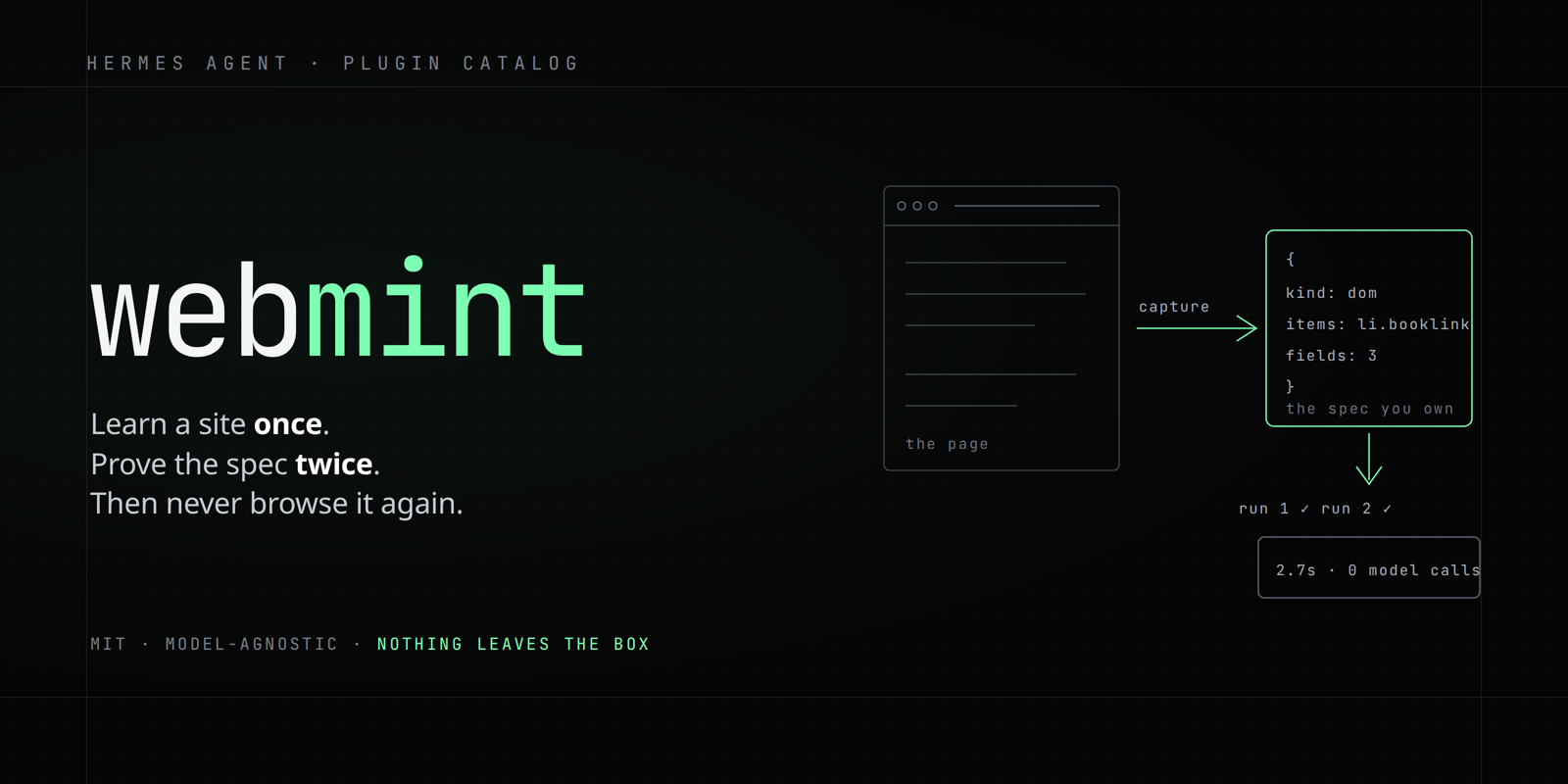
Turn a website into a deterministic, verified tool — using whatever model your agent already runs.
No OpenAI key. No cloud. No sandbox. The artifact is a JSON file you own.
hermes plugins install DECRUX9812/webmint
That's it. The first mint provisions its own browser if needed; webmint_setup does it
explicitly if you'd rather pre-install.
Why
Every agent demo ends the same way: it opens a browser, reads the screen, and guesses. Tomorrow the page moves and the agent guesses differently.
webmint learns the page once, turns it into a declarative spec, proves the spec twice, and then runs it as plain data — no model in the loop, ~3.5 s per call, same fields every time.
browser agent:  open browser → load → read pixels → parse → hope      (~31 s, shape varies)
webmint tool:   run_website_tool(query="...") → [{title, price}]      (~3.5 s, typed)
What makes it different
| Model-agnostic | The mint calls the host's own ctx.llm. Whatever provider/model your agent is on does the work — DeepSeek, Gemini, a local model. Nothing is hardcoded to one vendor. |
| Verified, not vibes | A tool is saved only if it runs twice, returns rows both times, and every declared field is non-empty in most rows. A spec that returns 25 rows of null is rejected and repaired, not shipped. |
| You own the artifact | tool.json — readable, editable by hand, committable. No service holds your integrations. |
| Signed-out by design | Every capture uses a fresh browser with no cookies or saved logins, and minted specs never replay Cookie/Authorization. Capture actions can fill, click and press keys on the page, and an http spec replays the captured request (GET or POST). Only public http(s) URLs are opened; loopback/private hosts need WEBMINT_ALLOW_PRIVATE_URLS=1. |
Tools
| tool | what it does |
|---|---|
webmint_setup |
Check/provision Node, Playwright and Chromium (about 120 MB once). Idempotent. |
webmint_mint |
Capture a URL → the model writes a spec → run twice → save only if both runs agree |
webmint_run |
Execute a minted spec with new inputs (no model) |
webmint_list |
List minted tools with site, kind and verified state |
webmint_remove |
Delete a tool and its capture |
Ask your agent:
Mint a tool for https://news.ycombinator.com/from?site=github.com that lists posts with title and url.
Then:
Use it for rust-lang.org.
Requirements
- Node >= 18 — found automatically (
$WEBMINT_NODE,~/.local/node24/bin/node,PATH,/usr/local/bin,/usr/bin; version checked). - Playwright + Chromium — found in
$WEBMINT_PW_MODULES, the plugin's ownnode_modules, an existing Pomerado install, or the global npm root. If none is present,webmint_mintprovisions it automatically (setWEBMINT_NO_AUTO_SETUP=1to opt out). - URL policy — the mint URL,
gotoactions, mintedurl_templates and every redirect must be publichttp(s). Inside Hermes the host's URL safety check decides (honourssecurity.allow_private_urls); standalone, setWEBMINT_ALLOW_PRIVATE_URLS=1to reach loopback/private hosts. Link-local and cloud-metadata addresses are always refused. - Everything else is stdlib Python.
Artifact
$HERMES_HOME/webmint/tools/<name>/
├── tool.json     the spec (hand-editable; hand-written specs are first-class)
├── meta.json     provenance: model, runs, fill rates, timing, example input
└── capture/      the recording it was built from
A spec:
{
  "name": "letterboxd_films",
  "kind": "dom",
  "url_template": "https://letterboxd.com/search/films/{query}/",
  "item_selector": "ul.results > li.search-result",
  "fields": {"title": "a.film-title", "year": "small.metadata a", "url": "a@href"},
  "input_schema": {"properties": {"query": {"type": "string"}}, "required": ["query"]},
  "limit": 20
}
Field expressions: "css", "css@attr", "+ .x" (next sibling), "^ .x" (parent) — the last
two exist because real pages split one record across sibling elements (arXiv's <dt>/<dd>).
kind: "http" replays a captured JSON endpoint instead (method, headers, body_template,
items_path, field_paths).
Measured
Six tools, eight sites, minted with deepseek-v4.1-flash (2026-10-26):
| tool | mint | run | rows | field fill |
|---|---|---|---|---|
| wikipedia_search | 28.3 s | 3.1 s | 20 | 100% |
| arxiv_recent | 64.2 s (1 repair) | 2.7 s | 25 | 100% |
| github_trending | 29.5 s | 4.0 s | 14 | 93% lang |
| books_scrape | 15.4 s | 2.7 s | 19 | 100% |
| hn_github_posts | 18.8 s | 2.5 s | 30 | 100% |
| letterboxd_films | 32.4 s | 4.9 s | 20 | 100% |
mean mint 31.4 s · mean run 3.5 s · 6 of 8 sites mintable · break-even ≈ 10 runs
Honest limits
- Bot walls. Headless Chromium gets 403 on some sites (Chewy, eBay) and an empty page on others (DuckDuckGo). Two of eight test sites failed this way. No prompt fixes a fingerprint — that needs your own browser profile, which is not in v0.1.
- Not strictly read-only. It never logs in or uses your cookies, but capture
actionscan fill and submit page forms, and anhttpspec replays the captured request, POST included. - Selectors rot.
meta.jsonrecords when a tool was verified; re-mint when a run starts returning zero rows. A repair cron is not included. - Weak models produce worse specs. The verifier turns that into a visible failure rather than a silent one, which is the most that can be promised.
Tests
python3 -m pytest tests/ -q # 13 tests: validation, store, verifier gates, real browser fixtures
Two tests launch Chromium against a local HTML fixture — the extractor and the sibling prefix are covered without touching the network.
Credits
Pomerado — github.com/Pomerado/pomerado, MIT — made the case that a website should be learned once and replayed instead of re-reasoned every run. webmint is an independent implementation of that idea for Hermes Agent: the same shape (capture → spec → verify → tool), rebuilt so the learning step runs on whatever model you already have, with the artifact as a JSON spec you own rather than generated source. Their Guardian/authority model and job contract are worth reading; nothing is copied here.
The conversation this came from — @Gamma_950 ("your browser agent re-reasons every page on every run"), @sreecharantwts ("browser use being slow and flaky is the real tax on agents"), @stretchcloud (structure loss in markdown flattening), @pamelafox (WebMCP as the endgame). Those posts are the reason the pitch is about verification, not speed.
License
MIT © Ritesh Patel