agent-ledger
Your agent said it did the job. Did it actually happen?
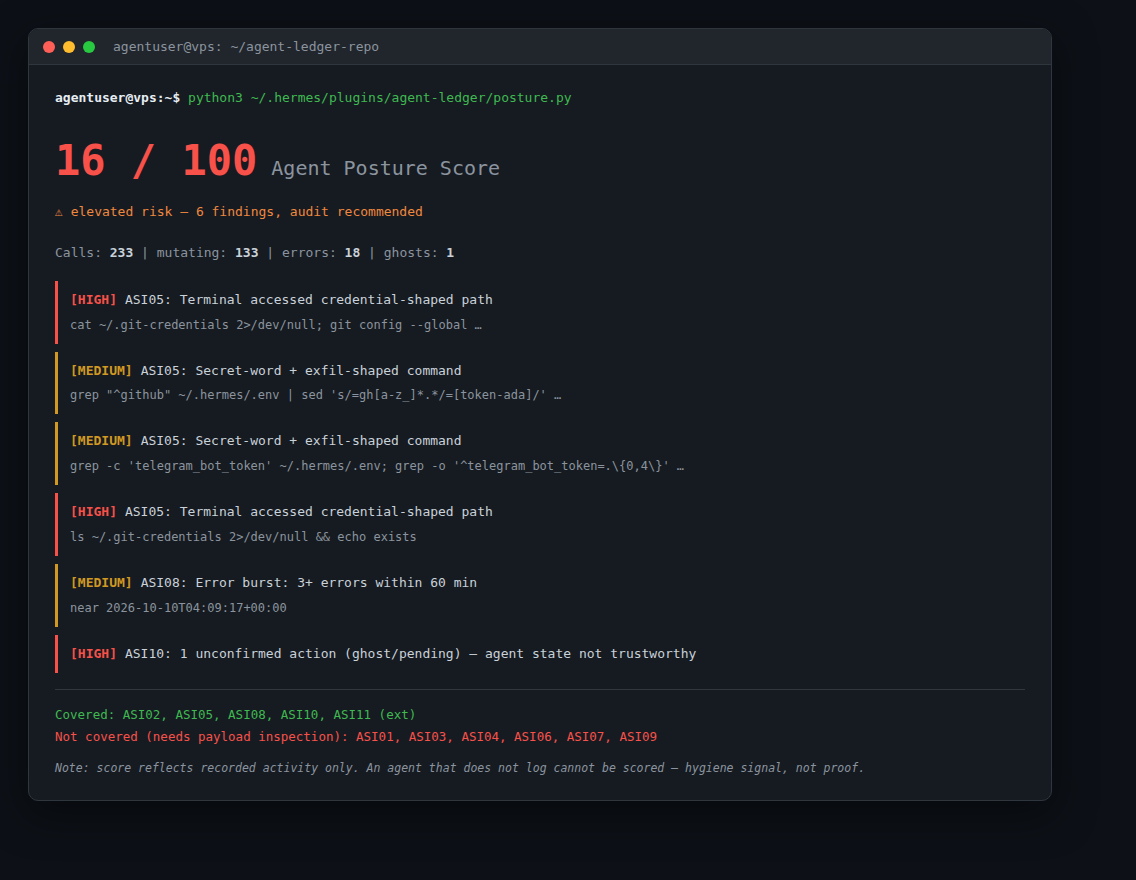
agent-ledger is a Hermes Agent plugin that keeps a write-ahead ledger of every state-mutating tool call — so actions that were issued but never confirmed (silently lost, e.g. when context compaction tears down an in-flight turn) get caught, reported, and injected back into the agent's context on the next turn.
Inspired by NousResearch/hermes-agent#90985: a cronjob_create tool call was issued, compaction tore the turn down before the result was persisted, and the job never existed — no error, no retry, no trace. The agent believed it never happened. So did the user.
How it works
pre_tool_call   → ledger entry PENDING   (tool, args, ts, session_id)
post_tool_call  → entry → CONFIRMED / ERROR:*
pre_llm_call    → reconcile: PENDING older than grace period = GHOST
                  → injected into the turn's context as a warning
- Observer-first — the ledger itself never blocks and never transforms: writes are sub-10ms SQLite inserts (WAL mode) on a dedicated thread-safe connection. Optional policy enforcement (below) is a separate, explicit opt-in — off until you turn it on.
- Ghost detection — a PENDING entry older than the grace period (2 min) is a candidate ghost: the call was issued but its effect was never confirmed.
- Context injection — ghosts surface in the next turn's context, so the agent itself is told: "verify whether this actually happened before trusting state."
- Mutating-tool filter — only tracks tools that change state (
write_file,patch,terminal,cronjob,delegate_task, kanban mutations, all MCP tools viamcp__prefix). Read-only tools cost zero overhead.
Install
mkdir -p ~/.hermes/plugins/agent-ledger
cd ~/.hermes/plugins/agent-ledger
# drop plugin.yaml + __init__.py here, or:
git clone https://github.com/ZidoCode/agent-ledger.git .
hermes plugins list          # should show agent-ledger
hermes plugins enable agent-ledger
hermes gateway restart       # plugin loads on the next session
Inspecting the ledger
sqlite3 ~/.hermes/plugin-data/agent-ledger/ledger.db "
  SELECT ts, tool_name, status, substr(args_json,1,60)
  FROM ledger ORDER BY id DESC LIMIT 20;"
Statuses: PENDING → CONFIRMED | ERROR:<type> | GHOST_REPORTED (flagged and surfaced to the agent).
Self-test
python3 selftest.py
# PASS: pending->confirmed via tool_call_id
# PASS: fallback confirm by tool name
# PASS: ghost detected
# PASS: context injection + GHOST_REPORTED
# PASS: mutating-tool filter
# PASS: hook signatures accept real fire-site kwargs
Agent Posture (OWASP Agentic Top 10)
posture.py scores the recorded activity against the
OWASP Top 10 for Agentic Applications 2026.
python3 posture.py                          # score the live ledger
python3 -m posture ~/.hermes/plugin-data/agent-ledger/ledger.db
Covered from ledger metadata: ASI02 (tool misuse), ASI05 (unexpected code
execution), ASI08 (cascading failures), ASI10 (rogue agents), plus
ASI11 (ext) — excessive agency, a community extension (the official
OWASP list stops at ASI10) labeled as such everywhere.
Not covered (requires payload/conversation inspection, out of scope): ASI01, ASI03, ASI04, ASI06, ASI07, ASI09.
Scoring is auditable: score = 100 − Σ severity_weight(finding), with
{CRITICAL:25, HIGH:15, MEDIUM:8, LOW:3}; findings are not deduplicated. The
full finding list is always returned so you can recompute by hand.
Trust model: the ledger is written by the agent being scored. An agent that doesn't log (or logs false entries) can't be scored by an observer — so a 100 means "nothing suspicious in the recorded activity", not "the agent was well-behaved." Treat it as a hygiene signal, not proof. (Tamper-evident logging is a separate, harder problem.)
Validation
| Suite | What it proves | Result |
|---|---|---|
test_posture.py |
ground truth: benign ledger → 100/no findings; malicious → all families | PASS |
test_posture_unit.py |
per-ASI must-fire + must-not-fire + 7 known evasions | 36/36 |
test_posture_scale.py |
10k rows / 50k rows + multi-session attribution | PASS (0.054s / 0.281s) |
selftest.py |
ledger FIFO matching, ghost reconcile | 13/13 |
Known coverage limits: these tests prove the scorer catches all 7
evasion patterns we know about (base64|bash, $HOME indirection,
rm -rf ./, rm -rf ~, wget|sh, chmod -R 777, git push -f) and none
of the benign look-alikes. They do not prove immunity to novel evasions —
signature-based detection over ledger metadata is, by construction, a step
behind attacks nobody has written a rule for yet. Novel-evasion resistance
is an open problem; behavioral anomaly modeling (rate/baseline deltas) is
the mitigation we ship today, and it's why the score degrades on any
unusual mutating activity even without a matching signature.
python3 test_posture.py && python3 test_posture_unit.py \
  && python3 test_posture_scale.py && python3 selftest.py
Daily audit (standalone script you schedule yourself)
posture_daily.py is not wired into the plugin runtime — you run it from
your own cron and it sends a Telegram report (score + delta + top findings,
plus a dry-run policy section when a policy is installed). Per catalog rule
11 it has its own credentials: set POSTURE_TELEGRAM_BOT_TOKEN and
POSTURE_TELEGRAM_CHAT_ID in the script's environment (a dedicated bot is
recommended). It never reads Hermes's .env and never reuses Hermes's own
bot token. Paths follow the active profile via get_hermes_home()
(override with POSTURE_LEDGER_DB / POSTURE_STATE_DIR).
Data handling & retention
- The ledger is a local plaintext SQLite database at
<hermes_home>/plugin-data/agent-ledger/ledger.db. It records tool arguments (up to 4000 chars: terminal commands, file contents, MCP args) and a 300-char result digest of every state-changing tool call. Anyone with filesystem access can read it — treat it like your shell history. - Ghost warnings injected into context are session-scoped: a session only ever sees its own unconfirmed calls.
- Grace windows are per-tool (e.g. 30 min for
delegate_task, 15 min forterminal) to avoid false ghosts from long-running calls; a late confirmation revives a reported ghost instead of duplicating rows. - The ledger is never pruned automatically. If you want a cap, delete old rows yourself, e.g. keep the newest 50000:
sqlite3 ~/.hermes/plugin-data/agent-ledger/ledger.db "DELETE FROM ledger WHERE id NOT IN (SELECT id FROM ledger ORDER BY id DESC LIMIT 50000)"
Policy enforcement (free, no license)
Everything in agent-ledger is free (MIT) — including real enforcement. Observation is what the core does; enforcement is what happens when you opt in:
- Install a policy pack:
cp policy.example.json ~/.hermes/plugin-data/agent-ledger/policy.json
- Watch the dry-run for a few days (blocks are only logged, your daily report shows what WOULD have been blocked):
echo dry_run > ~/.hermes/plugin-data/agent-ledger/policy_mode
- Trust it:
echo enforce > ~/.hermes/plugin-data/agent-ledger/policy_mode
From then on, matching calls (rm -rf ~, curl | bash, credential reads,
force pushes, …) are refused before they run, with a clear reason fed
back to the agent.
Honest coverage — read this before trusting enforcement. Policy matching is signature-based over the extracted command. Like every signature system, it is a step behind what nobody has written a rule for yet. Known bypass surfaces today:
sh -cstring building — the agent composes the destructive string from variables/pieces, so the literal never appears in the command.- Environment-variable indirection —
rm -rf $TARGETwhere TARGET is set earlier. - Split multi-call — do part A in one call, part B in the next, each individually harmless, together not.
Treat enforcement as a seatbelt, not a wall: it reliably catches the obvious accidental disasters (recursive deletes, pipe-to-shell, secret file reads) — which is what the dry-run exists to show you. It does not stop a determined evasion; novel evasions remain an open problem, same as the posture score. Run dry-run for a few days first and read what it would have caught — that report is also the honest measure of coverage.
If agent-ledger has saved your agent from something, a GitHub star and a share are the best thank-you. If you want to support development, ping the maintainer — but nothing here is gated.
Design notes
- Why pre_llm_call and not a background alert? The hook can return
{"context": ...}— injected into the current turn's user message without touching the (cache-sensitive) system prompt. The agent learns about the ghost in the conversation where it can fix it. - Why not block suspicious calls in pre_tool_call? Hermes fails pre_tool_call hooks closed after a 30s timeout — a slow ledger would block legitimate tools. The ledger is a flight recorder, not a gate.
- Why confirm-by-tool-name fallback? Some fire paths don't carry
tool_call_id; the fallback updates the most recent PENDING entry for that tool (safe under the write lock). - Tested on Hermes Agent v0.21.3 (Linux VPS).
Status
MVP, in daily use. Ghost-effect telemetry is being collected — real-world numbers will land in this README. Issues/PRs welcome.
License
MIT