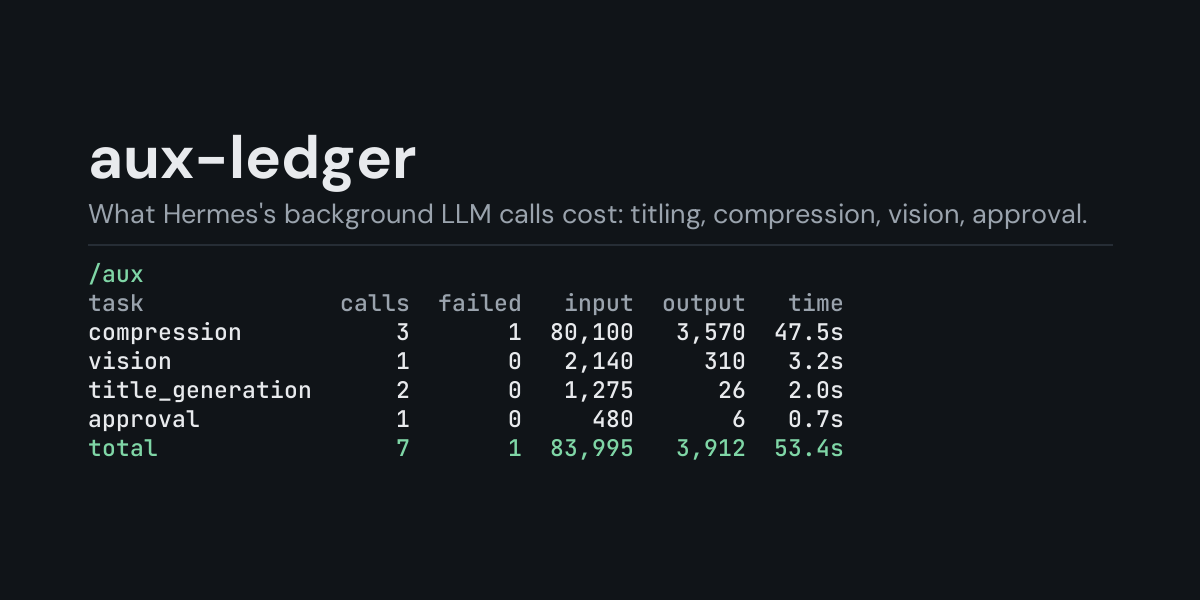
aux-ledger
A local ledger of the LLM calls Hermes makes behind a turn, and a /aux command that shows what
they cost.
Hermes calls a model for more than your turns: session titles, context compression, vision,
approval checks and other auxiliary tasks each make their own requests, with retries and
fallbacks. Those requests do not pass through the main-loop pre_api_request /
post_api_request hooks, so usage plugins built on them do not count this traffic. aux-ledger
subscribes to post_auxiliary_call and records one row per provider attempt.
Install
hermes plugins install aux-ledger --enable
Requires Hermes 0.21.5 or newer (the first release with the auxiliary-call hooks). No API key, no configuration, no dependencies.
Use
/aux             last 24 hours, by task
/aux session     the most recent session that made an auxiliary call
/aux all         everything in the ledger
/aux models      add to any of the above to group by model instead of task
/aux clear       delete the ledger
Example (/aux all, from the end-to-end test: one titling call, one compression call that
succeeded and three attempts of one that failed):
Auxiliary LLM calls, all recorded:

task              calls  failed  input  output  time
compression           4       3  1,000      50  0.0s
title_generation      1       0    321      12  1.1s
total                 5       3  1,321      62  1.1s

3 call(s) reported no token usage (streamed or failed).
- calls counts provider attempts, so a retried call shows up once per attempt.
- input is everything the provider read: fresh input plus cache reads and cache writes.
- time is the wall time of the attempts.
- Streamed and failed attempts carry no usage from Hermes; they are counted, with zero tokens, and the footer says how many there were.
What is recorded
One JSON line per attempt in <HERMES_HOME>/plugin-data/aux-ledger/calls.jsonl (per profile):
ts, session_id, aux_task, provider, model, response_model, retry_count,
streaming, duration_s, error_type, has_usage, input_tokens, output_tokens,
cache_read_tokens, cache_write_tokens, reasoning_tokens.
Not recorded: prompts, system prompts, responses, error messages (only the exception class name), base URLs, API keys.
The file is bounded: once it passes 2 MB it is rewritten to its newest 5,000 rows.
Security and footprint
register()only registers one hook (post_auxiliary_call) and one command (/aux).- No network access, no subprocesses, no downloads, no credentials read.
- Writes only
calls.jsonlunder its own plugin data directory./aux cleardeletes it. - Reads no Hermes state other than the hook payload it is handed.
- The hook is observer-only and never raises: if the ledger cannot be written, the auxiliary call proceeds and the failure is logged at debug level.
- Standard library only.
Development
python -m pytest tests                                   # unit tests, no Hermes needed
PYTHONPATH=<hermes checkout> python tests/e2e/hermes_e2e.py   # real loader + real auxiliary client
hermes plugins validate aux-ledger
MIT licensed.