Hermes Model Leaderboard
A LLM comparison dashboard plugin for Hermes Desktop: compare, score and rank LLM models as a full-page /model-leaderboard route — prices, benchmarks and OpenRouter news, no configuration needed.
Ported from the reference app sumaris-agent/docker/llm-dashboard (live at http://localhost:3004/), first tab only: authentication, dark-mode toggle and the consumption tab are intentionally out of scope — Hermes Desktop already provides the identity (the plugin runs inside the authenticated desktop context) and the theme (via the standard CSS variables).
Install
hermes plugins install e-is/hermes-model-leaderboard --force
hermes plugins enable model-leaderboard
hermes gateway restart
Then reload the desktop window (F5 / Cmd+R): Model Leaderboard appears in the sidebar.
Notes — the three things that trip people up:
--forceis expected. The install scanner rates any community pluginCAUTION(bundled React/recharts regexes read as "obfuscation",localStorageas "persistence"). The verdict isCAUTION, notDANGEROUS, so--forceapplies — there is no CRITICAL finding to accept. Two findings were real enough to fix in the build instead: aSECRET_DO_NOT_PASS_THIS_OR_YOU_WILL_BE_FIREDstring inside bundled prop-types (now split byscripts/build.mjs) and a zero-width joiner in an emoji.- The plugin key is
model-leaderboard(fromplugin.yaml), not the repository namehermes-model-leaderboard.hermes plugins enable hermes-model-leaderboardwill not match. Likewisedashboard/manifest.jsonmust carry the samename:plugin.yamldecides the namespace the renderer'sctx.restscopes to, while the manifest decides the path the gateway mounts the router under. A mismatch 404s every API call (No such API endpoint: /api/plugins/model-leaderboard/...). - The desktop needs its own toggle. A plugin coming from
~/.hermes/plugins/ships disabled in Hermes Desktop until you switch it on in Settings → Plugins. That choice is stored per renderer id: if you enabled an earlier build published ashermes-model-leaderboard, themodel-leaderboardrenderer is a new id and starts off again — no sidebar entry, no page. Enable it once more. enableasks about built-in tool override — "Allow this plugin to replace built-in tools (e.g. shell_exec, write_file)?". Answer no: this plugin registers no agent tools at all (it ships a dashboard API router, a desktop renderer and a read-only skill), so the prompt is not applicable. To skip it:hermes plugins enable model-leaderboard --no-allow-tool-override.
First run seeds the tracked-model list from the main model declared by each installed
Hermes profile (default first), then persists it to dashboard/data/models.json. Delete
that file to re-seed.
Features
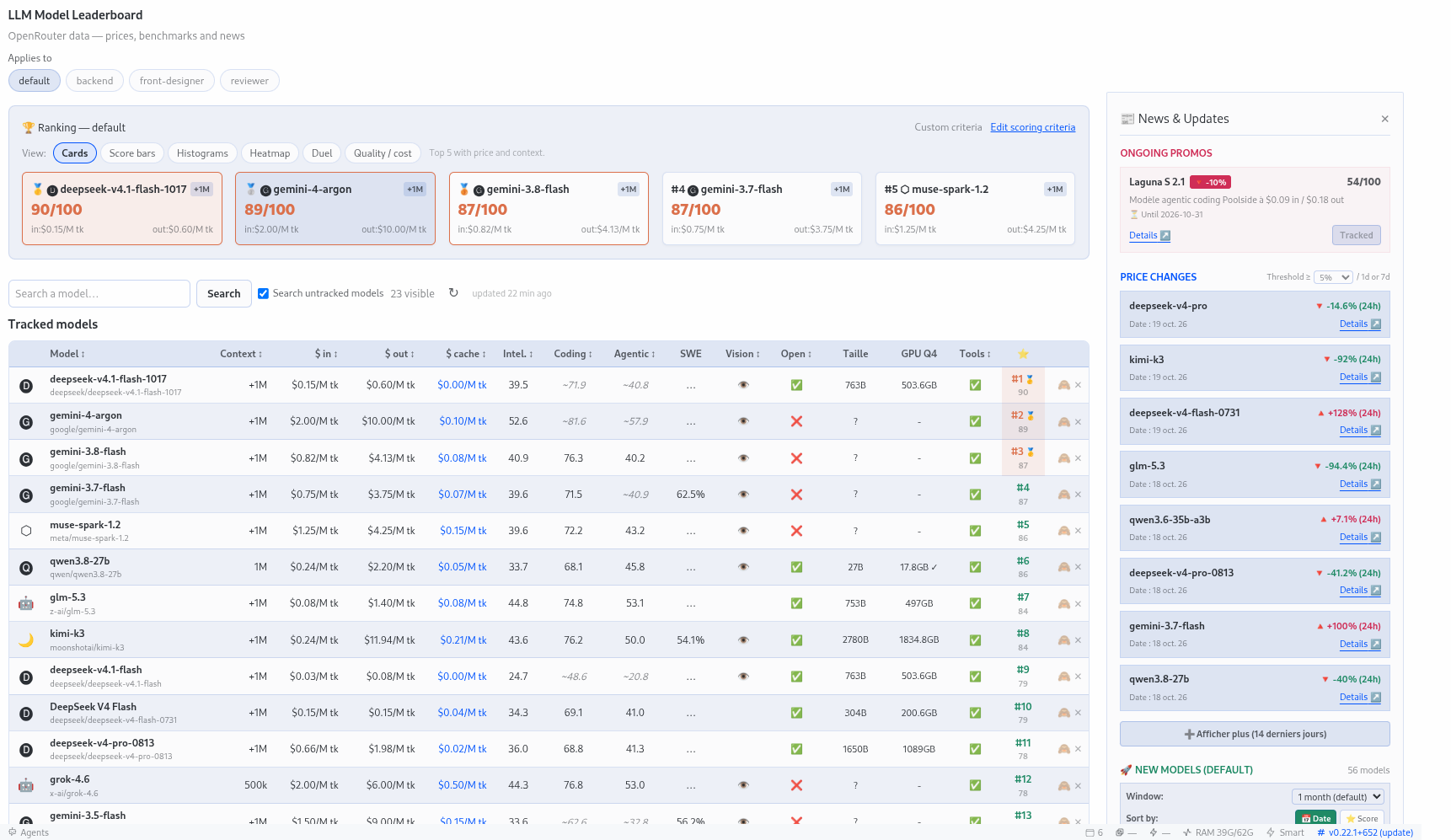
- 📊 Model comparison — context window, input/output/cache prices, Artificial Analysis indices (intelligence, coding, agentic), an SWE-bench Verified column, vision/tools support, open-weights, local VRAM estimate.
- ⭐ Per-profile scoring — one chip per Hermes profile (and
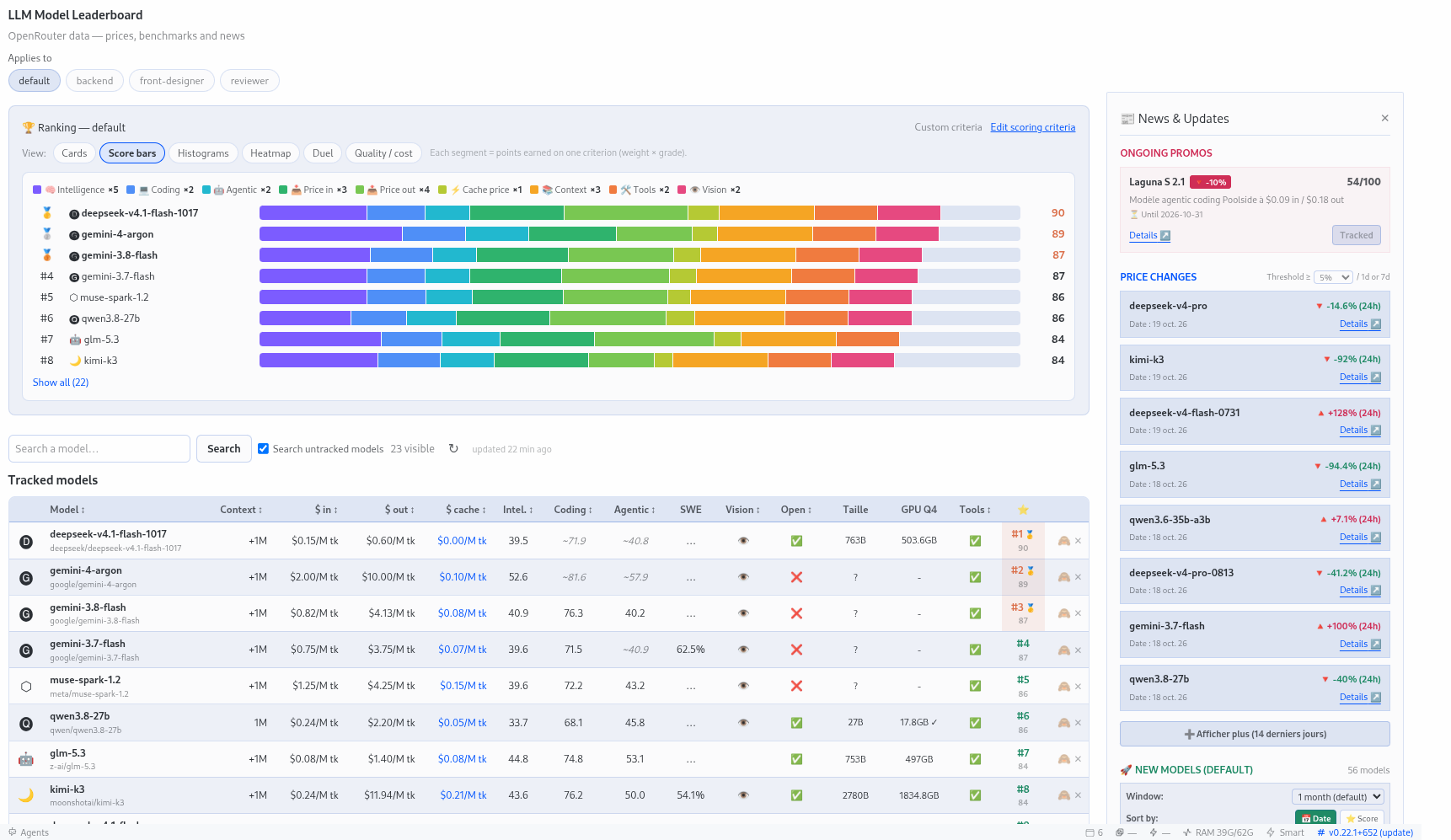
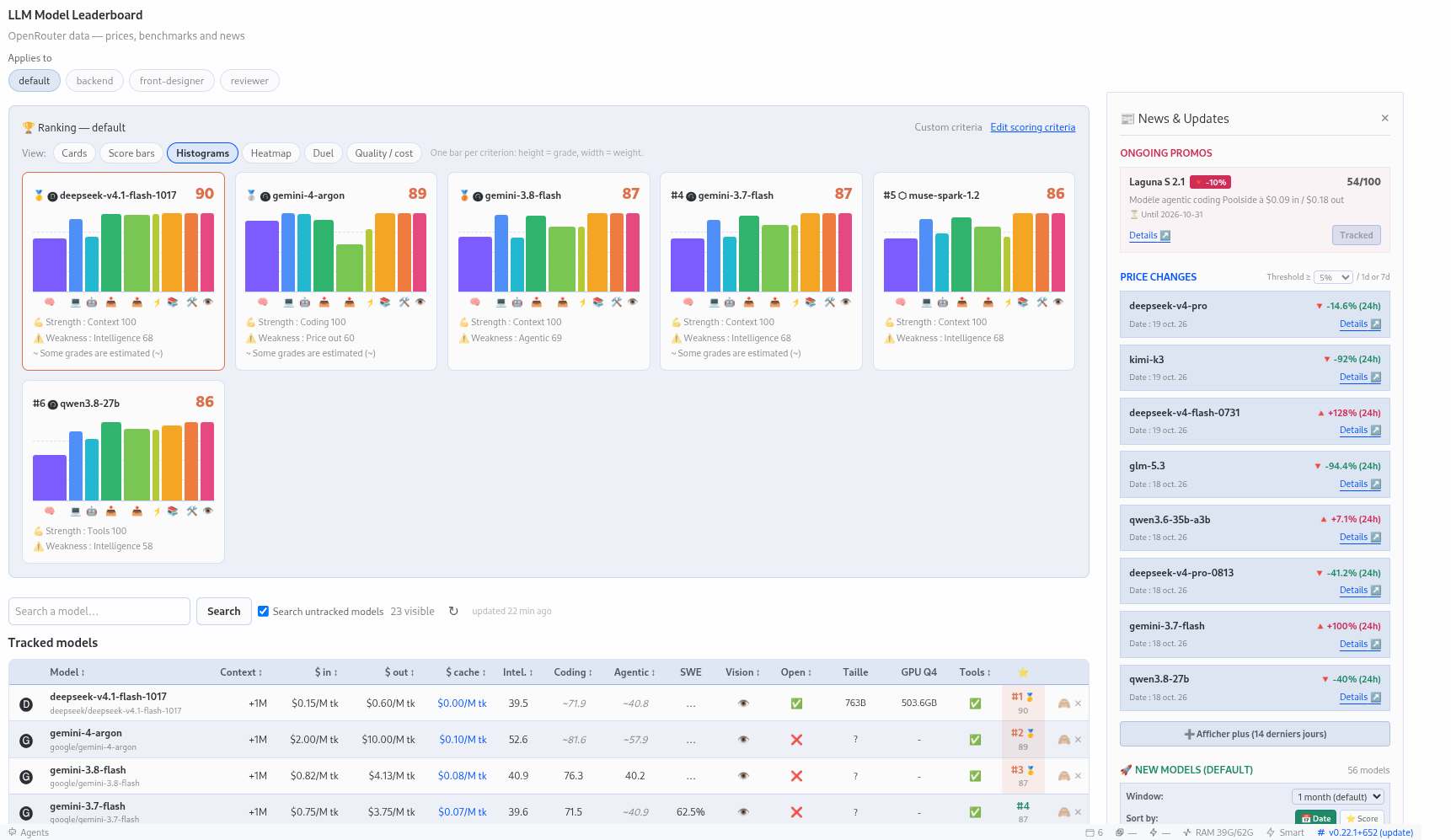
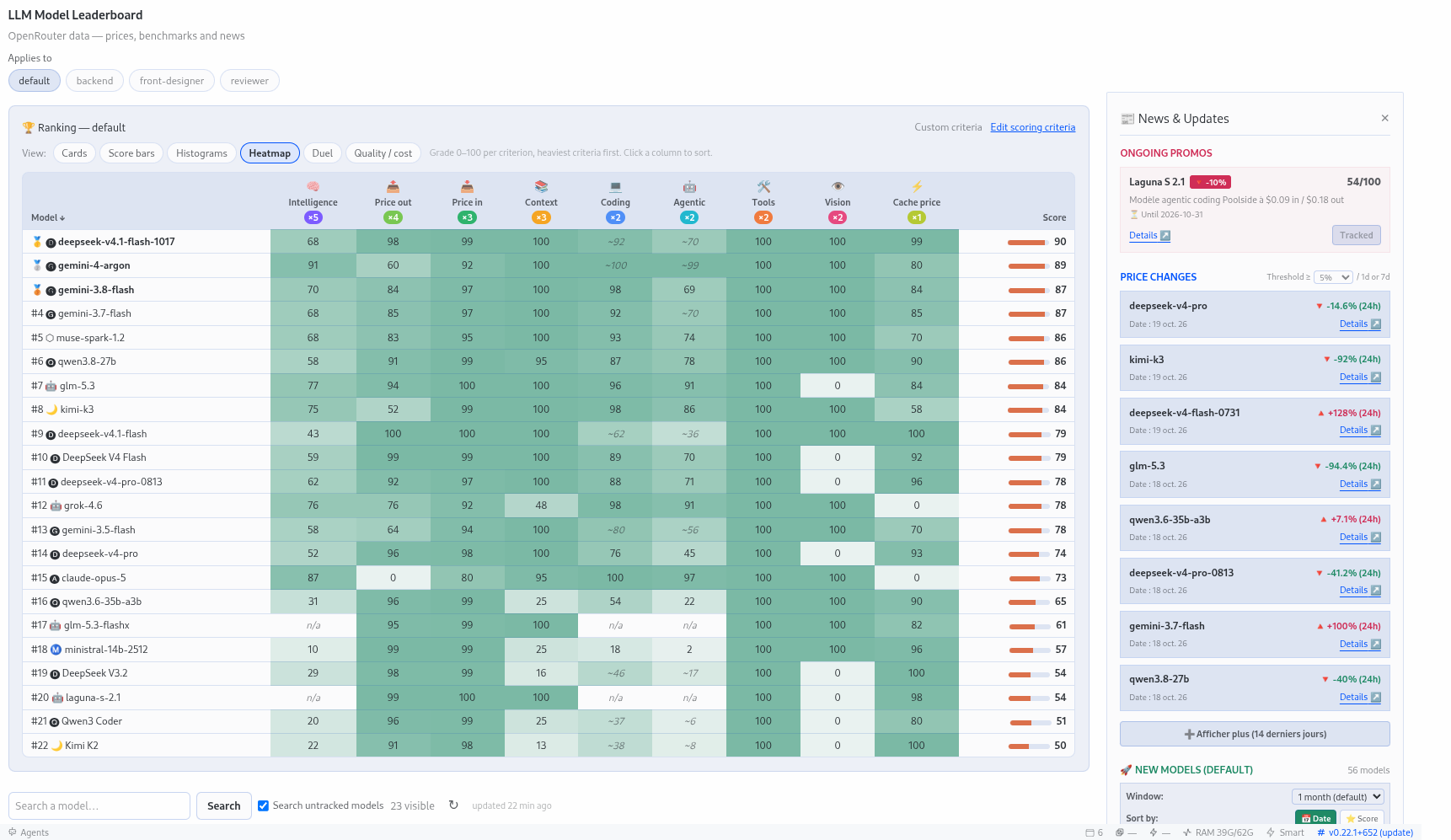
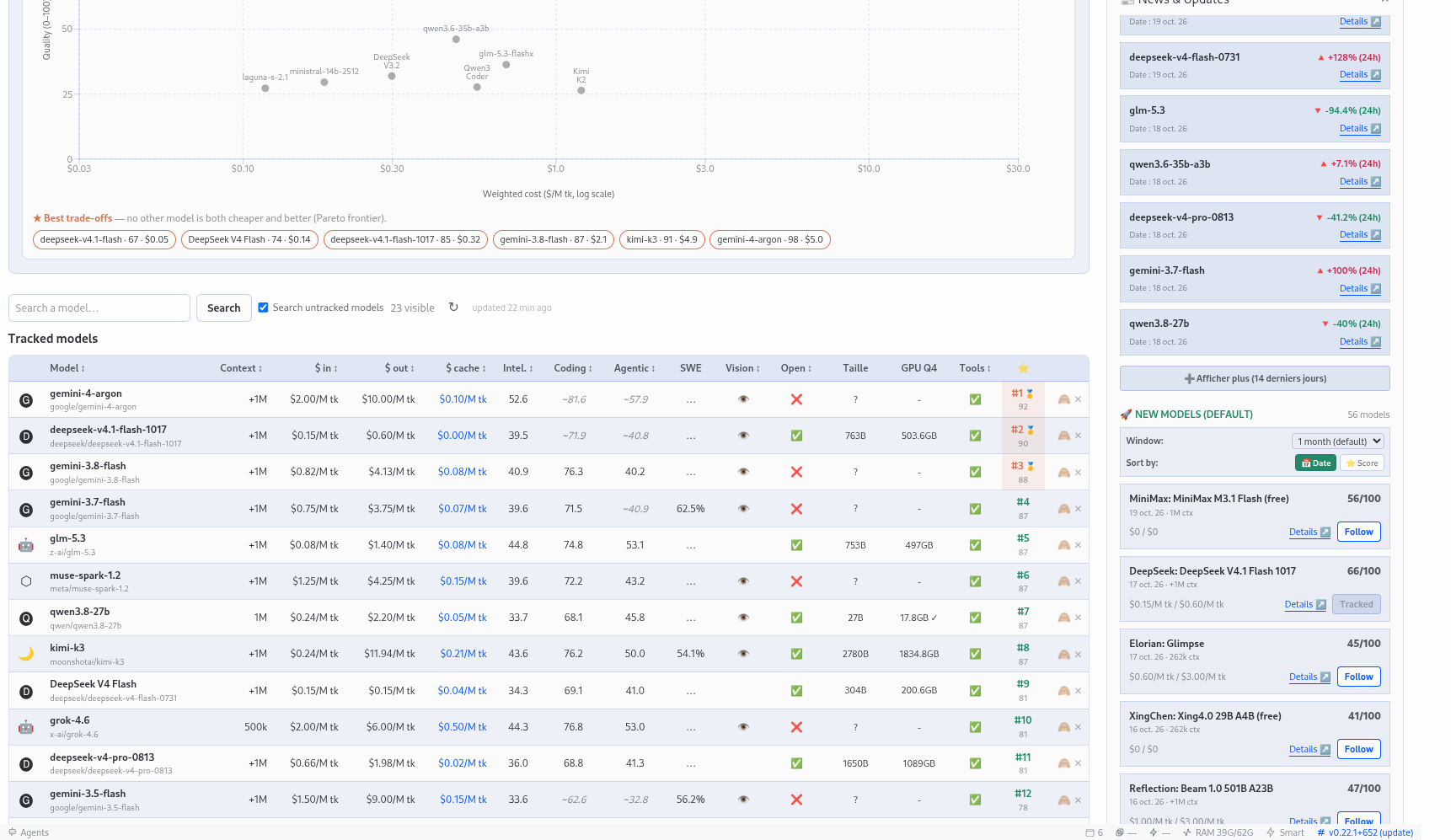
default), 0–5 weights on 11 criteria, instant re-ranking + top-5 cards. A profile with no saved criteria starts from a sane default (intelligence 5, price 3, rest 0). - 📈 Six score views — Cards, Score bars (points earned per criterion), Histograms (grade × weight), Heatmap (grade 0–100, heaviest criteria first; click a cell to enter a real value), Duel (two models, criterion by criterion), and Quality / cost: a scatter with the weighted cost on a log axis, the quality on the other, and the Pareto frontier dashed through the best trade-offs. Each grade says where it came from — OpenRouter, an estimate fitted on the other models, or a value you typed.
- 🤖 Auto-fill — a button in the criteria dialog asks Hermes' own LLM (
ctx.llm.complete_structured, the model the user is already running — no subprocess, no API key in the plugin) to propose weights for that profile; the answer is validated against a JSON schema. Never automatic, always user-triggered. - 🧠 Shipped skill —
skill_view('model-leaderboard:refresh-benchmarks')walks an agent through refreshing the hand-curated benchmark indices (SWE-bench Verified, LiveCodeBench) from the public leaderboards and writing them back. Read-only, loaded on demand. - 🔎 Search — filters the tracked table live and queries OpenRouter for untracked models (checkbox to opt out), with a one-click add.
- 📰 OpenRouter news — side panel: promotions (with end dates), price changes (rolling 1 d / 7 d, configurable threshold), new models (sort by date or score, +1-week pagination).
- 🛡️ Resilience — 5 min OpenRouter cache, stale-on-error fallback on 429s, plus a visibility-gated auto-pull (cheap local poll every 60 s, real refetch every 10 min — only while the page is visible).
- 🧭 Native desktop UX — deletion confirms through the desktop's own
ConfirmDialog(imported from the plugin SDK), tooltips and labels fully i18n'd (en/fr), styling left to the app's CSS variables. - 🔑 No auth plumbing — profiles always persist backend-side; the desktop supplies identity.
Architecture (unified Hermes plugin)
Same conventions as hermes-kanban-gantt:
| Reference (docker/llm-dashboard) | This repo |
|---|---|
backend/main.py (FastAPI :3004, /api/*) |
dashboard/plugin_api.py — FastAPI router mounted at /api/plugins/model-leaderboard/ |
backend/data/*.json |
dashboard/data/ (shipped seed data + runtime state) |
frontend/src/App.tsx + components (React 18, Recharts) |
src/ (TSX) → esbuild → desktop/plugin.js (artifact committed, SDK/react external, Recharts bundled) |
plugin.yaml          unified plugin manifest  (name: model-leaderboard)
plugin_ctx.py        host context (ctx.llm, …) shared with the standalone router
__init__.py          register(): publishes ctx.llm + the shipped skills
dashboard/           backend — FastAPI router → /api/plugins/model-leaderboard/
  manifest.json      name/label/version/api pointer  (name must equal plugin.yaml's)
  data/              seed: models, benchmarks
skills/              read-only skills → skill_view('model-leaderboard:<name>')
                     runtime (gitignored): openrouter cache, price history
desktop/             BUILD ARTIFACT — renderer loaded uncompiled
src/                 TSX authoring sources (esbuild → desktop/plugin.js)
  core/scoring.ts    pure scoring helpers (unit-tested)
  components/        NewsPanel
  hooks/             useResizable
tests/               pytest backend suite + node unit tests (scoring, path guards)
assets/              screenshots + animations/ + catalogue cards (scripts/shots.py, card.py)
Build & test
npm install
npm run build                                      # src/ → desktop/plugin.js
node --experimental-strip-types --test "tests/unit/*.test.ts"   # scoring + path guards
pytest tests/test_backend.py -q                    # backend
npm test                                           # both
To iterate without reinstalling: copy desktop/plugin.js into
~/.hermes/plugins/model-leaderboard/desktop/ and reload the desktop window. Remove
~/.hermes/desktop-plugins/model-leaderboard if the loader keeps serving the previous
artifact (the lift aborts with EEXIST when that folder already exists — a runtime
bug, not a plugin one).
Data sources
| Data | Source | Refresh |
|---|---|---|
| Prices, context, modalities, AA indices | OpenRouter GET /api/v1/models |
auto (5 min cache) |
| News: promos, price changes, new models | derived from the same cache + local price history | auto |
| SWE-bench Verified | curated in dashboard/data/benchmarks.json |
manual |
(The multilingual-coverage criterion was removed: OpenRouter exposes no language field and HF
cardData.language is empty for current models — see the roadmap below.)
Why the benchmark columns are curated rather than synced — measured, not assumed:
- Aider polyglot used to be a column here and was removed: the machine-readable
board (
raw.githubusercontent.com/Aider-AI/aider/main/aider/website/_data/polyglot_leaderboard.yml) stops at the gpt-5 / gemini-2.5 / claude-4 generation — 1 correct match out of 19 tracked models, and fuzzy matching paireddeepseek-v3.2-expwith "DeepSeek V3 (0324)" andgrok-4.6with "grok-4". Wrong numbers are worse than no column. - SWE-bench Verified has no API. The raw data lives in
SWE-bench/experiments(evaluation/verified/<run>/{metadata.yaml,results/}, 4355 files) where the headline figure depends on the scaffold/agent you pick — an editorial choice, not a derivation. - Artificial Analysis indices are already covered through OpenRouter, which also
exposes
GET /api/v1/benchmarks?source=artificial-analysis(154 models,meta.citation) covering 12/19 tracked models — usable as a gap-filler. Their own Data API is free at 100 req/24 h but non-redistributable, so fetched values must never be committed.
TODO / roadmap
Done
- Dynamic profile list — read from the installed Hermes profiles,
defaultincluded. - Default weights for new profiles — all criteria 0 except
intelligence: 5and price 3. - "Remplissage auto" —
ctx.llm.complete_structuredon the model the user is running, JSON-schema-validated (replaced thehermes -zsubprocess). - First-run seeding from the profile-declared models.
- Real refresh (cache-bypassing) + visibility-gated auto-pull.
- Native confirmation dialog (SDK
ConfirmDialog) and full en/fr i18n. - Shipped read-only skill
refresh-benchmarks(ctx.register_skill).
Next
- Benchmark sync — wire
GET /api/v1/benchmarks?source=artificial-analysisas a gap-filler for the indices (24 h TTL, runtime cache, prefer the plain/"Default Fallback" AA variant — "Max Effort" inflates the score), and surfacesource + datenext to the benchmark columns so staleness is visible instead of guessed. The hand-curatedswebench_verified/livecodebenchvalues are covered by the shippedrefresh-benchmarksskill (agent-driven, no API exists for them). - Recharts v3 (2.x is EOL) or native canvas — see the plugin plan note on bundle weight.
- Human-preference rating (LMArena) — the multilingual criterion was dropped instead
(OpenRouter exposes no language field; HF
cardData.languageis empty for 0/5 of the tracked open-weights models), but LMArena's overall Elo is worth a column: it covers closed models too. No API exists (arena.ai/api/*→ 403 "Route not allowed"; the leaderboard is server-rendered, and interaction triggers zero XHR), so it needs a DOM extraction guarded by a structure test. Per-language boards are gone from their public UI, so it cannot serve multilingual data.
Later
- Consumption tab → separate plugin (llm-plugin-plan): usage tracking with credits + analytics.
- WebSocket push (
ctx.socket) instead of polling, if multi-window use ever justifies it.
Screenshots
Captured from the real desktop (light theme, English UI, default profile) by
scripts/shots.py — it drives Hermes Desktop over CDP, walks the score views, edits the
criteria for real, and assembles the GIF below with ffmpeg. Every still is clipped to the
plugin's own pane, so no shell chrome (and none of the user's private session list) can
leak into a README image.
| Tracked models | Score bars |
|---|---|
 |
 |
| Histograms (grade × weight) | Heatmap (grades 0–100, provenance on click) |
 |
 |
| Quality / cost (Pareto frontier) | The table (23 tracked models) |
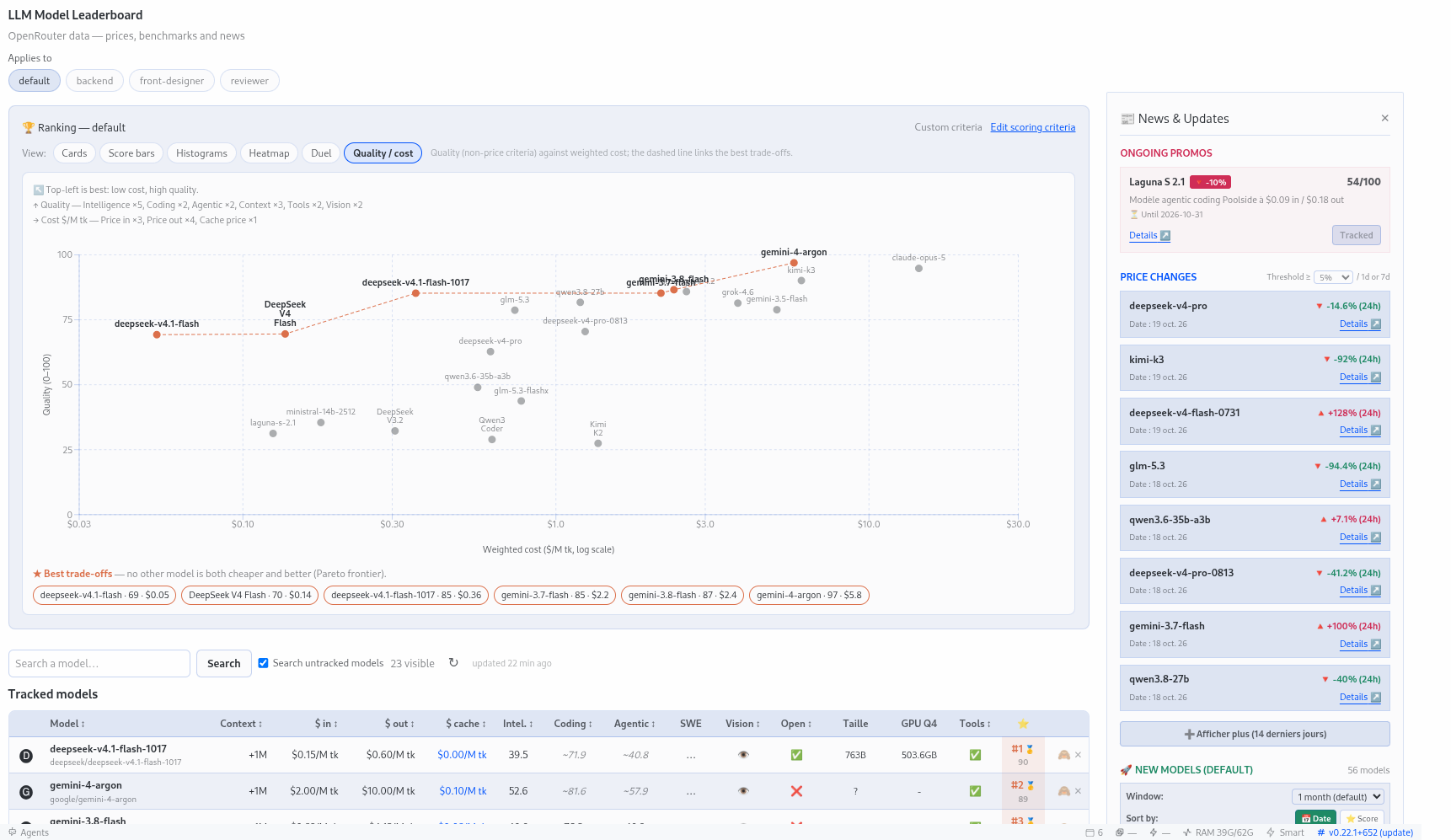 |
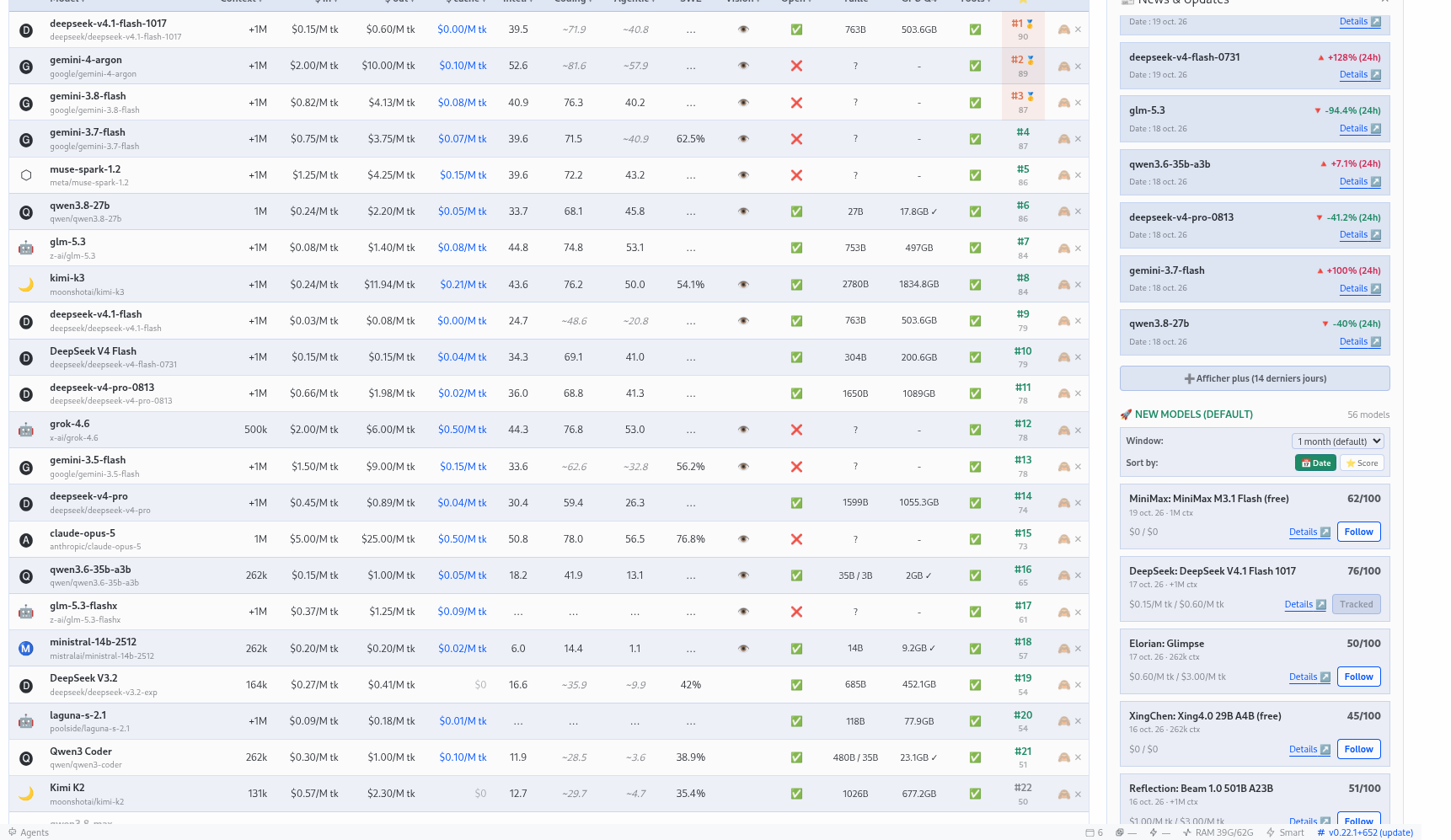 |
| Tracking profile (weights + Auto-fill) | …and the same profile, re-weighted |
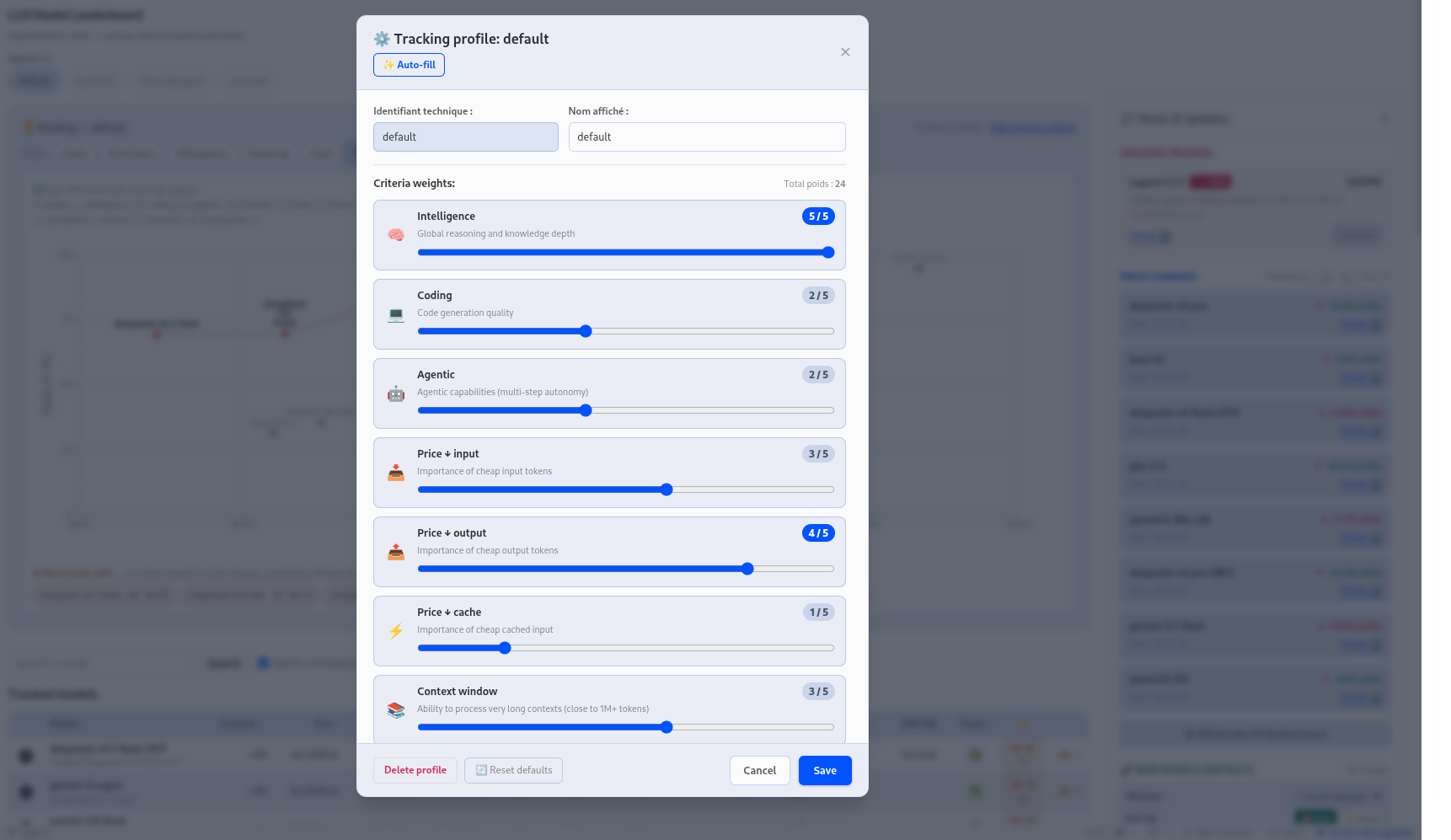 |
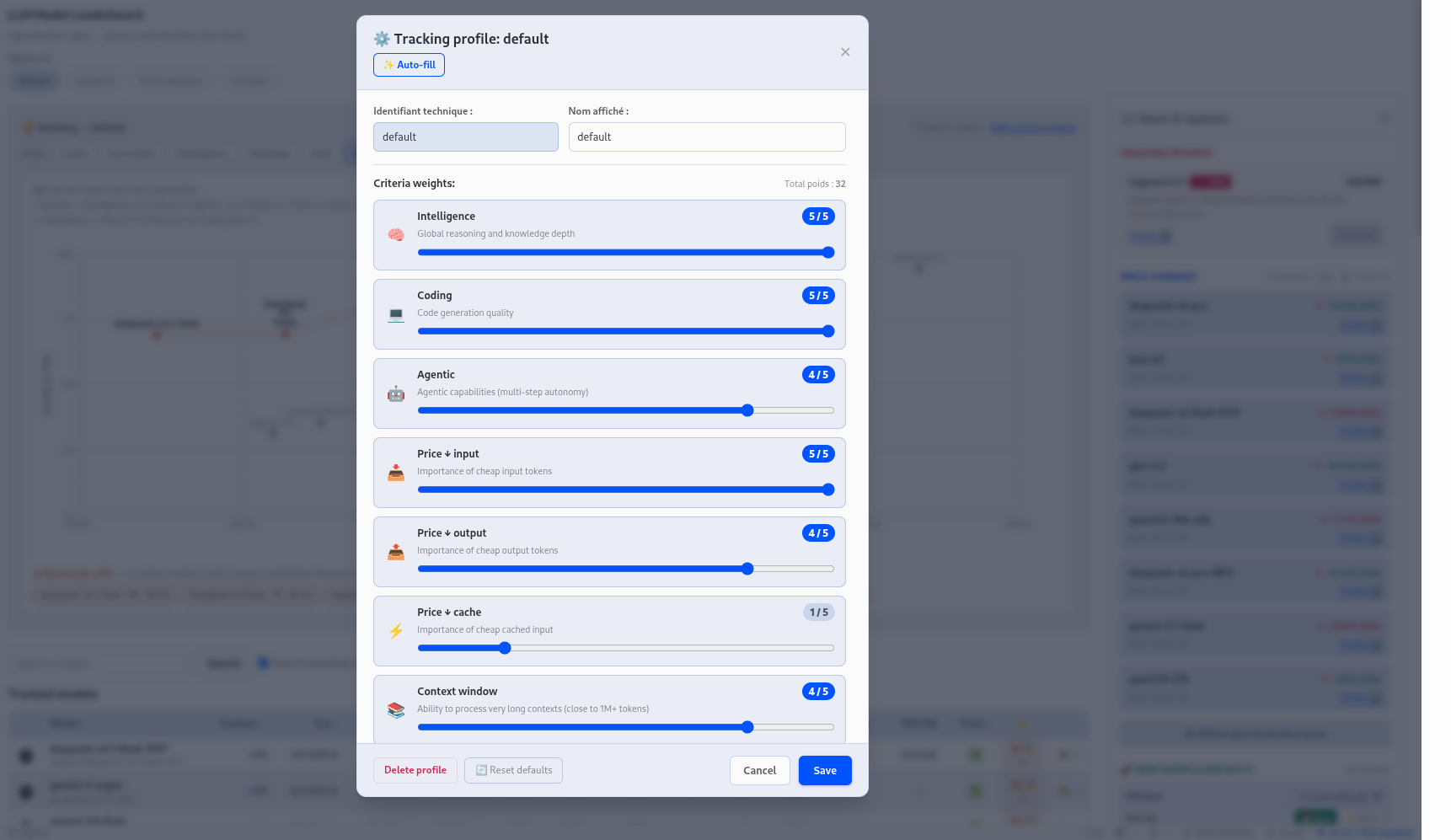 |
Applying those criteria re-ranks the page — the capture run moves Coding to 5, Agentic
to 4, the price weights to 5/4 and the context window to 4, saves, and photographs the
result: the cheap coding models climb (deepseek-v4-flash-1.1, glm-5.3) while the
expensive ones drop. The profile is handed back untouched at the end of the run.
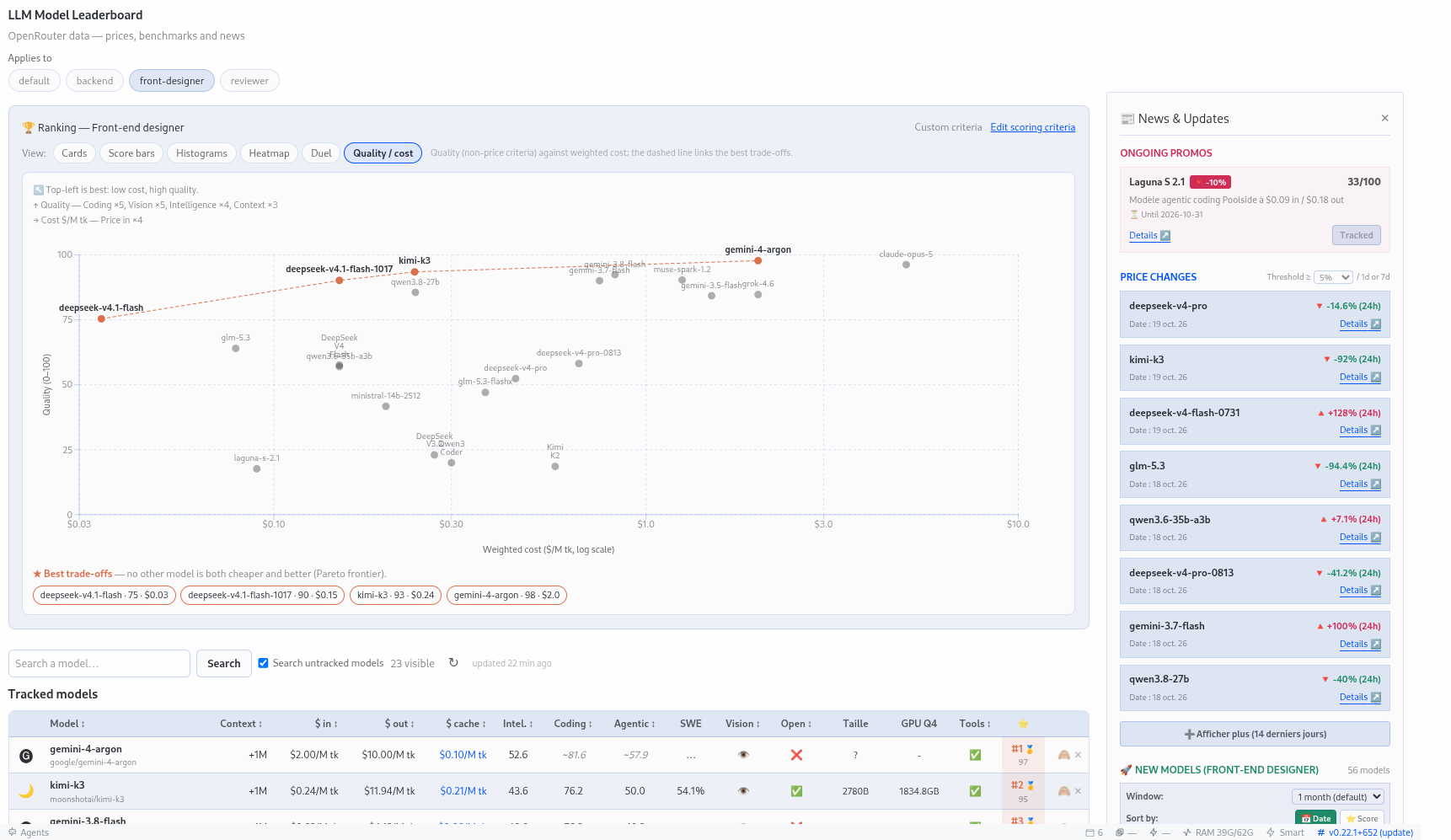
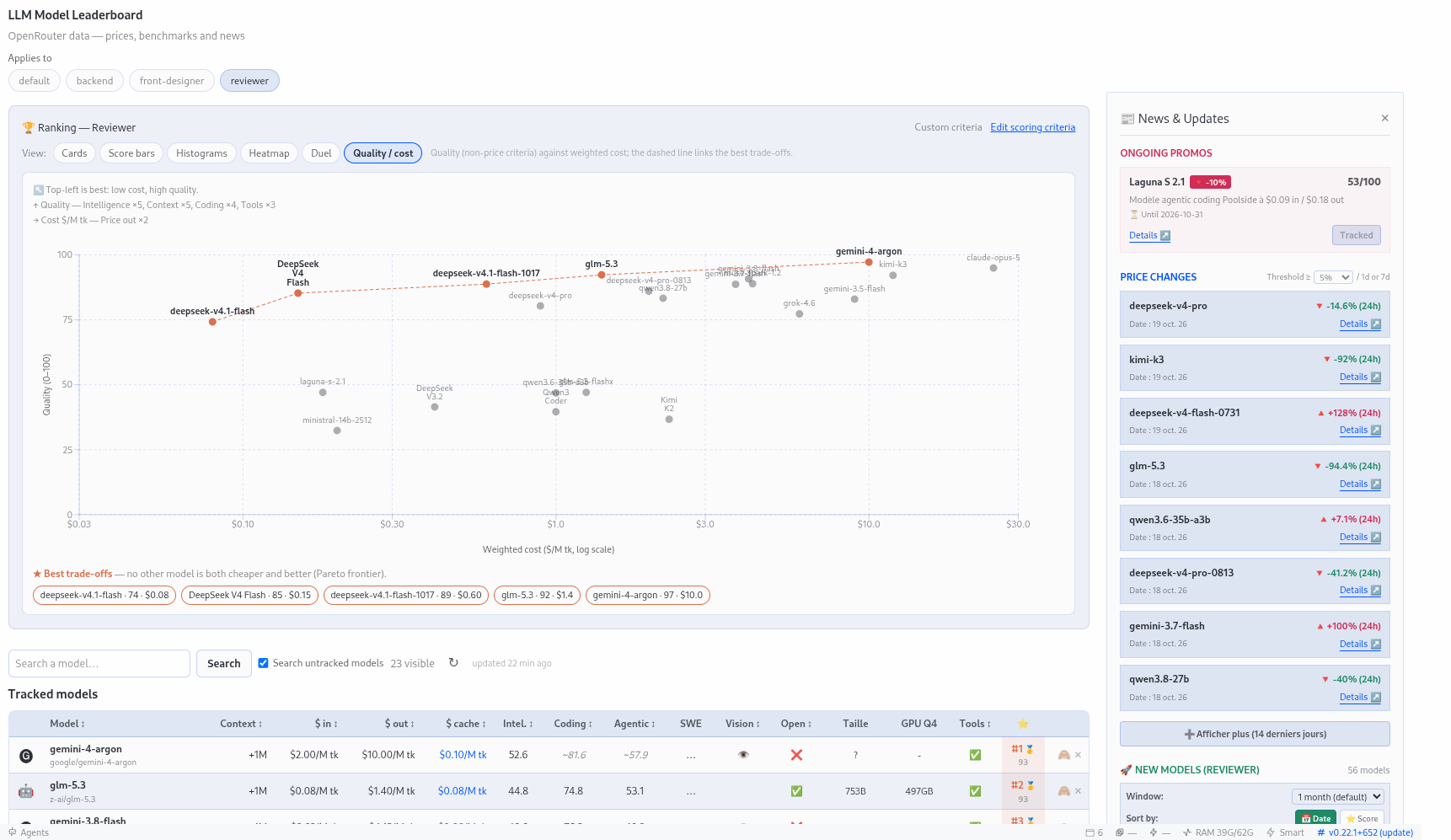
Scoring is per profile — the chip row is the list of installed Hermes profiles, and
each one keeps its own criteria. The capture run creates front-designer, reviewer and
backend (real profiles, removed at the end of the run), gives them opposed weights, and
photographs the same models ranked for two different jobs:
| Front-end designer — coding 5, vision 5 | Reviewer — intelligence 5, context 5 |
|---|---|
 |
 |
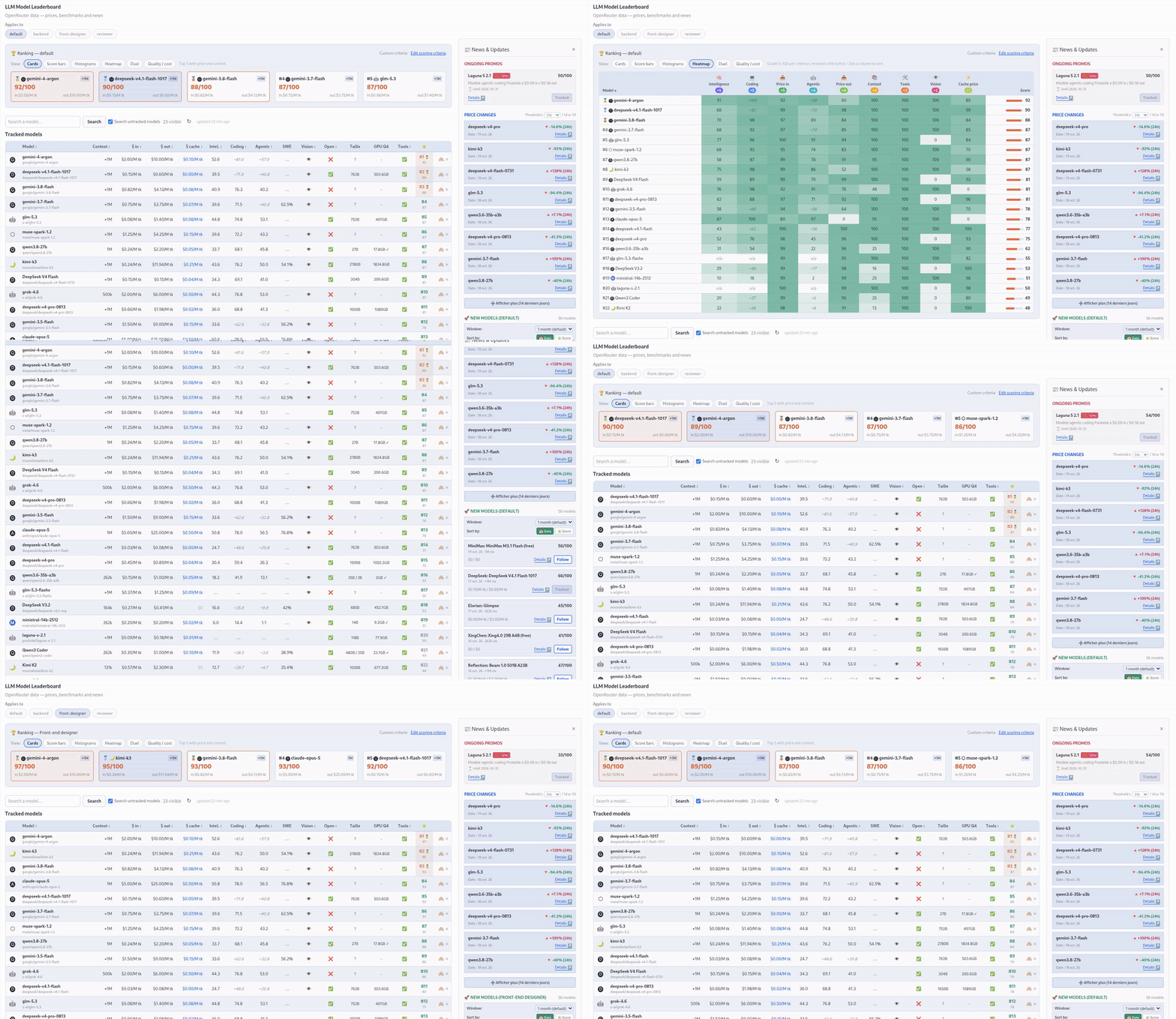
Navigation scenario — score views, the tracked table, the criteria dialog opened, edited and applied, then the profile chips re-ranking the page:
Regenerate them (the debug port is gated, hence the platform flag):
pkill -f 'release/linux-unpacked/Hermes'
~/.hermes/hermes-agent/apps/desktop/release/linux-unpacked/Hermes \
    --ozone-platform=wayland --remote-debugging-port=9222
python3 scripts/shots.py          # --no-gif to skip the animation, --keep-open to leave the page up
Catalogue card
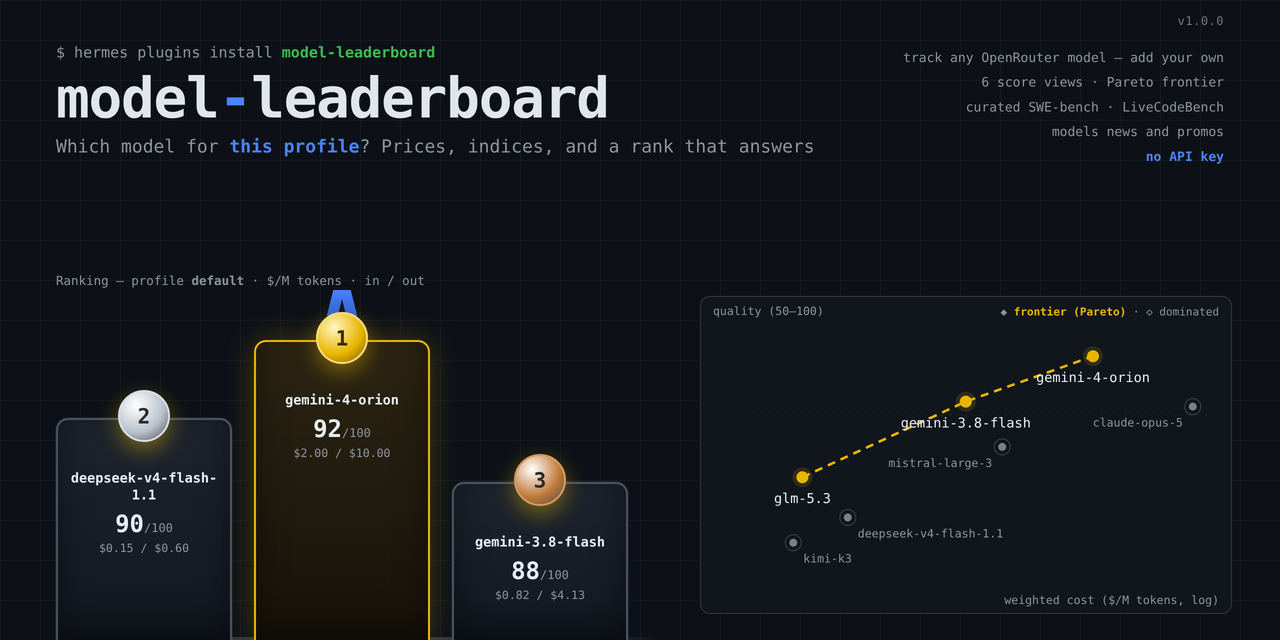
Drawn in HTML/CSS and rasterised with the Chromium Hermes ships (scripts/card.py), same
as hermes-kanban-gantt's card — no image
model, no desktop, no CDP port:
python3 scripts/card.py --variant podium     # podium | podium-light | bars | scatter
python3 scripts/card.py --all                # every alternative + assets/card-alternatives.html
License
GPL-3.0 — see LICENSE.