Sabi
Adaptive routing for coding-agent trajectories.
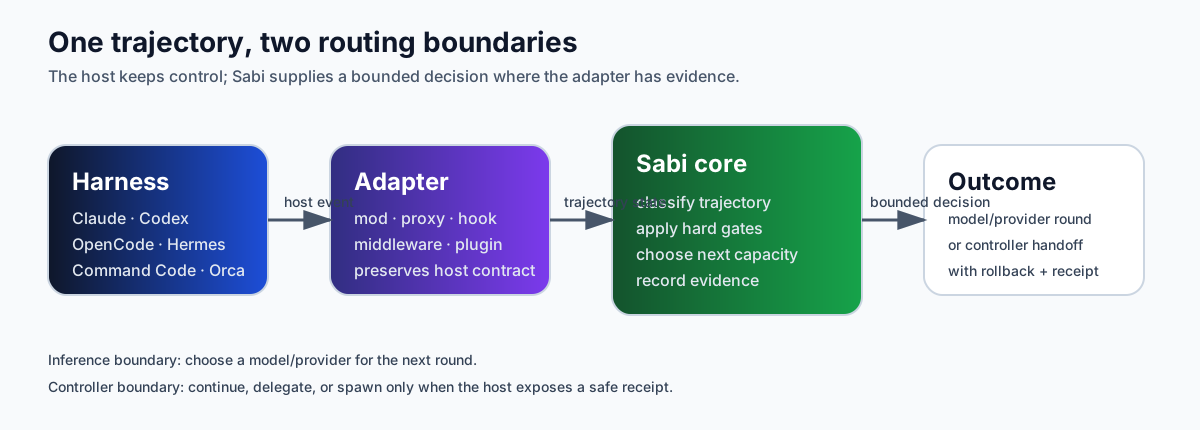
Sabi sits between a coding harness and the models it can call. The harness keeps its own loop, tools, permissions, history, and approvals. Sabi uses trajectory evidence such as tool calls, results, failures, context pressure, capabilities, and provider state to choose what serves the next inference or task transition.
Sabi is a host-agnostic routing layer, not another agent harness or editor. Adapters are optional bridges to the execution seams exposed by each host.
English · Português (BR) · 中文
Install Sabi once
Sabi is installed at user scope. You do not install it per worktree or choose a harness during installation.
For Claude Code, Codex and controller-backed OpenCode workflows, install the published controller:
npm install --global @vizuh/sabi-controller@0.1.0
sabi setup
sabi doctor
The @vizuh/sabi-controller package is released as controller-v0.1.0. For Hermes or OpenCode
inference through the local Sabi proxy, use the checkout-based proxy guide: the
controller package installs hooks and the daemon, not the proxy server or Hermes profile.
If the user's current host AI is doing the installation, give it the host-AI installation flow; it asks for the harness and route explicitly, and asks only for an OpenRouter key on proxy paths.
setup is idempotent: it keeps the daemon and state user-scoped, detects supported hosts, installs only supported Sabi-owned hooks, and keeps the normal harness path available if Sabi is unavailable. Use sabi setup --no-hooks when you want the daemon without changing host configuration.
After installation, open your normal harness. Choose an optional integration only when you need the capability it provides.
Choose an optional integration
| Goal | Integration | What Sabi does | Current boundary |
|---|---|---|---|
| Per-round model + reasoning-effort routing | Command Code mod | Uses the host's native loop and subscription catalog | Command Code only |
| Model/provider routing with your own credentials | Local proxy | Routes requests through an OpenAI-compatible endpoint | Model/provider routing; not native reasoning-effort switching |
| Move work between sessions and worktrees | Controller hooks | Coordinates bounded continue/delegate/spawn actions | Does not switch the model inside an existing native session |
| Use Sabi from DeepSeek Harness | DeepSeek Harness adapter | Adds sabi/sabi-code through DSH's native provider seam |
Inference-only; DSH lifecycle support is not claimed |
| Add another host | Maintainer contract | Defines the adapter boundary and evidence required | An adapter is not a second routing policy |
The 60-second mental model
One task produces a trajectory, not one request:
flowchart LR
  H["Harness keeps its loop"] --> A["Adapter translates host events"]
  A --> S["Sabi core classifies the next round"]
  S --> M["Model/provider selected"]
  M --> H
  S --> E["Decision + evidence"]
A Command Code trajectory might look like:
| Round | Evidence | Decision |
|---|---|---|
| 1 | New instruction | Keep the session model |
| 2 | Repository search and reads | Cheap tier |
| 3 | Edit and implementation | Mid tier |
| 4 | Tests/build | Mid tier |
| 5 | Failing tool result | Strong tier |
| 6 | Recovery after the failure | Strong tier |
| 7 | Verification passes | Mid tier |
For proxy clients, the first request is classified as first-turn and routed to the configured tier (mid by default). Only the Command Code continuing-turn hook leaves round 1 on the session model.
Sabi makes a decision at the boundary the host exposes. It does not fork the host loop, replay tools, or silently rewrite permissions.
What is actually shipped?
Sabi currently has two product families:
- Inference adapters. Command Code's in-process mod and the local OpenAI-compatible proxy route individual inference rounds.
- Controller adapters. The controller observes supported host events and can continue, delegate, or spawn a bounded target when the host and execution receipts make that safe.
The families share routing concepts and core types, but they are not interchangeable. A Claude or Codex hook does not prove native model switching. A model catalog entry does not prove plan entitlement. A local mock test does not prove model quality or savings.
Support is reported in layers:
- Source and tests show that the adapter exists and its contracts are tested.
- A protocol test shows that a real client reached a local Sabi endpoint or host seam with a bounded fixture.
- A live smoke test shows that an approved authenticated upstream was exercised under a spend cap.
- A completed-task evaluation measures quality and cost against a fixed baseline.
Current evidence and limitations live in Harness compatibility and each adapter page.
Optional integration details
Command Code native integration
Use the published mod only if you want Sabi to change the model and reasoning effort inside a Command Code trajectory:
cmd mods add -g npm:@vizuh/sabi
cmd mods list
No Sabi provider key or local proxy is needed. The mod uses the Command Code subscription already attached to the session. The full verification and plan-coverage notes are in Install and security.
Local OpenAI-compatible clients
Use the proxy when a client accepts a baseURL and you want Sabi to route your own OpenRouter, Ollama, or other provider credentials. This is an optional BYOK inference surface; its model/provider routing does not provide the native reasoning-effort signals of the Command Code mod. See Local proxy.
To opt into a current zero-priced OpenRouter quality lane, set OPENROUTER_API_KEY (or use the
configured Sabi secrets file) and run sabi setup --free-quality. Sabi refreshes the live catalog,
adds the fixed sabi-quality alias and routes verification rounds there; paid tiers remain intact.
The catalog refresh is availability evidence, not a model-quality or privacy guarantee.
Surplus inference: shadow QA
Sabi can use a configured zero-cost fixed lane to try to find a problem in the primary work without changing it. The first slice is explicit, read-only and shadow-only:
sabi surplus inventory
sabi surplus review --intent=bug-hunt
sabi surplus history
Only a bounded tracked diff is sent through the local Sabi proxy. Secret paths, secret-like markers, tools, environment values and absolute paths are refused; receipts store hashes and counts, not the diff or model claims. A claim is advisory until a deterministic verifier proves it. See Surplus inference.
Controller hooks
The user-level controller installed above can coordinate supported Claude Code, Codex, OpenCode, and Orca workflows. It is a task/session surface, not a generic way to rewrite the model inside an existing host session. See Adapters for the evidence and boundary of each host.
Routing logic
The deterministic policy classifies the current state first, then applies hard constraints before selecting a tier:
flowchart TD
  I["Round state: tools, results, failures, context, media"] --> C["Classify"]
  C --> P["Apply capability + transport gates"]
  P --> D["Choose cheap / mid / strong"]
  D --> J{"Ambiguous?"}
  J -- "no" --> U["Forward through host/proxy"]
  J -- "yes" --> V["Optional Jev judge over valid choices"]
  V --> U
  U --> R["Record allowlisted evidence"]
Default policy:
| Situation | Rule | Default target |
|---|---|---|
| Read/search/bookkeeping | exploration | cheap |
| Edit/implementation | implementation | mid |
| Test/build/lint | verification | mid |
| Failing tool result | failure | strong |
| Stuck or context pressure | stuck / context-pressure | mid |
| Rate limit, quota, timeout | transport | transport tier; never escalate because it looks scary |
| Image/file input | capability | first configured tier that declares the modality |
Jev is optional semantic judgment for ambiguous proxy rounds. It is a judge, not a worker model. Timeouts, invalid answers, and unavailable credentials fall back to deterministic policy.
Estimates: what can improve?
Sabi is not shipping a universal savings claim yet. The following is a transparent example using the rates in the checked-in configuration (USD per 1M tokens, verified 2026-09-18). It ignores cache discounts, provider minimums, retries, and output generated by the optional judge. Recheck rates before using it for a budget.
Assume an eight-round task:
| Tier | Rounds | Average input/output per round | Total tokens |
|---|---|---|---|
| Cheap | 3 | 3k / 1k | 12k |
| Mid | 4 | 5k / 2k | 28k |
| Strong | 1 | 8k / 3k | 11k |
| Total | 8 | n/a | 51k |
Using the example rates (cheap $0.06/$0.12, mid $0.20/$1.20, strong $2/$10):
- Adaptive mix: about $0.0605.
- All-strong at the same 37k input + 14k output: about $0.2140.
- Illustrative reduction against all-strong: $0.1535 / 71.7%.
- All-mid would be about $0.0242, so Sabi is not claiming it beats a fixed mid model on every task. The point is to reserve strong capacity for evidence that justifies it.
- Token count in this simple example is still 51k. Sabi changes the price and capability assigned to those tokens; it does not magically remove context or tool output.
- Strong-tier share falls from 100% to 21.6% of tokens. That is a routing allocation estimate, not a quality result.
- One 6k-token Jev input at the configured $0.042/M judge rate adds roughly $0.00025 before judge output/network costs. The report counts routing overhead separately.
The exact formulas and a worked spreadsheet-style example are in Estimates and accounting. The production claim to earn is measured on a fixed completed-task set: cost per completed task, success, escalation precision, latency, and router/judge overhead.
For maintainers
Sabi is designed to be a thin adapter around a host's supported extension point:
- The host owns the agent loop, tools, approvals, compaction, retry policy, and user-visible model pin.
- An adapter detects, identifies a session, receives an event/request, dispatches through a supported seam, observes an outcome, and uninstalls cleanly.
- Unknown capabilities remain unknown. Sabi refuses unsafe routes instead of dropping tools, files, images, reasoning fields, or structured output.
- Routing metadata is local attribution, not a permission mechanism. Loopback is the default.
- A catalog listing is not entitlement; a hook installation is not live routing; a mock pass is not a customer benchmark.
See Maintainer guide for the contract, evidence ladder, fixtures, rollback expectations, and how to propose an adapter without creating a second policy implementation.
Repository map
packages/core/                 shared state, policy, routing, telemetry
packages/server/               local OpenAI-compatible proxy
packages/adapters/             Command Code, DeepSeek Harness, Hermes, OpenCode, Orca, Prime Agent
packages/controller/           task/session controller and host hooks
packages/evals/                frozen evals, client smoke checks, accounting
docs/adapters/                 user-facing adapter guides
docs/research/                 verified upstream evidence and release gates
Useful references:
- Adapter directory
- Harness evidence
- Install and security
- Maintainer guide
- Estimates
- Decisions and boundaries
Sabi is MIT licensed. The repository is public at https://github.com/vizuh/sabi.