stt-vocab
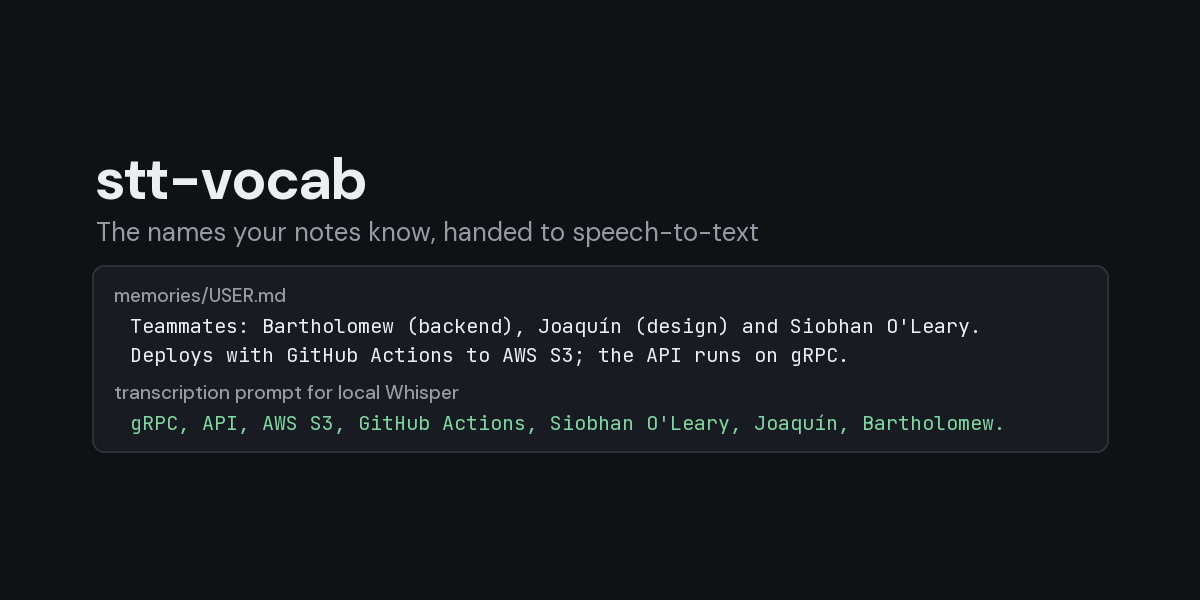
A Hermes plugin that tells the speech-to-text model which names to expect. Whisper-family
models mis-hear the words that matter most in a voice message: people, products, projects,
acronyms. They spell them right far more often when the request carries a short prompt that
contains them. Hermes can send one static prompt (stt.prompt); this plugin builds it for you,
per request, from:
- the terms you list in its settings, globally or for one surface (gateway voice messages, voice mode), and
- names it finds in this profile's memory files (
memories/USER.mdandmemories/MEMORY.md), the notes Hermes already keeps about you. Off for cloud STT unless you allow it (see Privacy).
stt.prompt (yours, kept as is)      Hermes, Nous Research.
+ stt-vocab                         PostgreSQL, Kubernetes, Project Atlas, Northwind, Ayşe Demir, Bartholomew.
It uses Hermes's pre_transcription hook, so it works with every built-in backend that accepts
a prompt: local faster-whisper, OpenAI, Groq, Mistral and DeepInfra. Backends that do not take a
prompt (xAI, ElevenLabs, command providers) transcribe as before.
Install
hermes plugins install stt-vocab --enable
hermes gateway restart   # if you use voice messages through the gateway
Settings
All optional, under plugins.entries.stt-vocab.settings. They are read on every transcription,
so a change applies without a restart.
| Setting | Default | Meaning |
|---|---|---|
terms |
[] |
Terms for every transcription. |
source_terms |
{} |
Extra terms for one caller surface: gateway (voice messages), voice_mode, ... These come first. |
from_memory |
true |
Add names found in memories/USER.md and memories/MEMORY.md. |
allow_remote |
false |
Also send memory-derived names to cloud STT providers. |
max_chars |
896 |
Longest prompt the plugin builds (1–4000). 896 is what Hermes keeps for Whisper-family backends, so it never has to cut the prompt. |
plugins:
  entries:
    stt-vocab:
      settings:
        terms: ["Teknium", "Kanban"]
        source_terms:
          gateway: ["Ayşe", "Northwind"]
Order matters: Whisper conditions on the end of the prompt, so the plugin writes the least
important terms first and the most important last: memory names, then terms, then
source_terms. Your stt.prompt stays at the front untouched, and terms it already contains
are not repeated. When everything does not fit in max_chars, memory names are dropped first.
A setting the plugin cannot use (for example terms: "Atlas" instead of a list) is logged once
as a warning and the transcription goes out unchanged.
How names are found in memory
Memory entries are free text, so the plugin keeps the words that look like names:
- words with a capital letter after the first one (
gRPC,PostgreSQL,AWS), - words that mix letters and digits (
S3,GPT-5), - capitalised words in the middle of a sentence (
Northwind), - runs of these as one name (
Ayşe Demir,Project Atlas,GitHub Actions).
A capitalised word that only opens a sentence is not trusted on its own. Common sentence openers
(Prefers, Uses, Then, ...), words that also appear in lowercase in your notes, weekday and
month names, URLs, paths, e-mail addresses and long letter-and-digit strings that look like keys
are never sent. More frequent names win when space is short. The rules are tuned for notes
written in English; in languages that capitalise every noun (German) more ordinary words will
pass.
Privacy
The prompt is uploaded to the STT provider together with the audio. Hermes's own documentation asks that nothing session-derived goes into it for a hosted API, so by default:
- your
termsandsource_termsgo to every provider, likestt.promptdoes; - memory-derived names go only to a backend running on this machine:
local(faster-whisper) orlocal_command. For any other provider, includingtype: commandproviders whose destination the plugin cannot know, the memory files are not even read.
Set allow_remote: true to send memory-derived names to cloud providers too.
Security and footprint
register()makes a single call,ctx.register_hook("pre_transcription", ...). No tools, middleware, commands or slash commands.- No network access and no subprocesses. Hermes, not the plugin, sends the request.
- Reads only its own settings and, when memory names are on and the backend is local (or
allow_remoteis set), the active profile'smemories/USER.mdandmemories/MEMORY.md, at most 256 KB each. Writes nothing. - Returns at most a new
prompt; never changesmodel,languageor the audio file. Hermes runs the hook fail-open: if it raised, the request would go out unchanged.
Compatibility
Needs Hermes 0.21.0 or later (pre_transcription and the stt.prompt threading shipped there).
Tested against v2026.8.31 (0.21.0) and main.
Development
python -m pytest tests/test_terms.py tests/test_plugin.py   # no Hermes needed
PYTHONPATH=/path/to/hermes-agent /path/to/hermes-agent/.venv/bin/python -m pytest tests
tests/test_hermes.py installs the plugin into a fresh HERMES_HOME, enables and configures it
with the Hermes CLI, writes memory files where Hermes keeps them, and runs Hermes's own
transcribe_audio against a local fake OpenAI-compatible server that records the prompt field
of each request.
License
MIT