jacobhausler
Hermes Beads workbench
The work graph your team keeps in a spreadsheet — now native on bd, wired into Hermes Agent.
One authoritative graph of tasks, blockers, and claims. Agents and humans read
the same bd ready / bd show state; the plugin gives agents honest tools
over it and gives humans a live pane in Hermes Desktop. Plain bd stays fully
sufficient on its own — the plugin only lowers agent effort, never gates what
bd can do.
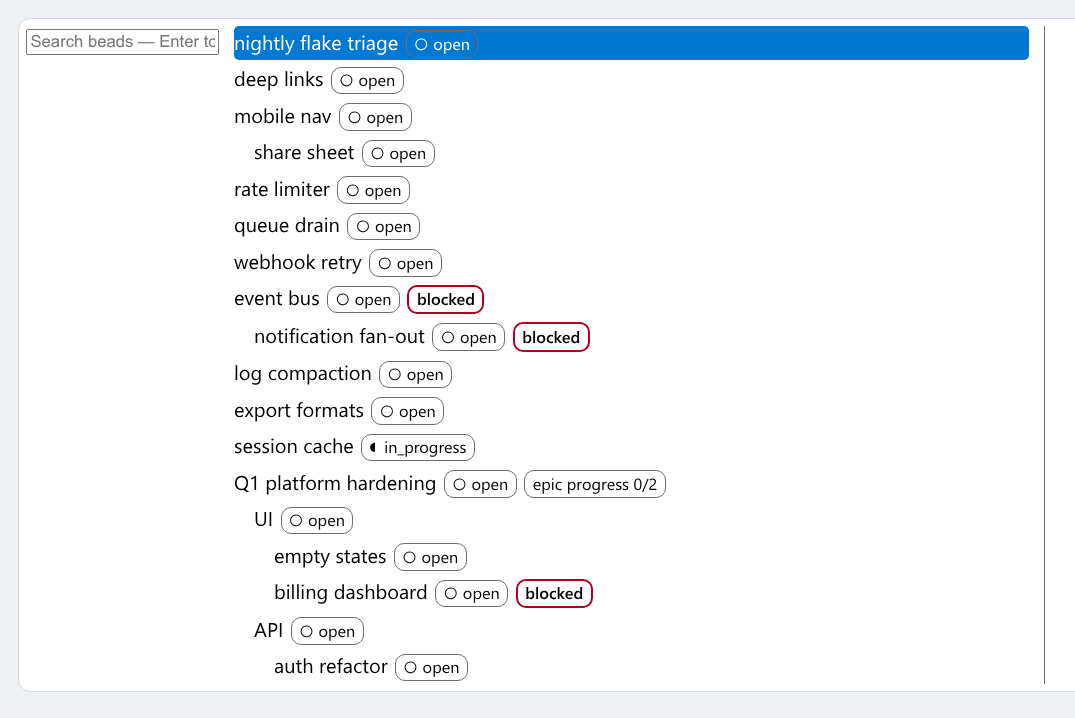
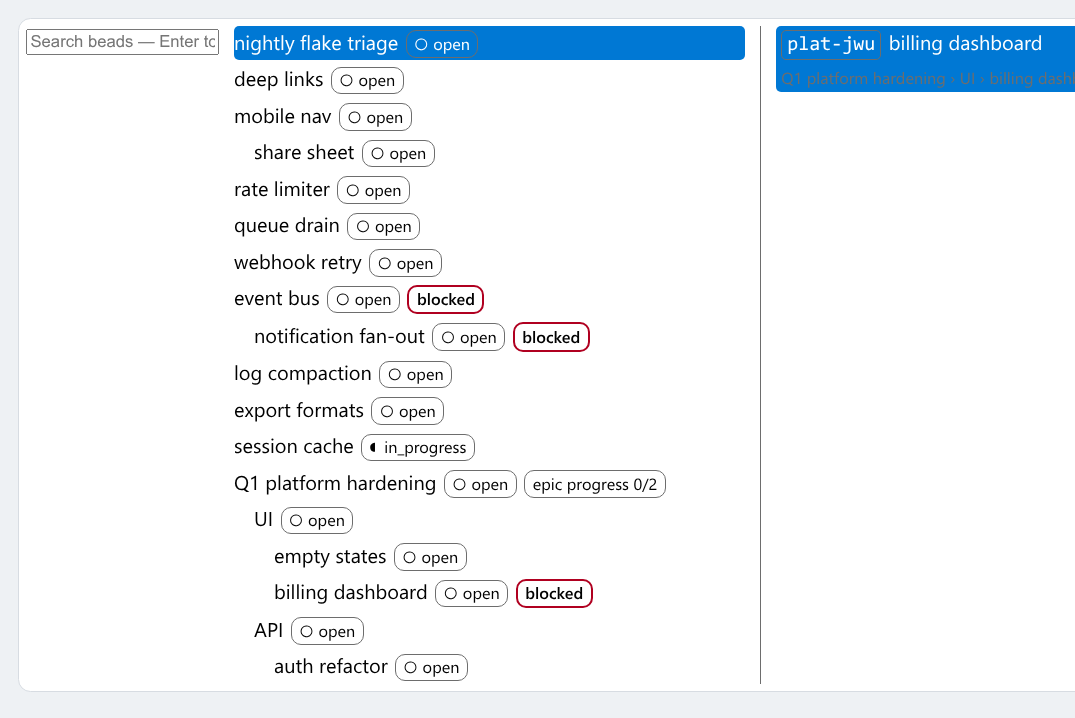
Click any row and the blocker card traces why it's blocked — the direct
blockers and the ones inherited through parents, with a breadcrumb home:
What you get
| | |
|---|---|
| Agent tools | beads_frontier (scoped ready rows, epics excluded), beads_show, beads_claim (claim with read-back — two agents never share a bead), beads_update (guarded metadata writes), beads_comment (append-only), beads_smoke |
| Fixed argv | every bd call is a fixed argv list — no shell, no interpolation; hostile ids are refused before spawn, and exit codes keep their meaning (13 means stale guard, nothing written, never "success") |
| Honest failures | named errors, never an empty list dressed up as "nothing to do"; a lost claim names the holder instead of retrying blindly |
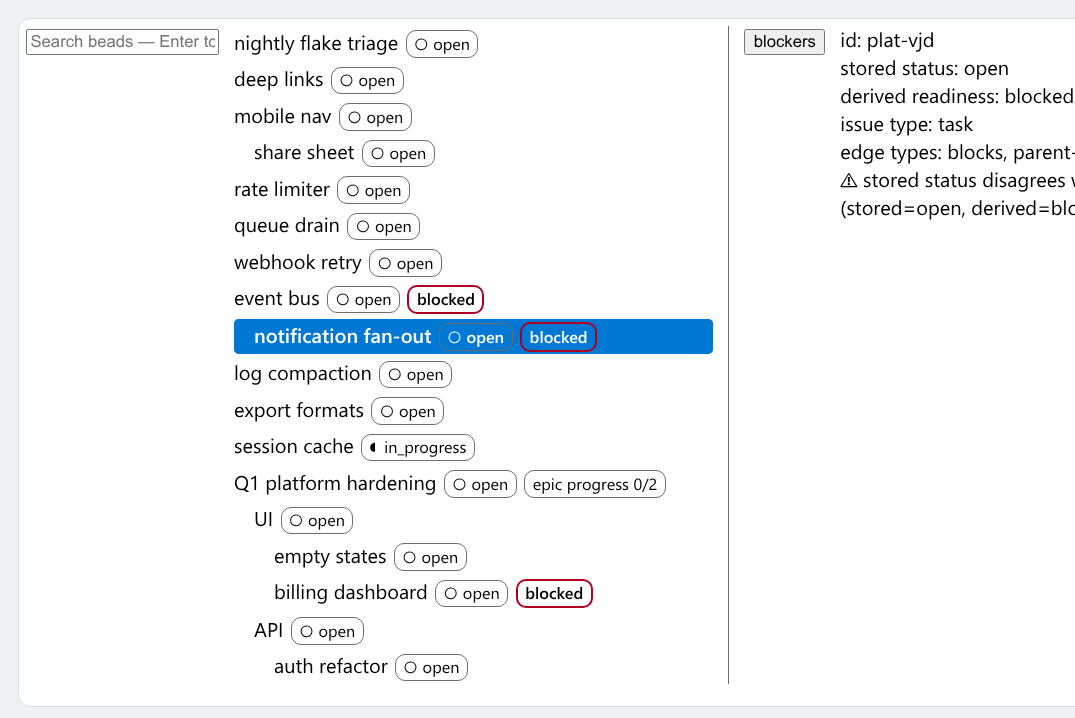
| The pane | Hermes Desktop tree with search, blocker jumps (direct and inherited), claim buttons, and a draft editor whose changes only land through the bot door — the panel never writes behind bd's back |
| Escape hatch intact | uninstall the plugin and bd alone still does everything; nothing here locks your data into a private format or daemon |
Install — two tiers
Full contract with the tier-2 patch snippet: docs/install.md.
Tier 1 — happy path (stock core; pane absent, honestly)
hermes plugins install jacobhausler/hermes-beads
hermes plugins enable hermes-beads
Restart the backend (hermes serve) so the tools mount. Requirements:
- bd 1.3.0+, configured by the operator — on
PATH, or
HERMES_BEADS_BD_BIN=/path/to/bdin the backend's environment (the tools
never take a binary path from the model) — releases
(brew install beads, or grab a tarball; verify againstchecksums.txt) - Hermes Agent ≥ 0.21 (stock — no patched core required)
- Python 3, stdlib only; Node only for the pane's tests
You get the six beads_* agent tools and their rich JSON cards. The desktop
pane is not part of this tier: no desktop/plugin.js registered through
@hermes/plugin-sdk ships today, so Hermes Desktop does not load the pane —
nothing about it "helpfully arrives" behind your back. Verify it yourself:
scripts/verify-tier1.sh enables the plugin into a throwaway HERMES_HOME
under $TMPDIR, proves the tools mount and the pane stays absent, and scans
the shipped docs for false pane tells (this runs in CI).
Then ask your agent: "show me the ready frontier in ~/code/myproj" →
beads_frontier answers with what bd ready sees, epics excluded.
Tier 2 — full features (OPTIONAL Hermes Desktop patch; documented only)
Want the workbench pane? It exists and is fully tested under node --test,
but it only runs when Hermes Desktop loads it — and that needs an optional,
version-pinned patch to Hermes Desktop exposing the plugin-SDK entry
point that wires desktop/*.mjs to the host-injected reads/provider/
telemetry/botView (desktop/workbench.mjs:45-58). The patch is documented —
pinned to Hermes Desktop v2026.9.24, with update/reset restore notes — in
docs/install.md; the real desktop/plugin.js entry point
is a stated follow-up slice. Until it merges, Tier 2 is a proposal, not a
supported install.
How it's built
flowchart LR
    A[agent tools<br/>claim / update / comment / frontier] --> B[beads/ package<br/>fixed-argv runner + guards]
    P[desktop pane<br/>tree · search · blockers · drafts] -->|host-injected reads & door| H[host: hermes serve]
    H --> B
    B -->|fixed argv, no shell| C[(bd / embedded dolt)]
    C -.plain bd stays fully usable.-> U[you]
Two rules fall out of that picture:
- Everything crosses one boundary.
beads/native.pyis the only place a
process spawns. Fixed argv, an explicit store path and actor every time, and
an exit-code map that mirrors what bd actually does — so a masked failure
can't turn into a quiet "success". - The pane is a view, not a writer. Reads arrive injected; anything that
mutates goes through the plugin door or refuses visibly. Delete the plugin
directory and your beads are exactly as reachable bybdas before.
Search and drafts
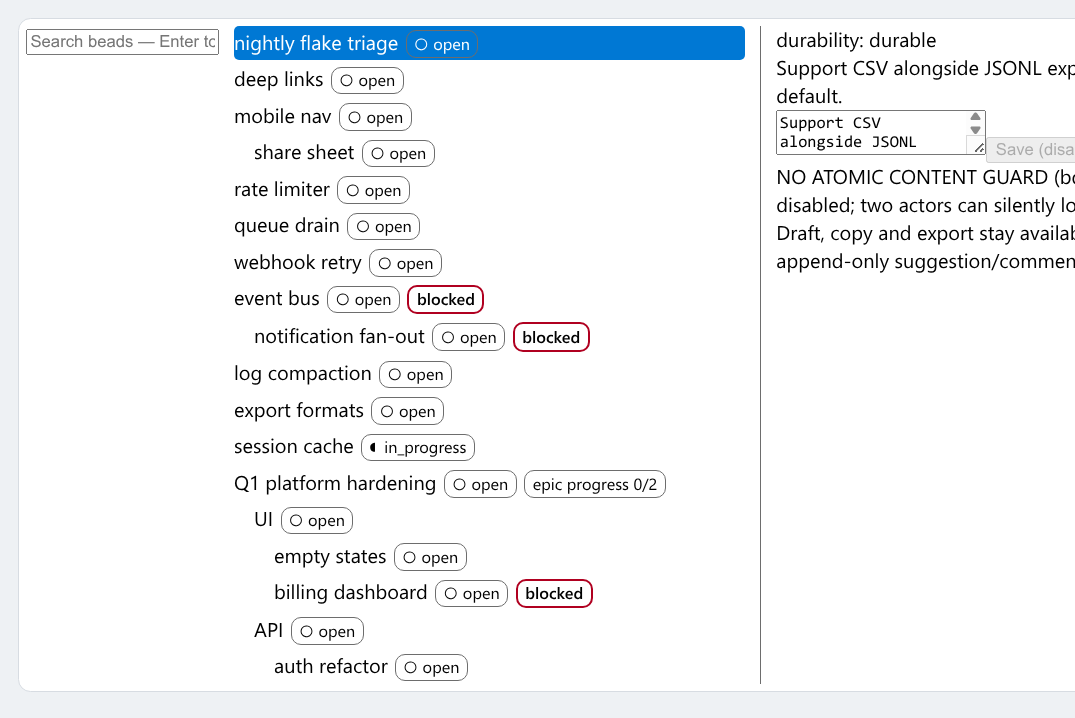
beads_frontier answers "what can I pick up" in one bounded call; the pane's
search box rides the same read facade, and the draft editor stages title/
acceptance edits that only land through the bot door:
Status and honesty
Claim atomicity is non-atomic by design on bd 1.3.0 (claim, then read back
and verify — a race is detected, not prevented); guarded writes rely on bd's
native --if-assignee/--if-status guards; content replacement (title/
description rewrite) is deliberately unsupported through the plugin — edit
content with bd directly. The plugin ships no close/reopen verb: closure is
plain bd close, always has been.
The pane's Write button stays disabled until a qualified runner door exists;
drafts and Ask/Refine are the shipped surface.
For agents and contributors
AGENTS.md is the front door: repo map, test contract, and the rules that keep
the tree publishable. The suite is stdlib-only — no pip installs, no mocks
against the boundary (the tests run a real bd binary against disposable
stores):
# Python half (needs bd on PATH, e.g. BEADS_LAB_BD=/path/to/bd)
for t in tests/test_*.py; do python3 "$t" || exit 1; done

# Desktop half (Node built-in test runner)
node --test tests/test_*.mjs
Both halves run in CI (GitHub Actions) against a pinned Hermes commit;
hermes plugins validate . is the admission gate.
License
MIT — see LICENSE.
README from the reviewed commit 9752631; it updates when the author re-pins.