 NousResearch
Meshy
Part of Hermes Official Plugins, Nous Research's official plugins for Hermes Agent.
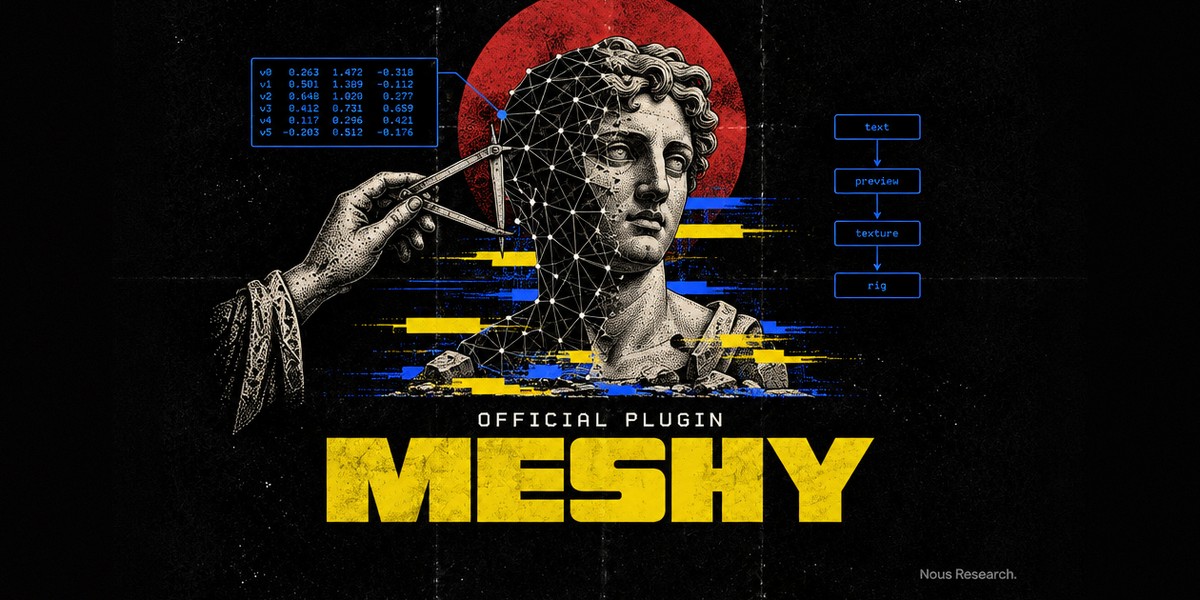
Make 3D models from Hermes with Meshy: text or image to 3D,
texturing, remeshing, rigging, animation, format conversion, real-world resizing, UV
unwrapping, 2D concept images, and 3D-print preparation (printability analysis and repair,
multicolor 3MF, splitting into printable parts, slicer handoff, Creative Lab products).
This is a portable Agent Plugins v1 package. One install ships:
mcp.json: Meshy's first-party MCP server
(meshy-dev/meshy-mcp-server, MIT),
launched asnpx -y @meshy-ai/meshy-mcp-server@0.6.5over stdio for every new session
while the plugin is enabled. Nomcp_serversedit in config.yaml.skills/meshy-3d/: a workflow skill. It carries the server's own routing rules (cost
confirmation, never re-creating an uncertain task, choosing the output format first, the
scenario playbooks), because Hermes does not pass MCP server instructions to the model, plus
a tool table generated from a livetools/list.
Install
hermes plugins install meshy        # from the Nous plugin catalog
hermes plugins enable meshy
Then add your Meshy API key. In Hermes Desktop: Settings → Plugins → Meshy (or the gear on
the plugin's row in Capabilities → Plugins), paste it into Meshy API key, Save. The running Meshy
server restarts with the new key on its own. Without Desktop, either of these does the same:
hermes config set MESHY_API_KEY msy_...        # writes the profile's .env
# or put MESHY_API_KEY=msy_... in ~/.hermes/.env (~/.hermes/profiles/<name>/.env)
Create the key at meshy.ai/developers/keys; any paid Meshy
plan can create one. Then ask, for example, "Make a low-poly treasure chest for Godot" or "Turn
~/photos/mug.jpg into a 3D model and get it ready to print at 10 cm".
Requirements: Node.js 18+ with npx on PATH. The first start downloads the pinned package
into npm's cache.
Spending credits: approval
Most Meshy tools spend credits (5–62 per call; the skill's references/tools.md lists the
prices). The plugin marks the server trust: untrusted, so Hermes asks before every
write-capable call (creates, downloads, cancels). Read-only tools (balance, usage, task status and
lists, the animation library, slicer detection) run without a prompt. The skill also tells the agent
to state the cost and get your yes before any paid call. Unattended runs (cron, hermes chat -q, a
gateway with no approver) cannot approve, so with the default settings paid calls are refused there.
The settings under Full creative control change that.
What the prompt's answers cover depends on your Hermes build:
| Answer | Hermes builds after v0.22.5 | v0.22.5 and older |
|---|---|---|
| Allow once | this call | this call |
| Allow for this session | that tool, for the rest of this chat | this call only |
| Always | that tool, in every chat of this profile (saved to command_allowlist as mcp:meshy/<tool>, e.g. mcp:meshy/meshy_text_to_3d; delete the line to revoke it) | this call only |
Each answer covers one tool: allowing meshy_text_to_3d does not allow meshy_rig.
The plugin also declares what each Meshy tool costs (Meshy's API price list; ranges where the model
or texture size changes the price) and a 200-credit spend limit per chat. The prompt then reads
"Costs about 5–25 credits" plus what the chat has spent. A call that would take the chat past the
limit always asks, even for a tool you allowed for the session or always, and that prompt offers
only Once or Deny: each further paid call in that chat asks again. Hermes builds without MCP tool
costs ignore the declaration.
Full creative control (no prompts)
-
Skip the trust prompt. On Hermes builds after v0.22.5, YOLO mode skips it:
/yolofor the
current chat,hermes --yolofor that process, orapprovals.mode: offinconfig.yamlfor the
whole profile (HERMES_YOLO_MODE=1works too). Or answer Always once per tool you want to run
freely. On any build, the override in step 2 also drops it, unless it keepstrust: untrusted. -
Raise or remove the spend limit. YOLO and Always do not lift it. Override the server in
config.yamlunder the same name. A config entry replaces the plugin's whole entry: its
trust: untrusted(an entry withouttrustis fully trusted, so no trust prompt), its working
folder and its 1,500 s call timeout. Only the plugin's declared costs and its 200-credit limit
carry over, unless the entry sets them. So repeat what you want to keep:mcp_servers: meshy: command: npx args: ["-y", "@meshy-ai/meshy-mcp-server@0.6.5"] env: MESHY_API_KEY: ${MESHY_API_KEY} timeout: 1500 # Creative Lab and status waits outlast Hermes' 300 s default spend_limit: 0 # 0 = no per-chat limit; or a number of credits, e.g. 1000 trust: untrusted # keeps the per-call prompt; delete this line for no prompts at all${PLUGIN_DATA}is not expanded inconfig.yaml, so the override cannot keep the plugin's own
working folder. Withoutcwd, a download the agent makes withoutsave_tolands in
meshy_output/in the folder the server was started in: the session's terminal folder at the
moment Hermes started the server, else the folder Hermes was started in. It is not re-read per
chat. The skill always passes an absolutesave_to, and you can name a folder in your request. To pin one folder, setcwd: ${userHome}/Meshy(create it first).
These settings apply to unattended runs too (cron jobs, hermes chat -q, a gateway with no
approver), not only to chats you watch. With approvals.mode: off, a process started with --yolo,
or an Always answer, such a run makes paid calls without asking until the chat reaches its spend
limit (200 credits by default). With spend_limit: 0 there is no limit left: anything that skips the
trust prompt (no trust line, YOLO, or Always) then lets an unattended run spend without any cap.
Prompts come back after /yolo is turned off, or after you delete the override and the
command_allowlist lines.
Long jobs and chat apps
A Meshy job takes minutes: meshy_get_task_status waits up to 300 s per call and Creative Lab waits
through two stages of up to 600 s each. The plugin declares a 1,500 s call timeout for its server
(timeout in plugin.json), so Hermes does not cut those waits off at its 300 s MCP default.
In Telegram, Discord, Slack and other chat apps the skill has the agent reply "started, about N
min" and end its turn, with a background timer that brings it back to check and deliver, so the chat
is not blocked meanwhile. Results arrive as attachments (MEDIA: lines): the thumbnail as a photo,
the model file as a document, and for rigged or animated models a short preview video rendered
locally.
Where files go
meshy_download_model saves to the absolute save_to path the agent passes (the skill asks
it to always pass one). Without it, the server writes under meshy_output/ in its working
directory, which this plugin sets to its own data directory
(~/.hermes/plugin-data/agent-plugin-meshy-<hash>/meshy_output/), not your project.
Settings
One page in Desktop: Settings → Plugins → Meshy (⌘K → "Meshy: settings", or the gear in
the gallery). Every option is a plain config key too, so the CLI and other surfaces reach the
same values:
| Setting | Default | CLI |
|---|---|---|
Meshy API key (api_key) | — | hermes config set MESHY_API_KEY msy_... (stored in .env, never config.yaml) |
Credit balance in the status bar (show_credits) | on | hermes config set plugins.entries.meshy.settings.show_credits false |
Inline 3D cards in chat (inline_viewer) | on | hermes config set plugins.entries.meshy.settings.inline_viewer false (directive lines then show as text) |
Auto-rotate in the gallery (auto_rotate) | on | hermes config set plugins.entries.meshy.settings.auto_rotate false |
Recent generations shown (gallery_limit) | 24 | hermes config set plugins.entries.meshy.settings.gallery_limit 10 (1–60) |
Blender optimized copy (blender_handoff) | ask | hermes config set plugins.entries.meshy.settings.blender_handoff always (ask, always or never) |
Default detail level (default_detail) | ask | hermes config set plugins.entries.meshy.settings.default_detail game (ask, game, mobile or detailed) |
Blender executable (blender_path) | empty (PATH and the usual install folders) | hermes config set plugins.entries.meshy.settings.blender_path /path/to/blender |
Desktop applies a saved change immediately; nothing needs a restart. The agent reads
blender_handoff, default_detail and blender_path when it needs them, so a change counts from
the next Meshy job.
Hermes Desktop
Turn on the plugin's Desktop switch in Capabilities → Plugins (Desktop halves are opt-in) and
you get, rendered with stock three.js:
- Inline 3D cards. After a download the agent ends its reply with
::meshy-model{path="/abs/model.glb" task="<task_id>"}; Desktop shows it as a card you click to
orbit, zoom, toggle wireframe and grid, or open in a tab. Other clients show the line as text.
Right after starting a job the agent can post just::meshy-model{task="<task_id>"}and reply at
once: the card shows Meshy's progress ("Meshy 38% · previewing"), then the thumbnail with Next and
Download, and fetches the GLB into the plugin's folder (free) when you click View in 3D. - Download menu on every card. It lists each file type Meshy produced for that task (a refined
model: GLB, FBX, OBJ with its .mtl and texture, STL, USDZ; a preview: GLB only) and saves the one
you pick next to the .glb, then opens its folder. No credits: Meshy made them all at generation
time. A tick marks formats already on disk. - Meshy 3D gallery (status-bar chip or ⌘K → "Meshy: open 3D gallery"): your recent
generations and the models on this machine next to a full viewer, with the same Download menu
for any model whose Meshy task is known. "Meshy: view a 3D model file…" opens a GLB, glTF, FBX,
OBJ (with its .mtl and texture beside it), STL, USDZ or 3MF; against a remote Hermes it sends the
file you pick to that machine (stored in the plugin'suploads/folder) instead of a local path.
The saved-files list ("On this machine", or "On " for a remote Hermes) shows every
format Meshy saved, BLEND included (listed without a 3D preview), and lists the plugin's
meshy_output/plus every model the viewer has opened or
saved elsewhere (a project folder): a small per-profile index,asset-index.jsonin the plugin's
data folder, holds path, size, sha256 and task id only (no URLs, no keys; 500 entries, vanished
files drop out). Nothing scans your home folder.
A product Meshy refuses to list for your plan, or whose route is down, gets a one-line notice
naming it and the reason, and every other product still lists; only a rejected key (or Meshy
being down for every product) replaces the list with an error.
Every row is labelled with the prompt that made it, and the search box filters by prompt.
Selecting a model shows Made from: the prompt (copy it, or put it back in the chat box), the
texture or style prompt, the source image for image models, settings, seed, credits, the chain of
steps it came from and what was made from it (each clickable), and Open chat for the
conversation that made it. Meshy keeps text prompts itself; for image models and later steps
(remesh, retexture, rig, animate, resize) the plugin records the creating tool call in
provenance.jsonin its data folder (prompt, settings, parent task, the image path or the image
URL without its query string; 2,000 entries). Models made before this or from another machine
show what Meshy and the download folder still know.
On a remote Hermes, "Show in folder" cannot open that machine's folders: Desktop shows where the
file is and copies the path instead. Binary USDZ (USDC) does not preview yet (three.js's reader is
a stub); open the GLB. - Credit chip in the status bar, refreshed after every Meshy tool call.
Images and saved assets
Use All / Images / Models to filter the gallery. Image previews support switching between
views, Download image / Download all N images, and Next actions for 3D generation,
image edits, and additional views through chat. Copy ID copies the task ID for follow-up requests.
API assets normally expire after three days. Viewing does not save them: use Download to
keep a local copy. Expired entries without local copies are hidden. Image sets are saved under
saved-assets/<task-id>/ in the plugin's data directory; interrupted sets offer Retry image download.
The gallery footer shows known local storage usage and a folder link; it does not scan arbitrary
files elsewhere on disk.
Model downloads list available exports for free. Missing formats have separate Convert actions
that request a paid conversion through chat.
The renderer never reads files or holds the key. dashboard/plugin_api.py (mounted at
/api/plugins/meshy/ once the plugin is enabled) answers the viewer: the balance and recent tasks
from Meshy's API, .glb/.gltf/image bytes from your home directory or the plugin's output folder
(nothing else, symlinks resolved first), and signed assets.meshy.ai downloads. Cards load on
click, render only while on screen, and free their WebGL context when unmounted, so a long chat
of models stays light.
Development
From meshy/, run the backend regression tests against a sibling Hermes checkout:
PYTHONPATH=../../hermes-agent python -m pytest tests/test_plugin_api.py -q
Use the latest patched Node.js 24 LTS release, supported by Hermes Desktop.
Run npm ci, npm run test:gallery, and npm run typecheck.
After renderer changes, run npm run build and commit the generated desktop/plugin.js.
Tools
28 tools (about 19K tokens of schemas), loaded on demand through Hermes' tool search, so they
cost nothing in the prompt until used. Hermes exposes them as mcp__meshy__<tool>:
Generation: meshy_text_to_3d, meshy_text_to_3d_refine, meshy_image_to_3d,
meshy_multi_image_to_3d, meshy_text_to_image, meshy_image_to_image.
Post-processing: meshy_remesh, meshy_retexture, meshy_convert, meshy_resize,
meshy_uv_unwrap.
Characters: meshy_rig, meshy_animate, meshy_text_to_motion, meshy_list_animations.
Printing: meshy_analyze_printability, meshy_repair_printability,
meshy_process_multicolor, meshy_auto_split, meshy_send_to_slicer, meshy_creative_lab.
Tasks and account: meshy_get_task_status, meshy_list_tasks, meshy_list_models,
meshy_download_model, meshy_cancel_task, meshy_check_balance, meshy_list_usage.
Privacy
- The server sends prompts, images you reference by path or URL, and models to Meshy's API
(api.meshy.ai) under your key. It sends no analytics of its own; requests carry a
meshy-mcp-server/<version>user agent. - Hermes passes MCP servers a filtered environment; this server gets only
MESHY_API_KEY
from your profile, filled in when the server starts.
Why local and not a hosted URL
Meshy publishes this server only as a local stdio package and offers no hosted MCP endpoint.
A local server is also what makes local file inputs (file_path), downloads to disk, and
slicer detection work.
Version pinning
mcp.json pins @meshy-ai/meshy-mcp-server@0.6.5 (published 2026-10-22). Bumping it is a
commit here followed by a reviewed SHA bump in the
hermes-agent plugin catalog.
@latest is deliberately not used.
Attribution
The MCP server and the workflow rules the skill carries are by Meshy AI
(meshy-dev/meshy-mcp-server, MIT,
Copyright (c) 2026 Meshy AI). Meshy is a product of Meshy AI. Packaging and skill: Nous
Research, MIT.
README from the reviewed commit 2937702; it updates when the author re-pins.