 pierrenode
progress-squash
A Hermes plugin that collapses carriage-return progress bars in terminal output
to the frame a terminal would show, so the model reads one line instead of every
redraw.
Why
A progress bar redraws its line by writing \r and the next frame. Your
terminal shows the last frame. Hermes captures the raw stream, so the model gets
all of them. Measured through Hermes's own terminal tool:
| Command | Output the model gets | With progress-squash |
|---|---|---|
a 300-step tqdm loop | 17,396 characters | about 120 characters |
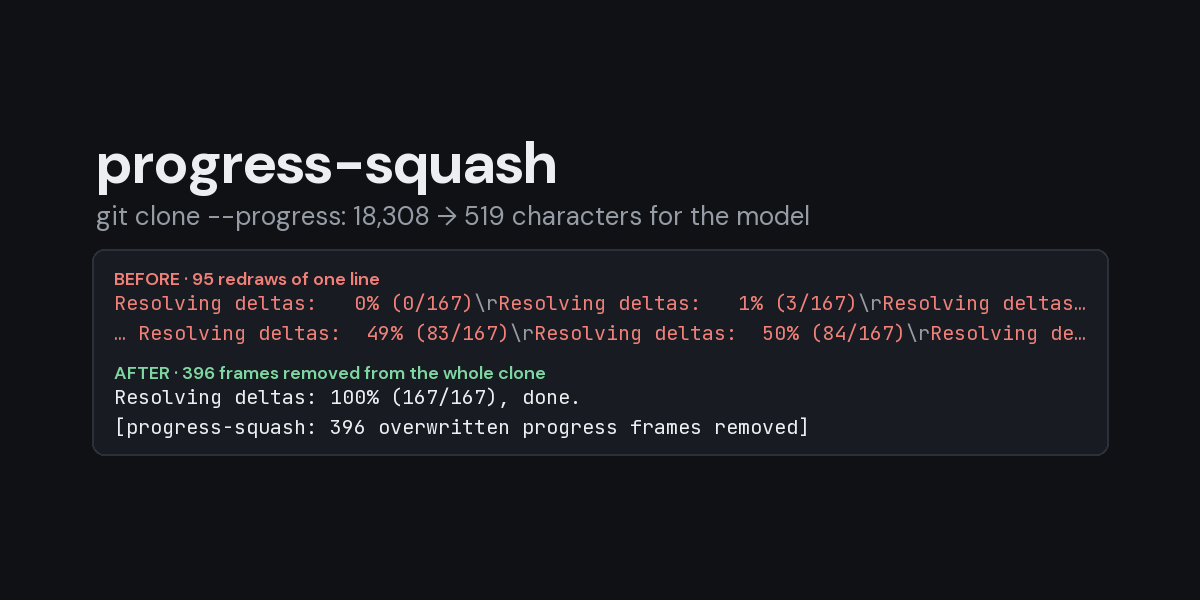
git clone --progress of an 11,886-object repository | 18,308 characters | 519 characters |
The frames use up the turn's context and count against the terminal output limit
(tool_output.max_bytes, 50,000 characters by default) without telling the
model anything the last frame does not.
What it does
For each line of output, the \r-separated frames of the same progress line are
reduced to the last one:
Receiving objects: 0% (1/11886)\rReceiving objects: 1% (119/11886)\r … \rReceiving objects: 100% (11886/11886), 67.61 MiB | 102.56 MiB/s, done.
becomes
Receiving objects: 100% (11886/11886), 67.61 MiB | 102.56 MiB/s, done.
[progress-squash: 396 overwritten progress frames removed]
Two frames belong to the same progress line when the text before their first
digit or bar character matches (epoch:, Receiving objects:). Anything else
written between redraws, such as an error or git's remote: Total … summary,
is kept on its own line. The footer tells the model how many frames were
removed. If you see it in a transcript, the plugin did the rewrite.
Left as they are:
- output with no carriage return, byte for byte (the hook returns
None); - Windows line endings (
\r\n); - a line with a single frame, or with no two consecutive frames of the same
progress line.
Install
hermes plugins install progress-squash
hermes plugins enable progress-squash
Restart Hermes afterwards (CLI, gateway or desktop backend); hooks are registered
when plugins load. Nothing to configure.
Where it applies
- Foreground
terminaltool output: Hermes 0.21.0 and later. - Background-process output (
process_managepoll, wait and log results and
completion notifications): Hermes 0.21.5 and later.
Hermes caps what it keeps of a command's output while it is still running (a
head/tail window of tool_output.max_bytes) and calls this hook afterwards.
Output the cap already dropped is gone before the plugin runs. The plugin saves
the tokens that remain; it does not bring back the middle of a very long log.
If another plugin also registers transform_terminal_output, Hermes uses the
first one that returns a string.
Security and footprint
register()registers one hook,transform_terminal_output. No tools,
commands, middleware or settings.- No network access, no subprocesses, no files read or written, no environment
variables or credentials read. - The hook only sees the output string Hermes passes it and returns a rewritten
copy. Hermes redacts secrets after the hook, so nothing the plugin returns
skips redaction. - Pure Python standard library (
re), no dependencies.
Compatibility
Hermes 0.21.0 (v2026.8.31) or newer. CI runs the test suite against that
release and against Hermes main every day.
Development
python -m pytest tests/test_squash.py                    # no Hermes needed
PYTHONPATH=../hermes-agent python -m pytest tests        # against a Hermes checkout
tests/fixtures/ holds real tqdm and git clone --progress output captured
through Hermes's terminal tool, with its \r bytes intact. The Hermes tests
install the plugin under a fresh HERMES_HOME, enable it with the CLI and run a
command through the real terminal tool, with and without the plugin.
License
MIT
README from the reviewed commit 044e6f1; it updates when the author re-pins.