 pierrenode
stt-vocab
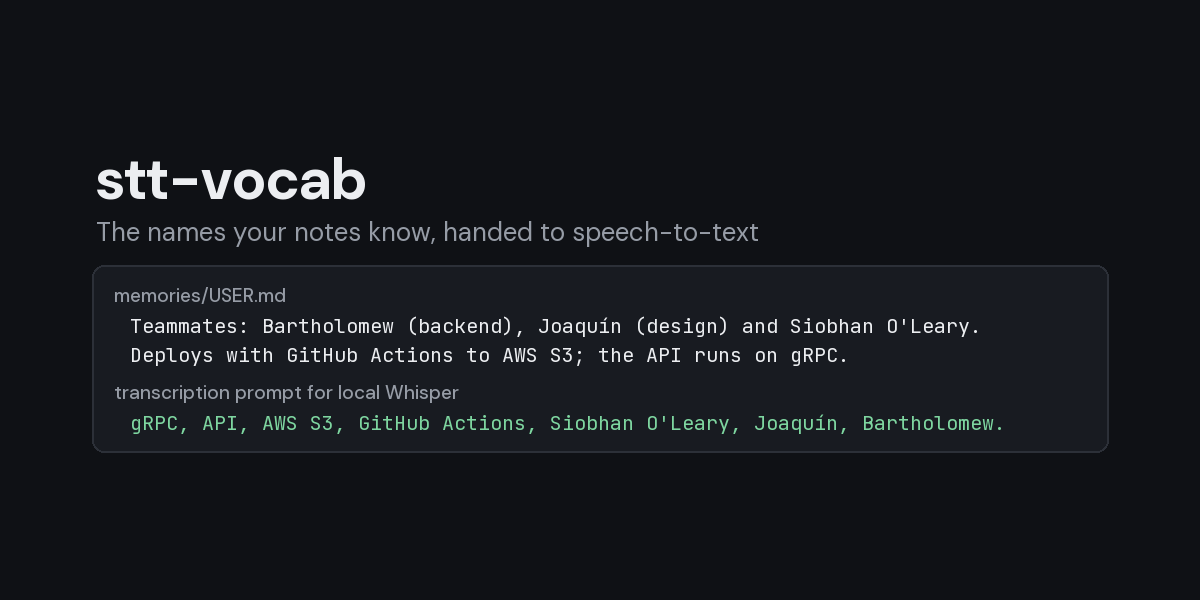
A Hermes plugin that tells the speech-to-text model which names to expect. Whisper-family
models mis-hear the words that matter most in a voice message: people, products, projects,
acronyms. They spell them right far more often when the request carries a short prompt that
contains them. Hermes can send one static prompt (stt.prompt); this plugin builds it for you,
per request, from:
- the terms you list in its settings, globally or for one surface (gateway voice messages,
voice mode), and - names it finds in this profile's memory files (
memories/USER.mdandmemories/MEMORY.md),
the notes Hermes already keeps about you. Off for cloud STT unless you allow it (see Privacy).
stt.prompt (yours, kept as is)      Hermes, Nous Research.
+ stt-vocab                         PostgreSQL, Kubernetes, Project Atlas, Northwind, Ayşe Demir, Bartholomew.
It uses Hermes's pre_transcription hook, so it works with every built-in backend that accepts
a prompt: local faster-whisper, OpenAI, Groq, Mistral and DeepInfra. Backends that do not take a
prompt (xAI, ElevenLabs, command providers) transcribe as before.
Install
hermes plugins install stt-vocab --enable
hermes gateway restart   # if you use voice messages through the gateway
Settings
All optional, under plugins.entries.stt-vocab.settings. They are read on every transcription,
so a change applies without a restart.
| Setting | Default | Meaning |
|---|---|---|
terms | [] | Terms for every transcription. |
source_terms | {} | Extra terms for one caller surface: gateway (voice messages), voice_mode, ... These come first. |
from_memory | true | Add names found in memories/USER.md and memories/MEMORY.md. |
allow_remote | false | Also send memory-derived names to cloud STT providers. |
languages | [] | Languages your memory notes are written in besides English: de, es, fr, it, nl, pt, tr (see below). |
max_chars | 896 | Longest prompt the plugin builds (1–4000). 896 is what Hermes keeps for Whisper-family backends, so it never has to cut the prompt. |
plugins:
  entries:
    stt-vocab:
      settings:
        terms: ["Teknium", "Kanban"]
        source_terms:
          gateway: ["Ayşe", "Northwind"]
Order matters: Whisper conditions on the end of the prompt, so the plugin writes the least
important terms first and the most important last: memory names, then terms, then
source_terms. Your stt.prompt stays at the front untouched, and terms it already contains
are not repeated. When everything does not fit in max_chars, memory names are dropped first.
A setting the plugin cannot use (for example terms: "Atlas" instead of a list) is logged once
as a warning and the transcription goes out unchanged.
How names are found in memory
Memory entries are free text, so the plugin keeps the words that look like names:
- words with a capital letter after the first one (
gRPC,PostgreSQL,AWS), - words that mix letters and digits (
S3,GPT-5), - capitalised words in the middle of a sentence (
Northwind), - runs of these as one name (
Ayşe Demir,Project Atlas,GitHub Actions).
A capitalised word that only opens a sentence is not trusted on its own. Common sentence openers
(Prefers, Uses, Then, ...), words that also appear in lowercase in your notes, weekday and
month names, URLs, paths, e-mail addresses and long letter-and-digit strings that look like keys
are never sent. More frequent names win when space is short. A possessive or a suffix written
after an apostrophe is dropped (Northwind's → Northwind, İstanbul'da → İstanbul).
Notes in other languages
The built-in openers are English. If Hermes writes your memory in another language, the word
that opens a sentence gets glued onto the name after it. Set languages to fix that:
plugins:
  entries:
    stt-vocab:
      settings:
        languages: ["tr"]
For each language this adds its function words, a few note words (Kullanıcı, Sonra,
Bugün, ...) and its month and weekday names. With the same notes in four languages:
| Notes | Without languages | With it |
|---|---|---|
| Turkish | Kullanıcı Northwind, Sonra Bartholomew, Ayrıca İstanbul | Northwind, Bartholomew, İstanbul |
| German | Der Nutzer, Bevorzugt Python, Seine Managerin, März | Python, Managerin (März dropped) |
| Spanish | Prefiere Python, Luego Bartholomew | Python, Bartholomew |
| French | Utilise Neovim, Préfère Python, Ensuite Bartholomew | Neovim, Python, Bartholomew |
English notes give the same names with or without languages. A function word in capitals stays
a name (USA with Spanish on). Known limits:
- German capitalises every noun, so ordinary nouns mid-sentence (
Kaffee) still pass. - A name that only ever opens a sentence is not trusted. In Turkish that is common
(Neovim ve PostgreSQL kullanıyor.); mention the name mid-sentence or add it toterms. - A generic noun that opens a sentence (
Yöneticisi Priya Raman) can still be glued on.
The word lists come from published sources and are used unchanged: the Snowball stop word lists
(BSD-3-Clause) for de, es, fr, it, nl, pt; Apache Lucene's Turkish stop words (Apache-2.0); month
and weekday names from Unicode CLDR. Licences are in THIRD_PARTY_NOTICES.md.
Privacy
The prompt is uploaded to the STT provider together with the audio. Hermes's own documentation
asks that nothing session-derived goes into it for a hosted API, so by default:
- your
termsandsource_termsgo to every provider, likestt.promptdoes; - memory-derived names go only to a backend running on this machine:
local(faster-whisper)
orlocal_command. For any other provider, includingtype: commandproviders whose
destination the plugin cannot know, the memory files are not even read.
Set allow_remote: true to send memory-derived names to cloud providers too.
Security and footprint
register()makes a single call,ctx.register_hook("pre_transcription", ...). No tools,
middleware, commands or slash commands.- No network access and no subprocesses. Hermes, not the plugin, sends the request.
- Reads only its own settings and, when memory names are on and the backend is local (or
allow_remoteis set), the active profile'smemories/USER.mdandmemories/MEMORY.md, at
most 256 KB each. Writes nothing. - Returns at most a new
prompt; never changesmodel,languageor the audio file. Hermes runs
the hook fail-open: if it raised, the request would go out unchanged.
Compatibility
Needs Hermes 0.21.0 or later (pre_transcription and the stt.prompt threading shipped there).
Tested against v2026.8.31 (0.21.0) and main.
Development
python -m pytest tests/test_terms.py tests/test_plugin.py   # no Hermes needed
PYTHONPATH=/path/to/hermes-agent /path/to/hermes-agent/.venv/bin/python -m pytest tests
stt-vocab/languages.py is generated by python tools/make_languages.py, which downloads the
word lists at pinned commits and checks their sha256.
tests/test_hermes.py installs the plugin into a fresh HERMES_HOME, enables and configures it
with the Hermes CLI, writes memory files where Hermes keeps them, and runs Hermes's own
transcribe_audio against a local fake OpenAI-compatible server that records the prompt field
of each request.
License
MIT. The bundled word lists in stt-vocab/languages.py keep their own licences; see
stt-vocab/THIRD_PARTY_NOTICES.md.
README from the reviewed commit 54e83f9; it updates when the author re-pins.