Agent Mixer
A mixing desk for how much a coding agent may change. Four dials (edits, scope, lines, deps) you set up front or turn mid-session with /mixer. Hermes is the first-class host; the same dials also work in Claude Code, Codex and Gemini CLI through an agent-mixer hook command.
Hermes can already ask before dangerous terminal commands (approvals.mode, /yolo). It has no permission modes for file edits, no write scope, no enforced read-only plan mode, no per-turn change budget and no new-dependency guard. Agent Mixer adds those as a plugin, using only public Hermes plugin APIs (plus three guarded host reads, listed below) and the Python standard library.
The board (every value says where it comes from, and the line budget says how much is left this turn):
Agent Mixer · sess_3f2a9c1e
  edits   ask  [ACTIVE] auto  plan  (session)
  scope   src/**, tests/**  (saved)
  lines   200 per turn, 113 left this turn  (saved)
  deps    allow  [ACTIVE] ask  block  (default)
  ask uses the host's approvals gate; always-allow remembers one file or one package. ...
Requirements: Python 3.12+. Hermes needs a 2026-era build (hooks, plugin commands, subagent hooks). The CLI harnesses need only the agent-mixer command.
Harness support at a glance
Agent Mixer is harness-agnostic: one engine, four adapters. The dials, presets, /mixer grammar and saved defaults are identical everywhere; only the enforcement transport differs.
| Harness | Install | Enforcement | Notes |
|---|---|---|---|
| Hermes (first-class) | hermes plugins install Sahil-SS9/hermes-agent-mixer --enable |
pre_tool_call hooks |
+ Desktop dial panel, web dashboard bar, status pill |
| Claude Code | agent-mixer install claude --yes |
PreToolUse + prompt hooks |
native ask approvals; live-tested on 2.1.x |
| Codex | agent-mixer install codex --yes |
PreToolUse |
ask becomes deny (Codex has no ask channel); trust the hook in /hooks |
| Gemini CLI | agent-mixer install gemini --yes |
BeforeTool |
ask becomes deny; hook timeouts in ms |
| Any CLI | uv tool install . or pip install . → agent-mixer … |
shell command | works wherever you can run Python 3.12+ |
The same engine enforces in every harness: plan/scope/lines/dep checks, per-turn budgets shared with subagents, session state, presets. agent-mixer doctor reports what is installed and what is wrong in any harness.
Hermes plugin catalog: submitted for review (see the catalog entry PR link in this repo's pinned issue). Install by name hermes plugins install hermes-agent-mixer once merged.
Screenshots
Composer icon and dial panel — a sliders icon next to the model and reasoning controls opens the dial panel in place (Windows voice-equaliser style):
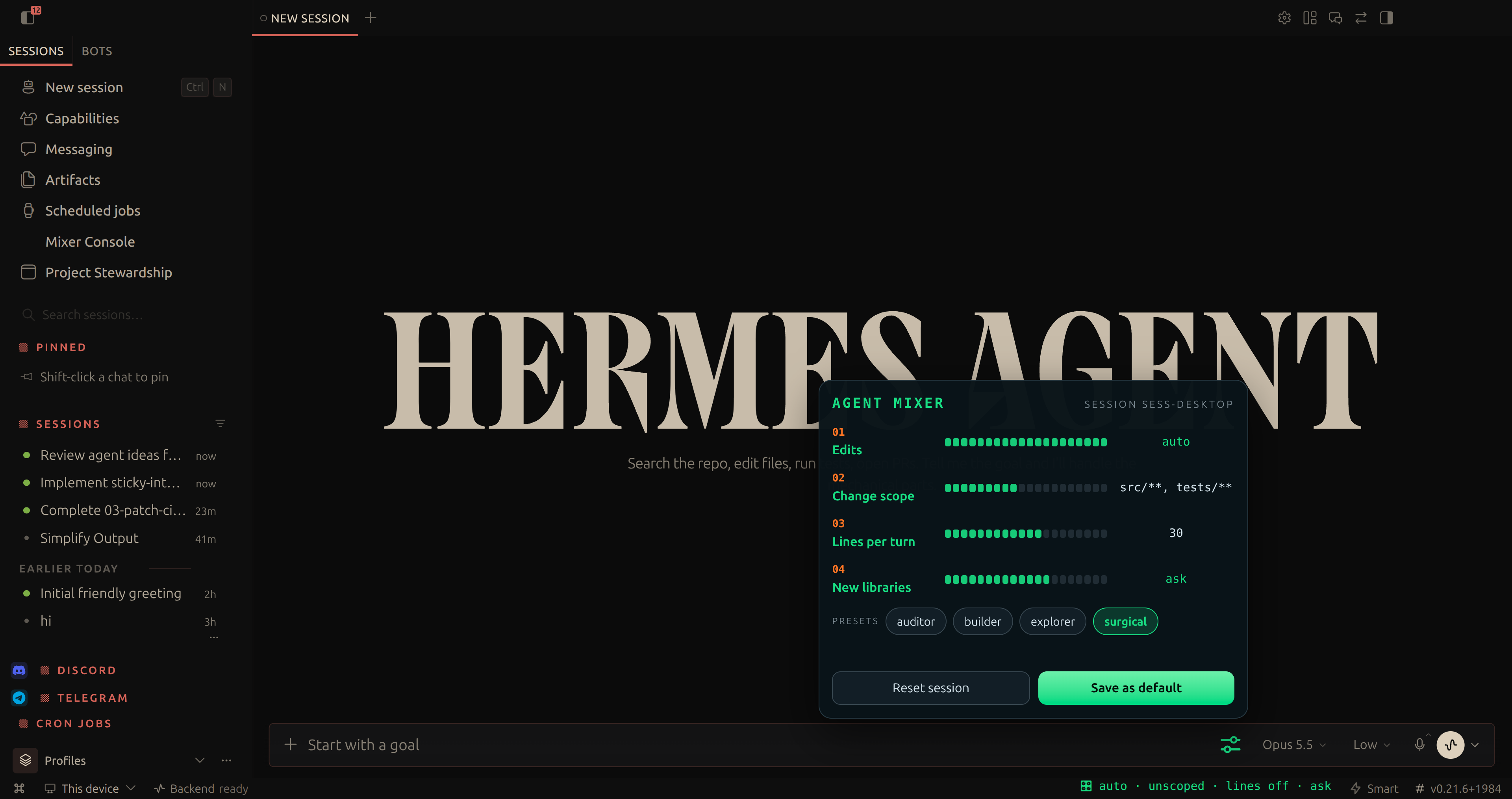
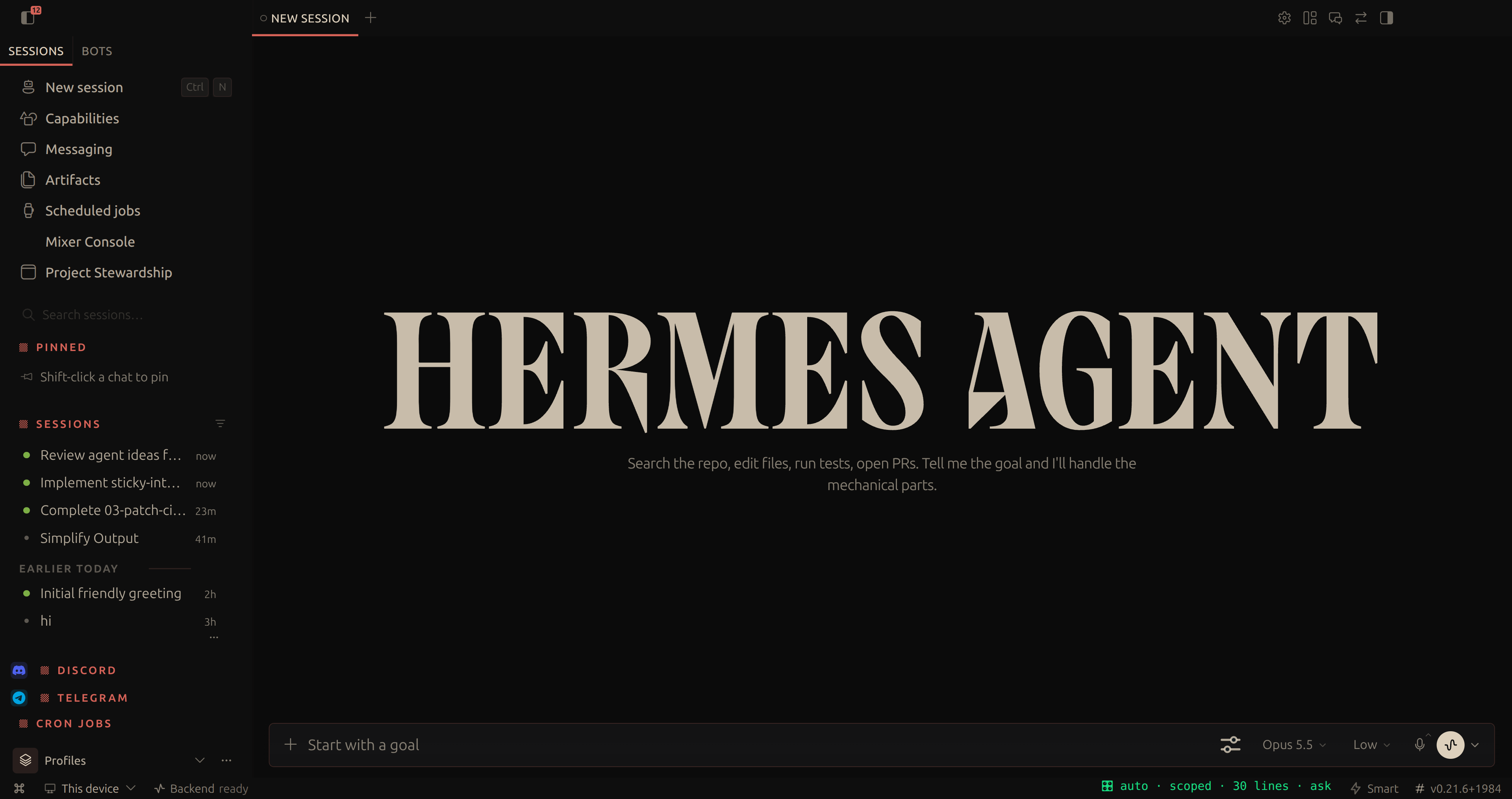
Status pill — the bottom-right pill shows the live dials (auto · unscoped · lines off · ask); clicking it opens the same panel.
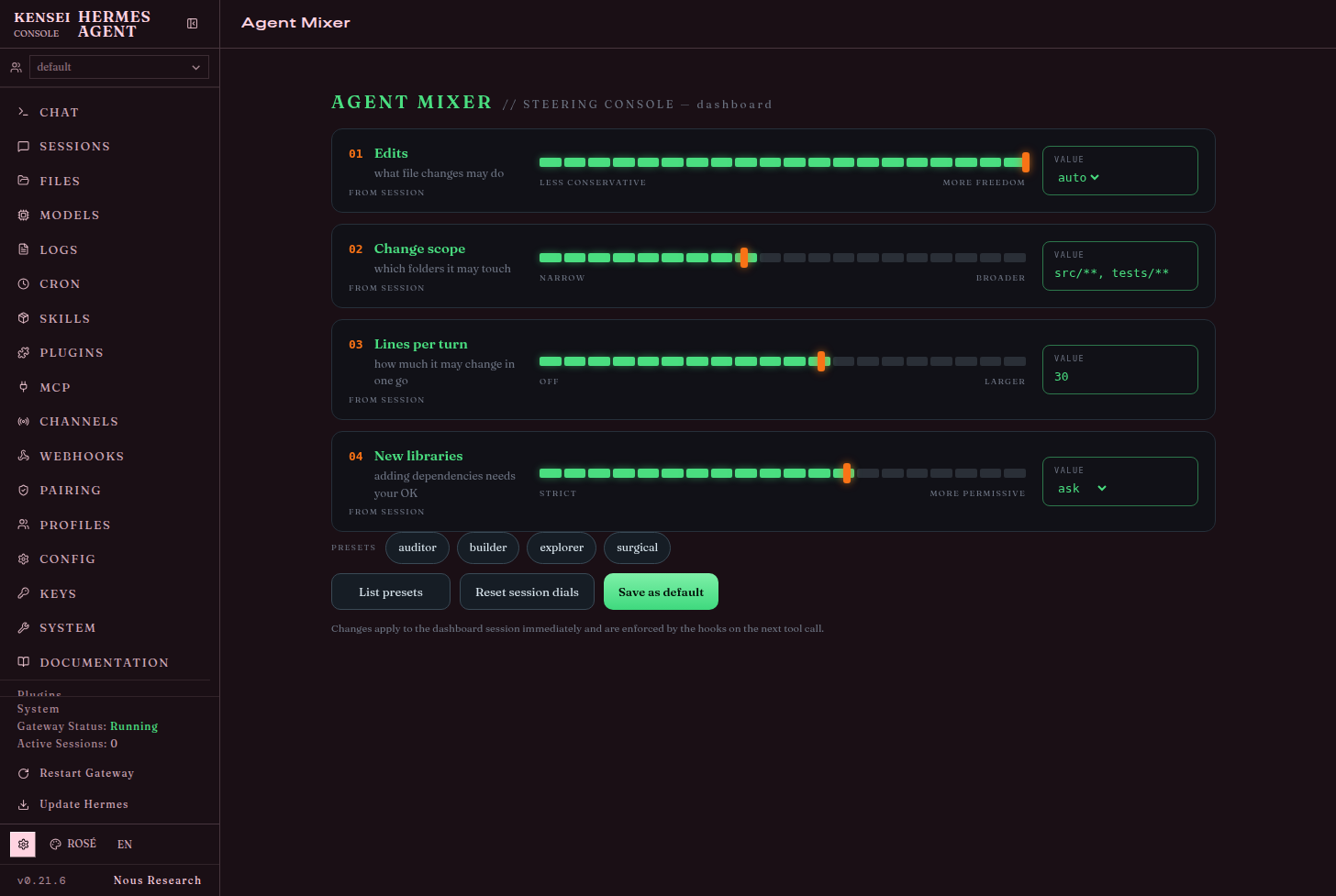
Full console page — the sidebar's Mixer Console row opens the retro steering console:
Web dashboard — the same panel lives under the chat input on the web dashboard (the chat:bottom mixer bar), plus the /agent-mixer tab:
Install
Hermes
With a git checkout (the repo layout is what hermes plugins install clones):
hermes plugins install <owner>/<repo> --enable      # from GitHub
hermes plugins install file:///path/to/hermes-agent-mixer --enable --yes-deps   # from a local clone
- The installer asks about Python dependencies because the repo carries a
pyproject.toml; the runtime uses only the standard library, so answering yes installs nothing extra.--yes-depsanswers that prompt for non-interactive installs. - A bare local path (no
file://) is treated as a GitHub URL. - Verify with
hermes plugins list(showshermes-agent-mixer enabled) andhermes plugins doctor hermes-agent-mixer --ci. - The plugin also declares a pip entry point in the
hermes_agent.pluginsgroup (modulehermes_agent_mixer). That suits an unmanaged Python environment; for a managed Hermes install use the directory-plugin installer so its environment manager admits the plugin.
Claude Code, Codex and Gemini CLI
uv tool install /path/to/hermes-agent-mixer      # or: pip install /path/to/hermes-agent-mixer
agent-mixer install claude                       # prints the plan, writes nothing
agent-mixer install claude --yes                 # merges the hooks into ~/.claude/settings.json
agent-mixer install claude --project --yes       # .claude/settings.local.json for this folder only
agent-mixer install codex --yes                  # ~/.codex/hooks.json
agent-mixer install gemini --yes                 # ~/.gemini/settings.json
agent-mixer doctor                               # what is installed, where settings live, what is wrong
agent-mixer uninstall claude --yes               # removes only Mixer's entries
Installs are idempotent, merge into existing files and keep your own hooks. Hook commands use the absolute path of the agent-mixer executable, so they do not depend on PATH. agent-mixer install claude --settings-json prints the hook JSON for a one-off claude --settings <file> run.
Developer checks
Use disposable HOME, HERMES_HOME and TMPDIR, never your live profile:
uv run --locked pytest -q
bash scripts/sandbox_install_load_check.sh /path/to/evidence
bash scripts/e2e_run.sh /path/to/evidence
The slow tests, the receipts and the native-host test share one cached base Hermes home under MIXER_SANDBOX_CACHE (default $XDG_CACHE_HOME/agent-mixer-tests): tools/, cache/ and installs/ are built once (about 1.6 GB) and symlinked into thin per-run homes. Never move the base home; the managed environments inside it record absolute paths. The native test (tests/native/test_host_contract.py) loads Mixer through the real Hermes plugin loader and runs only when MIXER_NATIVE_PYTHON points at the sandbox Hermes interpreter. The E2E script uses only http://127.0.0.1:8091/v1, model auto.
Commands
| Command | Effect |
|---|---|
/mixer |
Show the board. |
/mixer edits ask|auto|plan |
Set the edits dial for this session. |
/mixer scope add <glob> / remove <glob> / clear / show |
Manage the write-scope glob list. |
/mixer lines <N>|off |
Set the per-turn lines budget (0 also means off). |
/mixer deps allow|ask|block |
Set the dependencies dial. |
/mixer save |
Persist the current set as the saved defaults. |
/mixer save <dial> <value> |
Set one saved default directly, with no session needed (save deps block, save lines 40, save scope src/** docs/**, save scope add <glob>). |
/mixer preset builder|auditor|explorer|surgical |
Apply a named bundle of all four dials at once (preset show lists them). |
/mixer reset |
Drop this session's overrides, back to the saved defaults. |
The same grammar works in a shell, and /mixer typed in any harness is handled by its prompt hook (the change is applied, the prompt is blocked, and the board comes back as the reason, so no model turn is spent):
agent-mixer [--session ID | --saved] <dial> <value>
agent-mixer [--session ID] board
agent-mixer ui [--session ID | --saved] [--port N] [--no-open]
Presets
Four named bundles of all four dials, for the common working modes:
| Preset | edits | scope | lines | deps |
|---|---|---|---|---|
builder |
auto | (no limit) | off | allow |
auditor |
plan (read-only) | (no limit) | off | ask |
explorer |
plan (read-only) | (no limit) | off | allow |
surgical |
auto | src/**, tests/** |
30 | ask |
Apply one with /mixer preset <name> (or agent-mixer --saved preset <name> to make it the default). A preset writes all four dials explicitly — it pins the bundle, it doesn't nudge what differs. preset show lists them; an unknown name changes nothing. Presets are shorthand for the same dial changes, so /mixer reset and the board work exactly as before.
- With
--session IDthe change goes to that session (it need not have been seen yet). With--savedit edits the saved defaults. With neither, it acts on the latest session seen in the current folder and says which; if none has been seen it fails and suggests--saved. - Hermes session overrides and turn budgets live under the host-resolved
$HERMES_HOME/plugin-data/hermes-agent-mixer/sessions/, shared by hooks and panel backend. Saved Hermes defaults are written through the host's namespaced plugin-config facade (including managed-setting guards). CLI harnesses retain their independent$AGENT_MIXER_HOME/ XDG stores. - Saved keys:
edits,scope,lines(an int,0= off; the 0.1 text forms"off"and"50"still load),deps, andextra_write_tools.
Desktop settings
The manifest declares every setting with a label, a description and its type, so Hermes Desktop (Settings, Plugins) shows a real form: edits and deps are dropdowns, lines is a number field, scope and extra_write_tools are lists. An invalid saved edits or deps never weakens a dial: it falls back to ask, is logged, and shows on the board with a warning.
Steering console (Desktop + Dashboard)
The console ships as a unified package: this repo's desktop/plugin.js and dashboard/plugin_api.py load natively into the Desktop app and web dashboard — no browser tab, no separate server.
- Status bar (Desktop): a live pill showing the dials at a glance (
auto · scoped · 30 left · ask). Click it to open the console. - Console page (Desktop + Dashboard): the retro sliders as native app UI, at
Agent Mixerin the sidebar (or/agent-mixer). Panels use the same command grammar as the CLI, but share the Hermes hook store—not the separate CLI-harness store. The dashboard bar/page explicitly edits Hermes saved defaults, not the current chat: these affect sessions without an override on the next tool call. Desktop panel actions bind to the focused chat's durable session id and are enforced by Hermes hooks on the next tool call. Older Desktop hosts without that id refuse panel changes. - Settings ▸ Plugins: the manifest's
config_schemarenders there automatically; saving writes the saved defaults the same wayctx.set_config()does.
Install (unified package): put this repo at ~/.hermes/plugins/hermes-agent-mixer/ (or symlink it), add hermes-agent-mixer to plugins.enabled in config.yaml, then run hermes dashboard and/or the Desktop app. Enable the desktop half in Capabilities → Plugins (it ships off by default, like every desktop half). ctx.rest returning 404 means the backend isn't mounted: check plugins.enabled and restart the gateway.
Steering console (CLI, optional)
agent-mixer ui also serves the console as a local web page — useful over SSH. It binds 127.0.0.1 only, is token-guarded, and changes dials only. --port N (default 8377), --no-open to skip opening a browser.
plugins:
  enabled: [hermes-agent-mixer]
  entries:
    hermes-agent-mixer:
      settings:
        edits: auto
        scope: ["src/**", "tests/**"]
        lines: 0            # 0 = off; or a number such as 200
        deps: ask
        extra_write_tools: ["mcp__fs__write*"]
Knobs
| Dial | Values (default) | Effect |
|---|---|---|
edits |
ask · auto · plan (auto) |
ask: every file change waits for approval. auto: changes go ahead. plan: read-only; see Plan mode. |
scope |
list of globs (default: empty = no restriction) | Writes outside the scope are blocked with a message naming the scope. A relative glob anchors at the workspace root (not the process cwd); an absolute glob (/..., ~/..., a drive path on Windows) matches absolute paths anywhere. Symlinks are resolved before checking. |
lines |
N · 0 (0 = off) |
Most lines changed per turn across file edits, counted from a real diff (added + removed). A call that would go over is blocked, naming what remains. Subagents share their parent's budget. |
deps |
allow · ask · block (ask) |
New dependencies in manifests and install commands. Bumps, removals and reorders pass. |
extra_write_tools |
list of tool-name globs (empty) | Tools such as mcp__fs__write* are treated like write_file, using their path, file_path, filename or target argument. |
What counts as a new dependency:
- Manifest edits that add a name:
package.json(dependencies, devDependencies, peerDependencies, optionalDependencies);pyproject.toml[project] dependencies,optional-dependenciesand[dependency-groups];requirements*.txt;Cargo.toml[dependencies]and[dev-dependencies];go.modrequire. Names are compared before and after the change (on the post-patch text; when that cannot be worked out, the names in the call's old text against its new text). - Install commands in the shell:
npm|pnpm|yarn|bun add|install <pkg>,pip|pip3|uv pip install <pkg>,uv add,poetry add,cargo add,go get. A barenpm install,uv sync,yarn,poetry install,pip install -r ...orgo get ./...restores existing deps and is allowed.
How it decides
Every tool call runs the stages in a fixed order - plan, scope, deps, lines, ask - and the first deny wins. Mixer only restricts: it denies, asks, or says nothing. It never emits "allow", because that would override a harness's own permission prompts.
- File tools (
write_file,patch, Claude CodeWrite/Edit/MultiEdit/NotebookEdit, Codexapply_patch, Geminiwrite_file/replace, plusextra_write_tools): the host resolves the target path; scope checks every target including patch sources and destinations; the deps guard checks every affected manifest; the lines guard counts the real diff. Hard blocks come before any approval, so approving a dependency cannot override a line limit. - Patches the host fuzzy-matches (drifted whitespace and so on) are counted with the host's own matcher when it can be imported, otherwise with an exact-then-line-trimmed match. If no anchor matches, the changed lines are estimated as the larger of the old and new line counts and the call is never blocked just for that; the host reports a bad anchor itself.
- Approval grain:
askuses one rule key per absolute file (mixer:edit:<absolute posix path>) and one per package (mixer:dep:<ecosystem>:<name>), so Hermes' "always" approves that file or package, not every edit forever and not another project. - Shell commands: in
planmode only a read-only allowlist runs. In any other mode, if a scope is set, Mixer reads the write targets it can see - redirects (>,>>),tee,sed -i,cp/mv/ln/installdestinations,touch,rm,rmdir,mkdir,truncate,dd of=- resolves relative ones against the command's cwd, and checks them against the scope. Opaque commands (bash -c "$X",eval, running a script) are allowed. - Rules line: when a dial is off its default, the turn starts with one line (under 300 characters, starting "Agent Mixer:") saying so and asking the model not to work around blocks with terminal or
execute_code. Hermes returns it aspre_llm_callcontext; CLI harnesses add it asadditionalContext. With every dial at its default nothing is injected. Every block message repeats the "don't retry through terminal or execute_code" line and names the/mixerfix. execute_code: blocked in plan mode, otherwise untouched (its writes cannot be scoped statically).- The per-turn counter resets at the turn boundary. Parallel calls reserve budget atomically, and usage is reserved before execution or approval, so a denied or failed call can consume budget until the next turn.
- Failure (CLI harnesses): unreadable hook input exits 2 with the reason on stderr (all three harnesses treat that as blocking). An internal error while any dial is off its default denies, naming the error and
agent-mixer doctor. With every dial at its default Mixer stays silent.
Host modules imported (Hermes)
Everything Hermes-specific lives in hermes_agent_mixer/hermes/host.py. Each import is guarded, and each has a fallback that follows the same order:
| Module | Why | Fallback |
|---|---|---|
gateway.session_context.get_session_env |
The ContextVar-aware reader of HERMES_SESSION_ID and HERMES_SESSION_KEY (the ContextVar if bound, os.environ only when nothing is bound). |
os.environ |
tools.file_tools_paths._resolve_path_for_task, _authoritative_workspace_root |
How the file tools turn a path into a real one, and the workspace root they anchor to (session cwd, registered override, TERMINAL_CWD). |
an absolute, non-sentinel TERMINAL_CWD, then the process cwd |
tools.fuzzy_match.fuzzy_find_and_replace |
The matcher the patch tool applies, to count what a drifted patch really changes. | exact match, then line-trimmed |
No hermes_cli import. Tests may import host internals; a verbatim copy of the upstream modules is vendored in tests/upstream_shim/ (see its NOTICE).
Harnesses
| Harness | Config | Events | Turn | ask |
|---|---|---|---|---|
| Hermes | plugin install | pre_tool_call, pre_llm_call, subagent_start, subagent_stop + /mixer |
per pre_llm_call |
native approval prompt |
| Claude Code | ~/.claude/settings.json (.claude/settings.local.json with --project) + ~/.claude/commands/mixer.md |
PreToolUse, UserPromptSubmit, UserPromptExpansion |
prompt_id |
native ask |
| Codex | ~/.codex/hooks.json |
PreToolUse (Bash, apply_patch, mcp__*), UserPromptSubmit |
turn_id |
becomes deny |
| Gemini CLI | ~/.gemini/settings.json |
BeforeTool, BeforeAgent |
each BeforeAgent |
becomes deny |
- Claude Code (2.1.x, tested live):
agent-mixer install claude --yes. Scope globs anchor at$CLAUDE_PROJECT_DIR.PowerShellis read-only (Get-*,Select-String) in plan mode./mixeris handled in the prompt hook; the command file is only there so the command exists, and tells the user to runagent-mixer doctorif they ever see it. Subagents keep the parent'ssession_id, so they share its dials and budget. - Codex:
agent-mixer install codex --yes, then open/hooksin Codex and trust the new hooks. Trust is keyed to the hook's hash, so reinstalls are byte-stable and a changed hook must be trusted again. Codex treatspermissionDecision: "ask"(andcontinue,stopReason,suppressOutputon PreToolUse) as a failed hook and runs the tool, so Mixer never emits them:askbecomes deny, with a reason saying why and how to change it (agent-mixer edits auto). Codex describes hooks as "a useful guardrail, not a complete enforcement boundary". - Gemini CLI:
agent-mixer install gemini --yes(hook timeouts are in milliseconds).askbecomes deny as for Codex. There is no turn id, so everyBeforeAgentstarts a new turn for that session. stdout is JSON only; Mixer never crashes with a non-2 exit, which Gemini would treat as a warning and fail open. - Contract-tested only: Codex and Gemini CLI are not installed on the machine this was built on. Their adapters are tested against the documented payload and output shapes (
tests/harness/), not against the programs. Claude Code is exercised live (see the evidence in the run report).
Sessions and subagents
- Hermes hooks use the hook's own
session_id; they never read environment variables or ContextVars for it. /mixeron the classic CLI takesHERMES_SESSION_IDfrom the ContextVar-aware reader, which falls back toos.environ(the CLI publishes the id there) only when nothing is bound.- TUI and Desktop bind both the chat key and the session id;
/mixerapplies to that session. - Messaging gateway binds the chat key and an empty session id.
/mixertakes the key, maps it to a session through the key-to-session pairs recorded atpre_llm_call, and if that chat has not had a turn yet, parks the change under the key and applies it at that chat's next turn. The reply names only this chat's key or session, never another's. - Nothing bound (for example
api_server):/mixerchanges nothing, says it cannot tell which chat this is, and points to/mixer save <dial> <value>and the plugin settings. - Subagents:
subagent_startlinks the child to its parent; a child whosepre_llm_callnamesparent_session_idis linked too. Children read the parent's effective dials live (not a copy), draw from the parent's current-turn line budget, never reset it, and grandchildren resolve to the root session.subagent_stopunlinks the child. - Clean-up: Hermes drops session state idle for more than 24 hours and keeps at most 1,000 sessions. The CLI store drops state idle for more than 7 days.
- CLI harnesses: every hook is a separate process, so state is one file per session under the state directory, guarded by one store-wide lock (
fcntl.flockon the fixed file<state dir>/.lock,msvcrt.lockingon Windows). A hook waits up to 5 seconds for it, then fails closed. Files are written by atomic replace, so parallel tool calls never lose an update.
Not a sandbox
Mixer sees tool calls, not system calls. A terminal command, a script or a subprocess can still write anywhere it is not parsed: bash -c "$X", eval, running a script, a build step. Shell write-target checking is best effort on commands it can read. execute_code can write anything. The deps guard watches the listed manifests and install commands only, so copying a requirements file, vendoring, or an install helper it does not recognise will pass. The lines budget counts the calls Mixer can see, not total repository churn. For hard isolation use a container backend or an OS sandbox.
Plan mode
/mixer edits plan is a tool-level gate, not a prompt convention. File tools and execute_code are blocked outright and the shell is limited to a read-only allowlist with argument checks:
- General:
ls,cat,head,tail,wc,grep,rg,find(without-delete,-exec,-execdir,-ok,-fprint*),sed -n(now,W,e, no-i),sort(no-o),uniq(at most one file),cut,diff,cmp,stat,du,df,file,jq,echo,printf,basename,dirname,realpath,cd. - Git, read-only forms:
status,log,diff,show,grep,ls-files,ls-tree,blame,describe,shortlog,remote -v,config --get,tag -l,branch(listing only). - Allowed redirects:
>/dev/null,2>/dev/null,2>&1.$inside quotes is fine;$(...), backticks, process substitution, heredocs, subshells and other redirects are not. - Interpreters stay blocked, including
pytest --collect-only, because they run project code. - Claude Code's
PowerShelltool:Get-*cmdlets andSelect-Stringonly.
To leave plan mode: /mixer edits auto (or ask), or /mixer reset. A /yolo or approvals.mode: off Hermes session bypasses Mixer's ask approvals (the approve directive runs through Hermes' gate, which yolo skips); plan blocks still apply because they are deny directives.
Changelog
0.2.0
Fixes (IDs refer to the review in the 02b handoff):
- B1 The messaging gateway no longer locks the wrong chat:
/mixeridentifies the chat from its bound key and the session recorded for it at turn start, parks a change that arrives before the first turn, and never falls back toos.environonce a ContextVar is bound. - B2 Subagents no longer escape the dials: they inherit the parent's live dials and share its per-turn line budget (
subagent_start/subagent_stop,parent_session_id). - B3 The "project root" is no longer the process cwd. An empty scope means no restriction; relative globs anchor at the host's workspace root; absolute globs match anywhere. Defaults no longer block
/tmp, scratch or gateway project writes. - B4 Drifted patch anchors are counted with the host's fuzzy matcher (or an exact-then-line-trimmed fallback) and are never blocked just because the anchor was not found; manifest patches compare dependency names before and after, so only new names trigger
deps. - B5 Windows paths: no more blanket rejection. Windows hosts use
ntpathsemantics and case-insensitive matching; on POSIXC:\xis an ordinary relative file name. (A Windows CI job waits for the public repo.) - B6 "Always" no longer approves everything forever: rule keys are per absolute file and per package.
- B7 A saved typo can no longer weaken a dial: invalid
edits/depsfall back toask, are logged and show on the board. The settings form has dropdowns, labels and an intlines. - B8 Plan mode allows everyday read-only commands (29 of 39 were blocked before) and still blocks anything that writes or runs project code.
- B9 The terminal /
execute_codegap is narrowed (best effort, documented): rules line, block messages, shell write targets. - QW1 Manifest v2 with tags, labels and descriptions, dropdowns, an int
lines, the new hooks inprovides_hooksand anargs_hinton/mixer. - QW2 A rules line of under 300 characters is injected only when a dial is off its default.
- QW3 Every block message says not to retry through terminal or
execute_code, and names the/mixerfix. - QW4, QW5 The finer "always" grain (B6) and the wider plan-mode allowlist (B8).
- QW6 The board labels each value as session, saved or default, shows lines left this turn, and flags invalid saved values.
- QW7
extra_write_toolstreats chosen MCP tools likewrite_file. - QW8 Best-effort shell write targets are checked against the scope.
- QW9 Absolute scope globs, so a scope set from Discord means something.
- QW10
/mixer save <dial> <value>sets a saved default directly. - QW11 Idle sessions are pruned (24 hours, at most 1,000, on Hermes).
- P1 No
hermes_cliimport; every host import is guarded and lives inhermes/host.py. - P2 One cached sandbox Hermes home serves every slow lane.
New:
- X1 The engine moved to
core/, the Hermes adapter tohermes/, harness payload mapping toharness/. - X2 The
agent-mixerCLI. - X3 A file-backed session store with one lock, so parallel hook calls never lose an update.
- X4, X5, X6 Claude Code, Codex and Gemini CLI hook adapters (Codex and Gemini contract-tested only;
askbecomes deny there). - X7
agent-mixer install,uninstallanddoctor. - X8 Steering console: native in the Desktop app and web dashboard (
desktop/plugin.js+dashboard/plugin_api.py, status-bar pill +/agent-mixerpage + sidebar row over/api/plugins/agent-mixer/), plus the optional localagent-mixer uiweb helper (loopback-only, token-guarded). - X9 Presets:
/mixer preset builder|auditor|explorer|surgicalapplies a named bundle of all four dials through the same target path (preset showlists them; unknown names change nothing).
Compatibility: the /mixer grammar and the saved-setting keys are unchanged; saved 0.1 configs (including text lines) keep working.
0.1.0
First release: the edits, scope, lines and deps dials for Hermes, enforced in pre_tool_call, with /mixer, a board and plan mode.