atostivint
hermes-compute-priority
A Hermes plugin that keeps the process serving your connection ahead of the processes running your
agents.
The problem it solves
Hermes can run agent turns in a child process (dashboard.turn_isolation). That child is where the
GIL is held while a turn parses a model stream or dispatches tools. The process that answers your
Desktop's WebSocket is its parent.
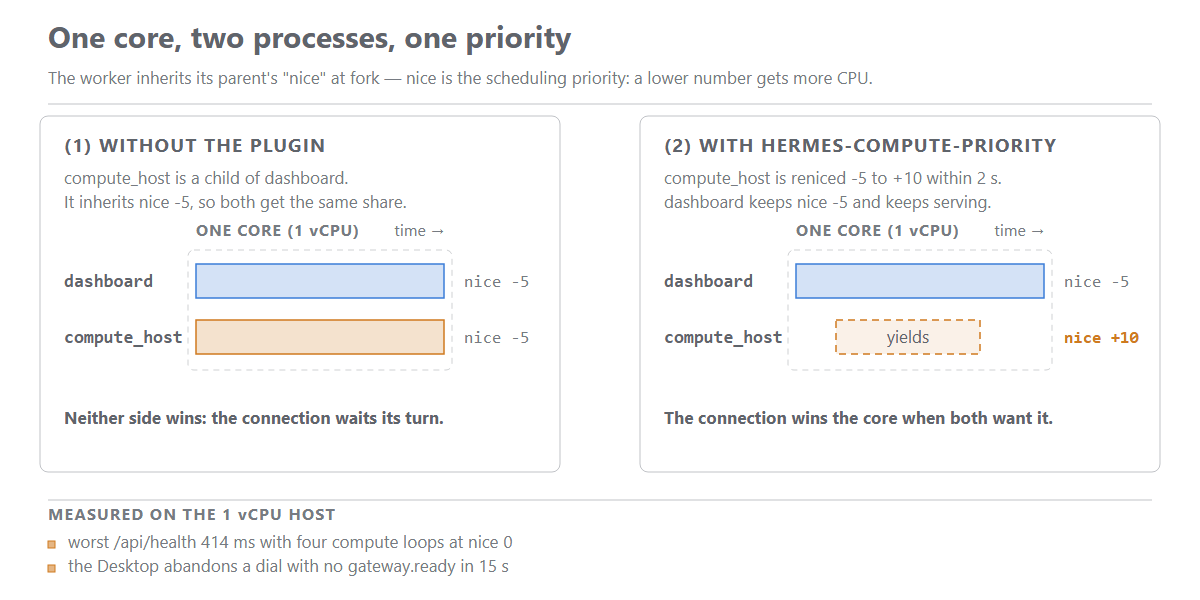
On a small machine, the parent must win — and configuration alone cannot make it:
| Knob | What it arbitrates | Why it is not enough |
|---|---|---|
CPUWeight (systemd) | between units | the child lives in the parent's cgroup, so it gets the same share |
Nice (systemd) | between processes | niceness is inherited at fork/exec: the child starts at the parent's nice and stays there |
Measured on a 1 vCPU host, five dashboard processes across two generations: all at -5. The parent
had no priority over its own worker.
So the worker's niceness has to be raised after it starts. That needs no privilege — lowering a
process's priority of a process you own is always allowed — and it can never make anything more
urgent than it already was.
What it does
Every two seconds, in the Hermes process that loaded it:
- finds processes owned by the same user whose command line contains
tui_gateway.compute_host(howtui_gateway/host_supervisor.pyspawns a turn worker) — by
reading/procon Linux, and by askingpsutilon macOS and Windows; - lowers their priority to
+10, skipping any worker already at or below that value; - logs one line per worker, once.
It does nothing else. On a host where turn isolation is off, no worker of that shape exists, so the
plugin is a no-op.
How scheduling priority works
Priority makes nothing faster: it decides who yields when two processes want the same core. POSIX
calls that number nice — -20 to 19, a larger value meaning less CPU — and Windows uses a
per-process priority class instead, which the plugin maps explicitly. The catch is inheritance: a
child starts at its parent's nice, so a systemd unit cannot separate the two, and the child has to be
lowered after it starts. How scheduling priorities work covers the two layers
(cgroup CPUWeight between units, nice between processes), which operation needs a privilege on each
platform, and what this plugin deliberately leaves alone.
What it does not do
- It does not speed up turns: work handed to a worker still costs the same CPU, it just yields
first. - It does not help sessions whose agent was built in-process (they never use a worker, so there
is no separate process to deprioritise). - It is not a resource limit. If you want a hard ceiling on a whole process tree, use cgroup
CPUQuotain the unit — this plugin is about ordering, not capping.
Install
hermes plugins install https://github.com/atostivint/hermes-compute-priority
hermes plugins enable hermes-compute-priority
Or copy the directory into <HERMES_HOME>/plugins/hermes-compute-priority/, run
hermes plugins enable hermes-compute-priority, and restart the gateway.
install only offers to enable — it prompts, and a non-interactive run (CI, Docker, a piped
script) leaves the plugin disabled. Hermes imports a user plugin's backend only when the plugin is
listed in plugins.enabled, so the enable line is a required step, not a confirmation.
The backend is reached through the dashboard, so the directory has to keep
dashboard/manifest.json next to dashboard/plugin_api.py. The manifest is what tells the
dashboard to import that file and mount its router at /api/plugins/hermes-compute-priority/;
without it Hermes skips the plugin silently and the status route below does not exist at all.
tests/test_dashboard_manifest.py fails if the manifest disappears or if its version drifts
from plugin.yaml's.
The root __init__.py exists only to satisfy the plugin loader's shape check — a directory plugin
is "a plugin.yaml and an __init__.py exposing register(ctx)", and Hermes logs
Failed to load plugin 'hermes-compute-priority' in logs/errors.log without it — and it
registers nothing: the loop is started by the dashboard loader, never by this file.
The plugin works on Linux, macOS and Windows; see Platforms for what each one does
and for the psutil requirement on macOS and Windows.
Platforms
One contract, three backends (platform_backend.py). The observable behaviour is the same
everywhere: the turn workers of the current user are found by command line and lowered, once, with
no privilege and never in the other direction.
| Platform | Enumeration | Priority | Extra dependency |
|---|---|---|---|
| Linux | /proc/<pid>/cmdline, st_uid for ownership | os.setpriority (0–19 niceness) | none |
| macOS | psutil.Process.cmdline() | psutil.Process.nice(10) (0–19 niceness) | psutil |
| Windows | psutil.Process.cmdline() | psutil.Process.nice(<priority class>) | psutil |
psutil is already a core hermes-agent dependency, so on those two platforms it is normally
present. It stays optional for this plugin: with no psutil on macOS or Windows the plugin
loads, enumerates nothing, changes nothing, and says so:
{"ok": true, "enabled": false, "backend": "psutil-win32", "platform": "win32",
 "available": false, "reason": "psutil is not installed, so processes cannot be enumerated on this platform; install it with `pip install psutil` …"}
enabled: false plus a reason is the whole point: a plugin that cannot see processes must not
report a scan loop that is running fine.
Windows: niceness has no 0–19 scale
On Windows nice() reads and writes a priority class, not a number between 0 and 19. The
translation is an explicit table, not arithmetic, because it is a policy choice:
| Target niceness | Windows priority class | Meaning |
|---|---|---|
15–19 | IDLE_PRIORITY_CLASS | the lowest class Windows offers |
5–14 | BELOW_NORMAL_PRIORITY_CLASS | clearly behind the serving process |
0–4 | (no action) | NORMAL is the floor the plugin is allowed to ask for |
A target below 5 does nothing on purpose. The only classes left are NORMAL_PRIORITY_CLASS (the
ordinary priority — i.e. no change at all) and classes above NORMAL, which would make a process
more urgent than the default. This plugin only ever lowers a priority, so anything under 5 is
refused rather than approximated; /status reports it in a note field when you configure such a
target. The default of 10 lands on BELOW_NORMAL_PRIORITY_CLASS.
Reading a class back for the idempotence check is coarse but safe: IDLE reads as 19,
BELOW_NORMAL as 10, and anything at or above NORMAL as 0 — low enough that a worker which
somehow outranks NORMAL still gets lowered, never raised. An unrecognised class is skipped.
Same user, on a platform without uids()
psutil.Process.uids() is POSIX-only. Where it is missing, the candidate's
psutil.Process.username() is compared with this process's own (case-insensitively on Windows,
where account names are case-insensitive). A user name that cannot be read — or our own — means
the candidate is skipped, not guessed at: not knowing who owns a process is not a licence to
lower its priority.
Settings
Environment, read once when the backend is imported:
| Variable | Default | Meaning |
|---|---|---|
HERMES_COMPUTE_PRIORITY | 1 | 0 disables the scan entirely |
HERMES_COMPUTE_PRIORITY_NICE | 10 | target priority for workers: niceness 0–19 (19 is the lowest) on Linux and macOS, translated to a priority class on Windows (see Platforms; 5–14 = below normal, 15–19 = idle) |
HERMES_COMPUTE_PRIORITY_INTERVAL_S | 2.0 | seconds between scans |
HERMES_COMPUTE_PRIORITY_RULES | (empty) | opt-in extra process classes, see below |
Extra rules — off by default
The plugin knows exactly one class of process until you tell it about others. That is deliberate: a
published plugin must not start deprioritising parts of someone else's Hermes without being asked.
HERMES_COMPUTE_PRIORITY_RULES='[
  {"name": "mcp",         "match": "mcp-server",              "nice": 15},
  {"name": "plugin-host", "match": "hermes_cli.plugin_host_child", "nice": 8}
]'
Each rule is:
| Field | Meaning |
|---|---|
name | a label, for the log line and the status route |
match | a plain substring of the command line, at least 3 characters — the only stable handle a plugin has, since it may not hook core code |
nice | target niceness, 0–19 (on Windows: 5–14 = below normal, 15–19 = idle, below 5 = no action) |
A match shorter than three characters is refused. "a" would hit most command lines on the
machine, and a typo must not renice half the box.
Rules are evaluated in order, and the first match wins. A process already at or below its target
is skipped, so a rule can never make anything more urgent — and a nice below 0 is rejected at
parse time, because raising a priority needs a privilege this plugin does not want.
Anything invalid in the list is dropped silently rather than raising: a typo in an optional feature
must not take down the loop that protects the connection.
Per-process configuration
The plugin runs inside each Hermes process, so "per process" is simply "per unit":
# hermes-dashboard.service.d/10-scheduling.conf
Environment=HERMES_COMPUTE_PRIORITY_NICE=15

# hermes-gateway.service.d/10-scheduling.conf
Environment=HERMES_COMPUTE_PRIORITY_NICE=5
Only the process that actually spawns a worker benefits: today that is the one serving sessions
(the dashboard). Configuring a unit that never isolates turns is harmless and inert.
Verify it works
# before a turn that uses an isolated session  (Linux; on macOS: ps -o pid,ppid,ni,command -A)
ps -o pid,ppid,ni,args -C python3 | grep compute_host
# Windows: the class is what moves, not a 0-19 number
Get-CimInstance Win32_Process -Filter "Name = 'python.exe'" |
  Where-Object { $_.CommandLine -like '*tui_gateway.compute_host*' } |
  ForEach-Object { Get-Process -Id $_.ProcessId | Select-Object Id, PriorityClass }
# -> BelowNormal by default (Idle for a target of 15 or more)
The worker should move within a couple of seconds of starting, while the serving process keeps its
own value. The plugin also answers a read-only route:
# the deployment's session token, or a Bearer token from the auth flow
curl -H "X-Hermes-Session-Token: $HERMES_DASHBOARD_SESSION_TOKEN" \
  http://127.0.0.1:<dashboard port>/api/plugins/hermes-compute-priority/status
which reports the target, the scan count, the workers deprioritised so far, the backend in use
(procfs, psutil-posix, psutil-win32) and the last error if any. On a platform where the
backend cannot run, it answers {"enabled": false, "reason": …} — read that field before assuming
a plugin that loaded is a plugin that works.
The route sits behind the dashboard's auth gate: nothing under /api/plugins/ is on the public
allowlist, so a credential-less request gets 401 {"error": "unauthenticated", "detail": "Unauthorized", ...} from the gate and never reaches the plugin — a 401 therefore says nothing
about whether the plugin loaded. dashboard.basic_auth is a form provider (the password is
POSTed to /auth/password-login); there is no HTTP Basic, so curl -u with that username and
password does not authenticate anything. The gate only reads Authorization: Bearer <token>, a
session cookie, or X-Hermes-Session-Token, and on /api/* it always answers with the 401 JSON
above — never a redirect.
Two proofs need no credentials at all:
# one line per worker reniced, from the plugin's own file log. The dashboard process installs
# file handlers only and runs uvicorn with log_config=None, so nothing of this reaches the journal.
grep compute-priority /var/lib/hermes-agent/.hermes/logs/agent.log

# the plugin's scan thread, inside the serving process. comm is truncated to 15 characters,
# so "compute-priority" (16) shows up as "compute-priorit".
grep -l compute-priorit /proc/$(systemctl show -p MainPID --value hermes-dashboard)/task/*/comm
If both are empty while turn isolation is on, check hermes plugins list first — a plugin that is
installed but not enabled never has its backend imported.
Disclosure
Written the way the Hermes plugin catalog expects:
- Network: none. The plugin opens no socket and contacts nothing.
- Files: on Linux, reads
/proc/<pid>/cmdlineand/proc/<pid>/ownership for processes of
the same user. On macOS and Windows, enumeration goes throughpsutil, which reads process
metadata from the OS. Reads nothing in your home directory and writes no file. - Processes: lowers the priority of processes it has already matched and that belong to the
same user —os.setpriorityon Linux and macOS,SetPriorityClassviapsutilon Windows. It
never raises a priority, never signals, stops or kills anything, and it skips its own pid. - Threads: one daemon thread inside the Hermes process that loaded it, started at import and
stopped when that process exits. - Credentials: none read, none stored.
- Telemetry: none.
Limitations, stated plainly
- Polling, not hooking. The delay between a worker starting and being deprioritised is up to one
interval. Hooking the spawn would be exact, but that is core code: a plugin may only use the
published plugin API. - Detection by command line. If upstream renames the module, the match breaks — loudly in the
status route (applied_totalstops moving), silently otherwise. - One process. The plugin acts inside the process that loaded it. If your dashboard and gateway
are separate units, install it on the one that spawns the workers. - Windows granularity. Three priority classes are coarse next to 20 niceness levels: a target of
6and one of13are the sameBELOW_NORMAL_PRIORITY_CLASS. The direction is always right; the
step is wider. psutilon macOS and Windows. Without it there is no enumeration, so the plugin stays idle
and reports why. Linux never needs it.
The better fix, upstream
subprocess.Popen(..., preexec_fn=...) or a nice= argument in
tui_gateway/host_supervisor.py would make this exact, in one line, without a polling thread (on
Windows the same spawn takes creationflags= with a priority class). This plugin exists because
that line is not there yet.
License
MIT — see LICENSE.
README from the reviewed commit 2a1cc9a; it updates when the author re-pins.