All plugins

timestamp-ref

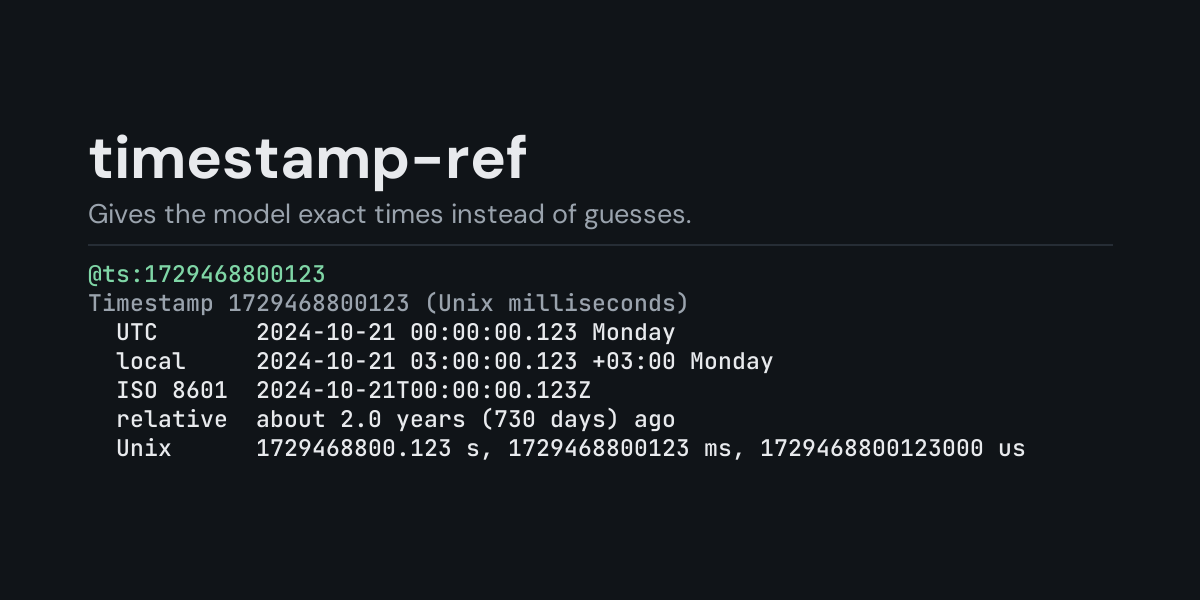
@ts: context references that turn timestamps into readable times for the model: @ts:1729468800123 attaches the moment in UTC, in the local time zone and as ISO 8601, with its weekday, how long ago or ahead it is, the same moment in Unix seconds, milliseconds and microseconds, and its ISO week; bare numbers are read as seconds, milliseconds, microseconds or nanoseconds by their length (or an s/ms/us/ns suffix) and the block says which; ISO 8601 and RFC 2822 dates and now work too, and up to 10 values in one reference also get the gaps between them; the TUI and Desktop composer preview a value as you type it. Disclosure — reads only the text of the reference itself and the system clock, using Python's datetime; no network, no files read or written, no subprocess, no credentials; register() only adds the @ts: reference provider

olric3015Toolsv1.0.0Updated 29 days ago

About

@ts: context references that turn timestamps into readable times for the model: @ts:1729468800123 attaches the moment in UTC, in the local time zone and as ISO 8601, with its weekday, how long ago or ahead it is, the same moment in Unix seconds, milliseconds and microseconds, and its ISO week; bare numbers are read as seconds, milliseconds, microseconds or nanoseconds by their length (or an s/ms/us/ns suffix) and the block says which; ISO 8601 and RFC 2822 dates and now work too, and up to 10 values in one reference also get the gaps between them; the TUI and Desktop composer preview a value as you type it. Disclosure — reads only the text of the reference itself and the system clock, using Python's datetime; no network, no files read or written, no subprocess, no credentials; register() only adds the @ts: reference provider

timestamp-ref

@ts: references for Hermes: put @ts:1729468800123 in a message and Hermes replaces it with
the moment that number stands for, worked out on your machine: UTC, your local time, ISO 8601,
the weekday, how long ago (or how far ahead) it is, and the same moment in Unix seconds,
milliseconds and microseconds. Written dates work too (@ts:2024-10-21T09:00:00+03:00,
@ts:"Mon, 21 Oct 2024 03:00:00 +0300"), and several values in one reference also get the
gaps between them.

Logs, databases, API responses and JWTs are full of Unix timestamps, and a model converting
1729468800123 to a date in its head gets the unit, the day or the time zone wrong often
enough to matter. With @ts: it gets the conversion already done, exactly, together with which
unit the number was read in.

Install

hermes plugins install timestamp-ref --enable

Requires Hermes 0.21.5 or newer. No API key, no configuration, no dependencies.

Use

@ts:1729468800                 Unix seconds (10 digits)
@ts:1729468800123              milliseconds (13 digits), microseconds (16), nanoseconds (19)
@ts:1729468800ms               a suffix (s, ms, us, ns) chooses the unit
@ts:2024-10-21T09:00:00+03:00  ISO 8601; without an offset the value is read as UTC
@ts:"Mon, 21 Oct 2024 03:00:00 +0300"   RFC 2822 (HTTP and mail headers), in quotes
@ts:now                        the current time
@ts:1729468800,1729555200.5    up to 10 values, plus the gaps between them

A bare number is read by its length: up to 11 digits are seconds (that reaches the year 5138),
12-14 milliseconds, 15-17 microseconds and longer ones nanoseconds. The block always says which
unit it used. Negative numbers are before 1970; fractions and _ digit separators are fine.
Values with spaces go in quotes (", ' or a backtick); Hermes reads a reference up to the end
of the line.

Example, from the end-to-end test (one-shot hermes chat turns run on 2026-10-21 on a machine
set to UTC+3). The message When did this job start? @ts:1729468800123 reaches the model as the
message followed by:

Timestamp 1729468800123 (Unix milliseconds)
  note: read as milliseconds from its 13 digits; add s, ms, us or ns to choose
  UTC       2024-10-21 00:00:00.123 Monday
  local     2024-10-21 03:00:00.123 +03:00 Monday
  ISO 8601  2024-10-21T00:00:00.123Z
  relative  about 2.0 years (729 days) ago
  Unix      1729468800.123 s, 1729468800123 ms, 1729468800123000 us
  calendar  day 295 of 2024, ISO week 2024-W43

A written date with an offset also shows the time as written. From the same run,
@ts:2024-10-21T00:00:00+03:00:

Timestamp 2024-10-21T00:00:00+03:00 (ISO 8601)
  as written  2024-10-21 00:00:00 +03:00 Monday
  UTC         2024-10-20 21:00:00 Sunday
  local       2024-10-21 00:00:00 +03:00 Monday
  ISO 8601    2024-10-20T21:00:00Z
  relative    about 2.0 years (730 days) ago
  Unix        1729458000 s, 1729458000000 ms, 1729458000000000 us
  calendar    day 294 of 2024, ISO week 2024-W42

and @ts:1729468800,1729555200.5 ends with:

Differences:
  1 -> 2: +1 day (+86,400.5 s)
  • local is the time zone of the computer Hermes runs on. Where the system cannot convert a
    date (Windows refuses dates before 1970) the row says so instead.
  • relative is counted from the moment the message is sent, in at most two units ("3 days 4
    hours ago"), or in years past 365 days.
  • Times are exact to the microsecond; a nanosecond value says when it drops the rest.

Suggestions

In the TUI and the desktop app, typing @ts: suggests now and the current Unix time, and
@ts: followed by a value previews it (@ts:1729468800123 shows 1729468800123 = 2024-10-21 00:00:00.123 UTC). The classic CLI does not show reference suggestions.

Security and footprint

  • register() only registers one context reference provider (@ts:).
  • It reads nothing but the text of the reference itself and the system clock, and only when you
    write @ts: in a message.
  • No network access, no subprocesses, no downloads, no credentials read, no files read or
    written.
  • Standard library only (datetime, email.utils).

Development

python -m pytest tests                                              # unit tests, no Hermes needed
PYTHONPATH=<hermes checkout> python tests/e2e/timestamp_ref_e2e.py   # real hermes chat turns and TUI suggestions
hermes plugins validate timestamp-ref

Changes

  • 1.0.0: first release.

MIT licensed.

README from the reviewed commit 241fccb; it updates when the author re-pins.
More by olric3015

18 plugins by olric3015 in the catalog.

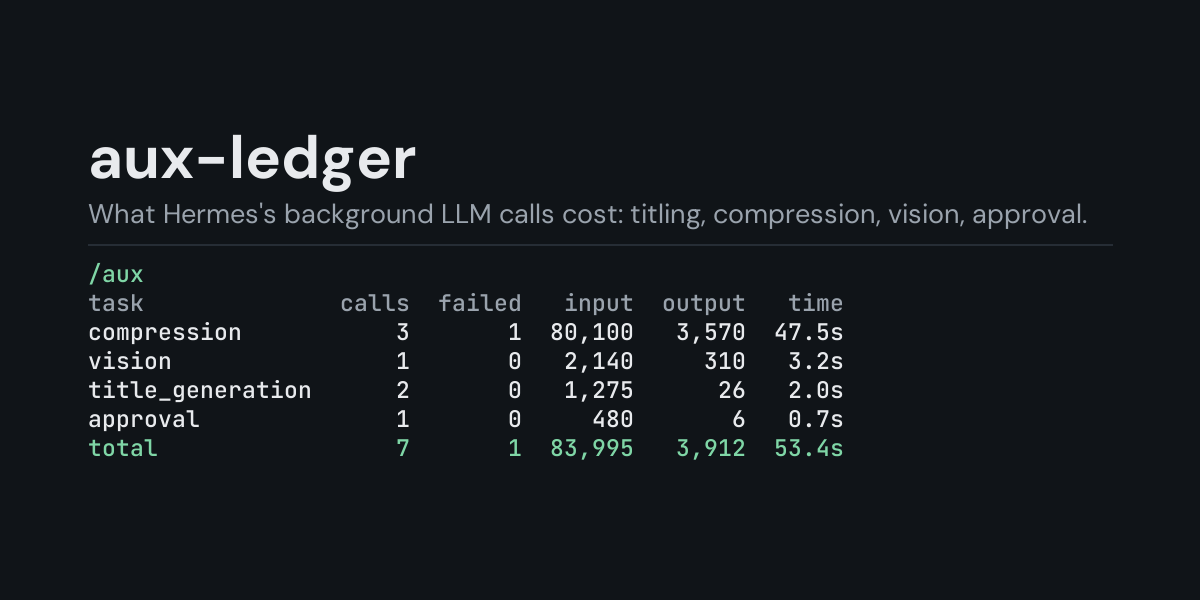
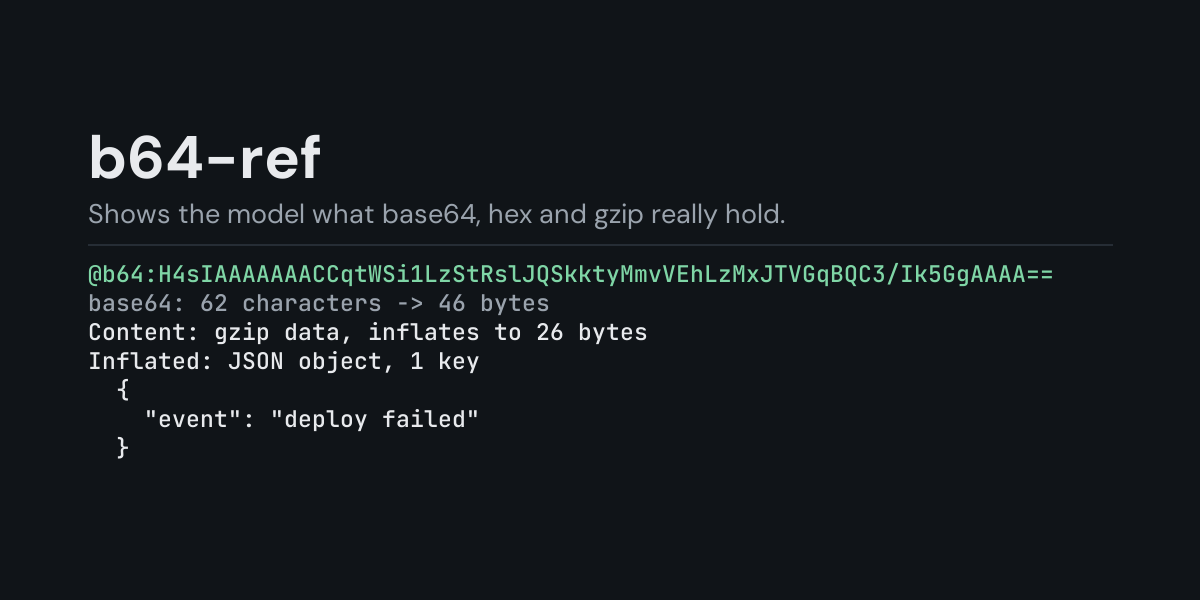
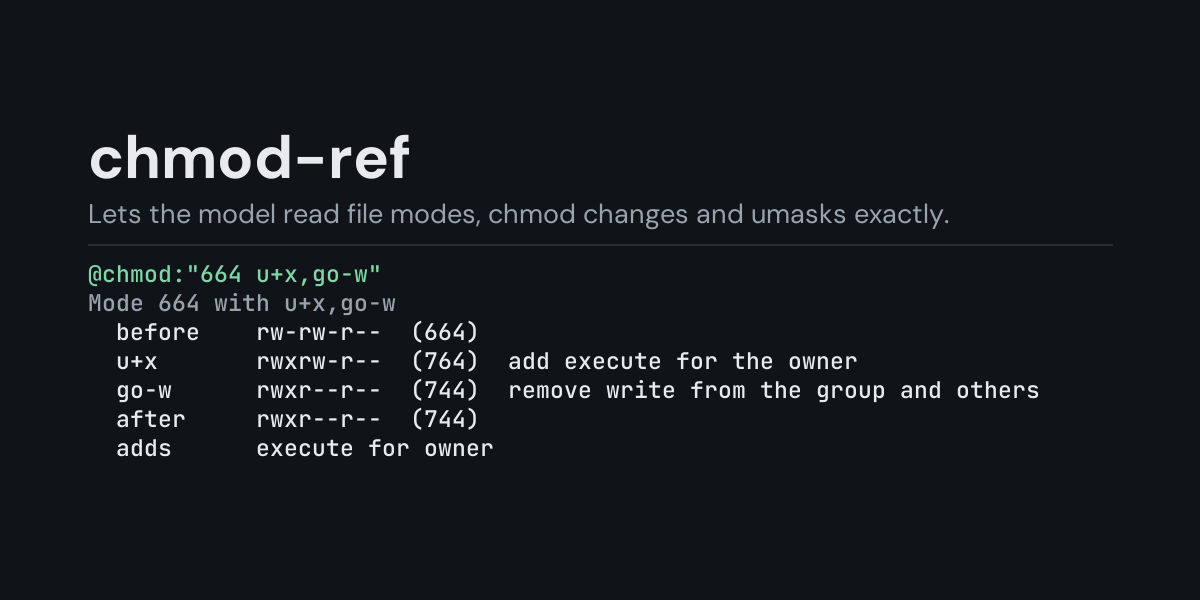
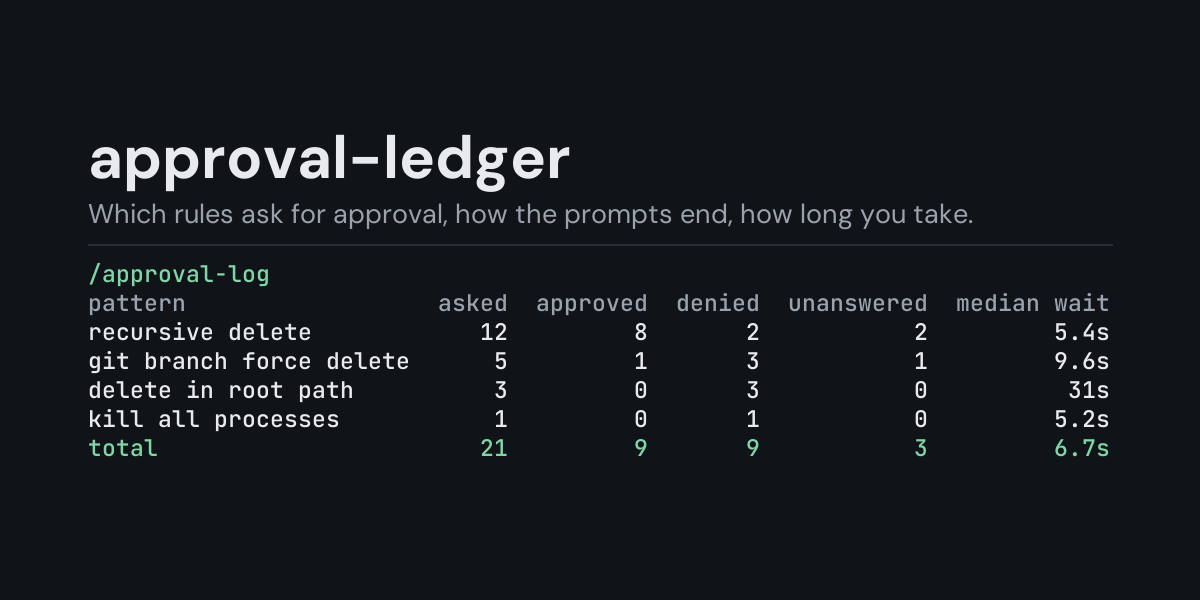
olric3015approval-ledgerLocal ledger of Hermes's approval prompts (dangerous commands, protected writes, MCP consent, smart-mode verdicts): /approval-log shows how often each rule asked, how many prompts were approved, denied or left unanswered, and how long a person took to answer, per rule, per surface or per day, for the last 24 hours, any number of hours or days, the latest session or everything recorded; /approval-log recent lists the newest decisions (ten, or up to 100 with /approval-log recent 50). Disclosure — writes decision metadata (session id, surface, rule label, answer, timings; no command, description or session key) to plugin-data/approval-ledger/approvals.jsonl, trimmed to 5,000 rows past 2 MB; observer only, cannot answer or change an approval; no networkCommunitytoolsolric3015aux-ledgerLocal ledger of Hermes's auxiliary LLM calls (titling, compression, vision, approval): /aux shows tokens, time and failures per task, model, provider or day, or lists the newest calls (ten, or up to 100 with /aux recent 50), for the last 24 hours, any number of hours or days, the latest session or everything recorded. Disclosure — writes auxiliary-call metadata (ids, models, timings, token counts, no prompt or response text) to plugin-data/aux-ledger/calls.jsonl, trimmed to 5,000 rows past 2 MB; no networkCommunitytoolsolric3015b64-ref@b64: context references that decode encoded text for the model: @b64:<value> takes base64 (standard or URL-safe, padded or not), hex (0x48656c6c6f, 48:65:6c, \x48\x65), percent-encoding or a data: URI, told apart by the value's shape or picked with base64:, base64url:, hex: or url:, and attaches what it holds: text as text with control and invisible characters escaped, JSON pretty-printed, gzip and zlib inflated in memory (at most 1 MiB, one layer), and binary named by its format (PNG and GIF with their size, JPEG, PDF, ZIP, ELF, SQLite and more) with a hex dump of its first 128 bytes; notes point out a value that was cut short, padding that is off, a second layer of encoding and a JWT inside; the TUI and Desktop composer preview a value as you type it. Disclosure — reads only the text of the reference itself, using Python's base64, json, urllib.parse and zlib; nothing decoded is run, opened or saved; no network, no files read or written, no subprocess, no credentials read; the plugin keeps no copy of what it decodes, but the @b64: reference and the decoded contents become part of the message sent to your model provider and saved in the session history, so decode only values you are willing to share with it; register() only adds the @b64: reference provider.Communitytoolsolric3015chmod-ref@chmod: context references that explain a file permission mode for the model: @chmod:<mode> takes an octal mode (755, 0755, 4755), ls -l text (-rwsr-xr-x, with the file type letter and a trailing + . or @) or an st_mode as stat and git write it (100644), and attaches both forms, each class's rights in words (directory rights named as such), what setuid, setgid and the sticky bit do and where they are ignored, and notes such as a mode everyone can change, one private to the owner, or a class holding rights the class before it lacks; @chmod:"644 u+x,go-w" applies a symbolic change step by step the way GNU chmod does (u g o a, + - =, r w x X s t, copies like u=g), @chmod:"100644 100755" shows what changes between two modes, and @chmod:"umask 027" shows what new files and directories get; the TUI and Desktop composer preview a mode as you type it. Disclosure — reads only the text of the reference itself, using Python's re; it never looks at a file on disk; no network, no files read or written, no permission changed, no subprocess, no credentials read; the plugin keeps no copy of what you write, but the @chmod: reference and the explanation become part of the message sent to your model provider and saved in the session history; register() only adds the @chmod: reference provider.Communitytools

Developer Mode

Explore built-in Hermes toolsets and actions.

HermesAgent

Developer?

Create a Hermes extension for Desktop or agent workflows.

Developer Section