All plugins

unicode-ref

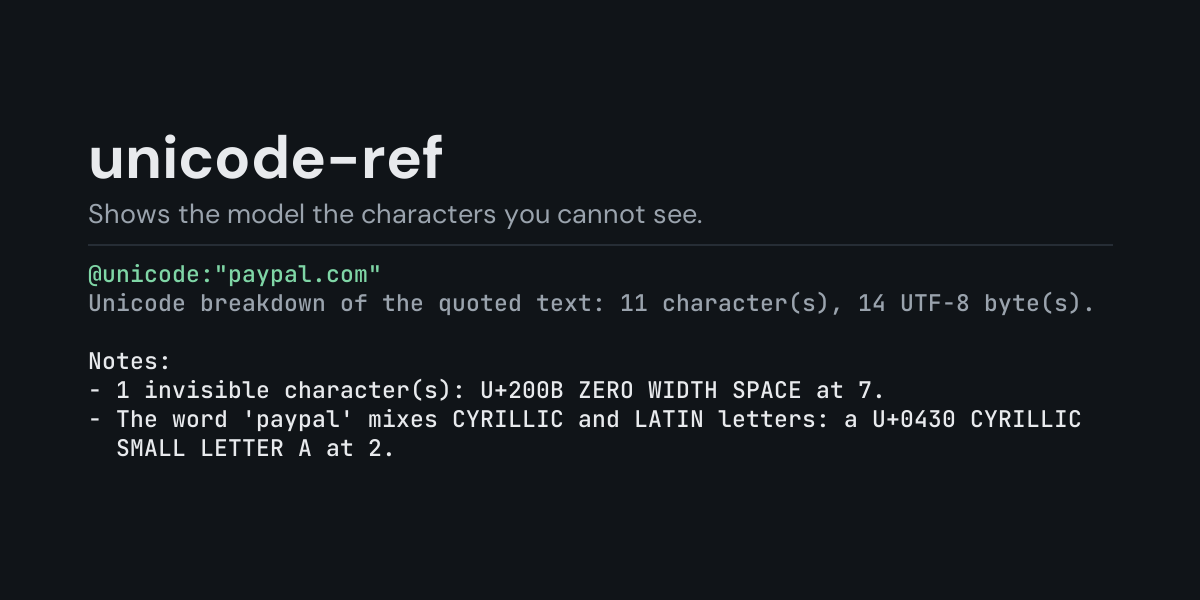
@unicode: context references that spell text out character by character for the model: @unicode:"text" attaches a table of every character of the quoted text (code point, Unicode name, category) with notes on what does not show on screen: invisible characters and their positions, text-direction controls, spaces other than the ordinary one, Unicode tag characters (decoded), words that mix Latin letters with lookalike Cyrillic, Greek or fullwidth ones, and private-use or unassigned code points; @unicode:U+200B describes up to 20 code points (name, category, UTF-8 bytes, decomposition); the TUI and Desktop composer suggest characters by name. Disclosure — reads only the text of the reference itself, using Python's unicodedata; no network, no files read or written, no subprocess, no credentials; register() only adds the @unicode: reference provider

olric3015Toolsv1.0.0Updated 21 days ago

About

@unicode: context references that spell text out character by character for the model: @unicode:"text" attaches a table of every character of the quoted text (code point, Unicode name, category) with notes on what does not show on screen: invisible characters and their positions, text-direction controls, spaces other than the ordinary one, Unicode tag characters (decoded), words that mix Latin letters with lookalike Cyrillic, Greek or fullwidth ones, and private-use or unassigned code points; @unicode:U+200B describes up to 20 code points (name, category, UTF-8 bytes, decomposition); the TUI and Desktop composer suggest characters by name. Disclosure — reads only the text of the reference itself, using Python's unicodedata; no network, no files read or written, no subprocess, no credentials; register() only adds the @unicode: reference provider

unicode-ref

@unicode: references for Hermes: put @unicode:"some text" in a message and Hermes replaces it
with a character-by-character breakdown of the quoted text (code point, Unicode name, category)
and notes on everything that does not show on screen: invisible characters, text-direction
controls, unusual spaces, Unicode tag characters and words that mix lookalike letters from
different scripts. @unicode:U+200B describes one code point.

Text you paste from a web page, a PDF or a chat can carry characters you cannot see: a
zero-width space that breaks a search or a variable name, a right-to-left override that shows
characters in a different order than they are stored, a Cyrillic letter that looks like a Latin "a" inside a domain name,
or tag characters that spell out text nobody sees. A model reads text as tokens and cannot
reliably tell these apart either. With @unicode: it gets them spelled out, so it can say
exactly what is in the string.

Install

hermes plugins install unicode-ref --enable

Requires Hermes 0.21.5 or newer. No API key, no configuration, no dependencies.

Use

@unicode:"text to look at"     every character of the quoted text, plus notes
@unicode:U+202E                one code point: name, category, UTF-8 bytes, decomposition
@unicode:U+200B,U+00A0         up to 20 code points at once

Quote the text with ", ' or a backtick (whichever it does not contain itself). Hermes reads a
reference up to the end of the line, so the text must be on one line.

Example, from the end-to-end test (a one-shot hermes chat turn): the message
What is odd here? @unicode:"paypal paypal ok", typed with a zero-width space after the first
pa, a Cyrillic р (U+0440, which looks like p) starting the second word and a no-break
space before ok, reaches the model as the message followed by:

Unicode breakdown of the quoted text: 17 character(s), 21 UTF-8 byte(s).

 #  char  code    name                      cat
 1  p     U+0070  LATIN SMALL LETTER P      Ll
 2  a     U+0061  LATIN SMALL LETTER A      Ll
 3        U+200B  ZERO WIDTH SPACE          Cf   invisible
 4  y     U+0079  LATIN SMALL LETTER Y      Ll
 5  p     U+0070  LATIN SMALL LETTER P      Ll
 6  a     U+0061  LATIN SMALL LETTER A      Ll
 7  l     U+006C  LATIN SMALL LETTER L      Ll
 8        U+0020  SPACE                     Zs
 9  р     U+0440  CYRILLIC SMALL LETTER ER  Ll
10  a     U+0061  LATIN SMALL LETTER A      Ll
11  y     U+0079  LATIN SMALL LETTER Y      Ll
12  p     U+0070  LATIN SMALL LETTER P      Ll
13  a     U+0061  LATIN SMALL LETTER A      Ll
14  l     U+006C  LATIN SMALL LETTER L      Ll
15        U+00A0  NO-BREAK SPACE            Zs
16  o     U+006F  LATIN SMALL LETTER O      Ll
17  k     U+006B  LATIN SMALL LETTER K      Ll

Notes:
- 1 invisible character(s): U+200B ZERO WIDTH SPACE at 3.
- Spaces other than the ordinary one: U+00A0 NO-BREAK SPACE at 15.
- The word 'рaypal' mixes CYRILLIC and LATIN letters: р U+0440 CYRILLIC SMALL LETTER ER at 9.
  • char is the character itself, left empty for the ones that draw nothing on their own
    (invisible characters, spaces, combining marks). cat is the Unicode general category (Ll
    lowercase letter, Zs space, Cf format, ...).
  • The notes cover the whole text: invisible characters with their positions, text-direction
    controls (U+202A..U+202E, U+2066..U+2069, U+200E, U+200F, U+061C), spaces other than U+0020,
    Unicode tag characters (decoded, since they can hide ASCII text), words that mix Latin letters
    with Cyrillic, Greek, Armenian, Cherokee, Coptic, fullwidth or mathematical ones, and private-use
    or unassigned code points. Zero-width joiners and variation selectors inside emoji are flagged
    too, with a note that they are expected there.
  • Long text: the first 200 characters are listed one per line, the notes cover the first 10,000.

@unicode:U+202E,U+00A0 (same run):

U+202E  RIGHT-TO-LEFT OVERRIDE
  category Cf (format), invisible, changes text direction
  UTF-8 E2 80 AE

U+00A0  NO-BREAK SPACE
  category Zs (space)
  UTF-8 C2 A0
  decomposes to: <noBreak> 0020

Suggestions

In the TUI and the desktop app, typing @unicode: followed by the start of a character's name
suggests matching characters (@unicode:zero offers U+200B ZERO WIDTH SPACE, U+200D ZERO WIDTH JOINER, ...), and choosing one inserts @unicode:U+200B. Each word you type must start a
word of the name. The classic CLI does not show reference suggestions. The name list is built
the first time you ask for one (well under a second).

Security and footprint

  • register() only registers one context reference provider (@unicode:).
  • It reads nothing but the text of the reference itself, and only when you write @unicode: in a
    message. Python's unicodedata supplies the names; nothing is looked up anywhere else.
  • No network access, no subprocesses, no downloads, no credentials read, no files read or
    written.
  • Standard library only.

Development

python -m pytest tests                                            # unit tests, no Hermes needed
PYTHONPATH=<hermes checkout> python tests/e2e/unicode_ref_e2e.py   # real hermes chat turns and TUI suggestions
hermes plugins validate unicode-ref

Changes

  • 1.0.0: first release.

MIT licensed.

README from the reviewed commit d33c8c9; it updates when the author re-pins.
More by olric3015

18 plugins by olric3015 in the catalog.

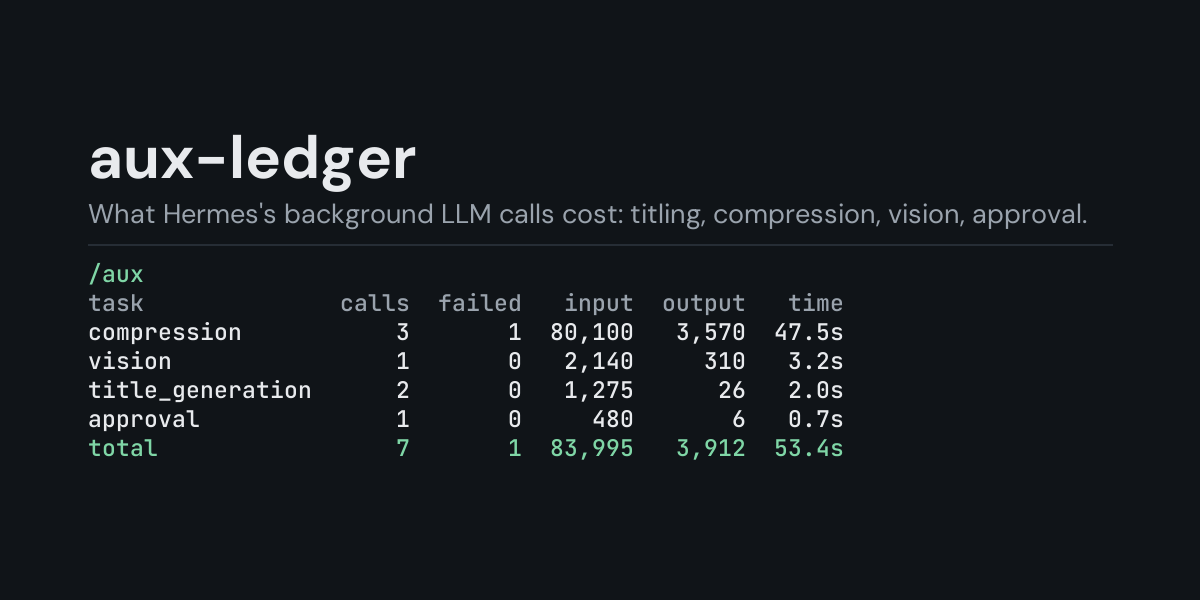
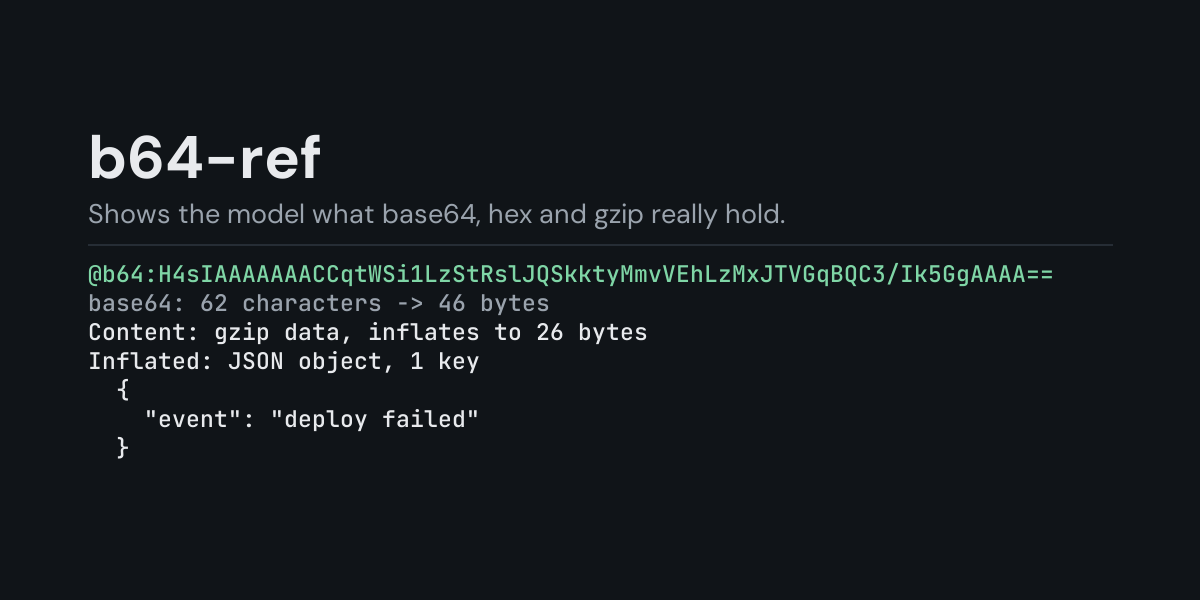
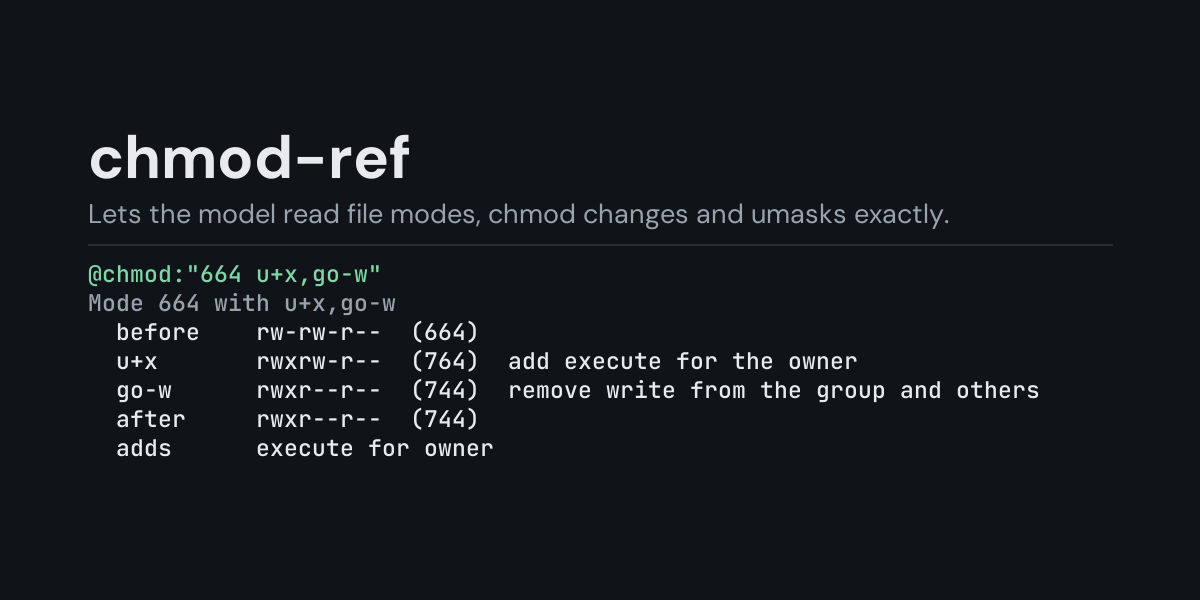
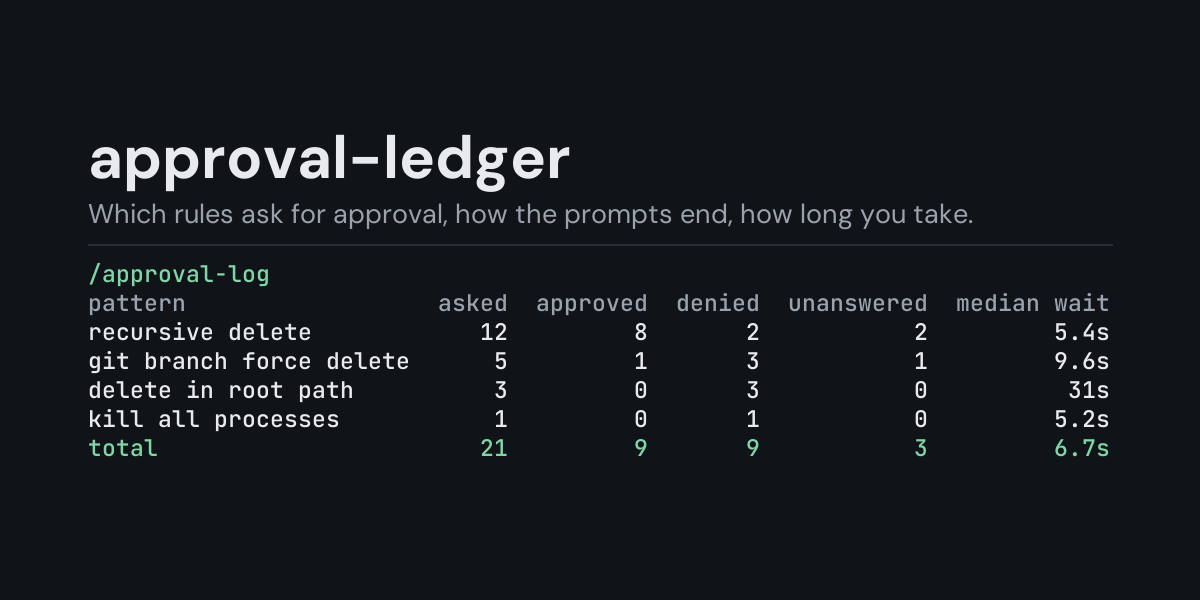
olric3015approval-ledgerLocal ledger of Hermes's approval prompts (dangerous commands, protected writes, MCP consent, smart-mode verdicts): /approval-log shows how often each rule asked, how many prompts were approved, denied or left unanswered, and how long a person took to answer, per rule, per surface or per day, for the last 24 hours, any number of hours or days, the latest session or everything recorded; /approval-log recent lists the newest decisions (ten, or up to 100 with /approval-log recent 50). Disclosure — writes decision metadata (session id, surface, rule label, answer, timings; no command, description or session key) to plugin-data/approval-ledger/approvals.jsonl, trimmed to 5,000 rows past 2 MB; observer only, cannot answer or change an approval; no networkCommunitytoolsolric3015aux-ledgerLocal ledger of Hermes's auxiliary LLM calls (titling, compression, vision, approval): /aux shows tokens, time and failures per task, model, provider or day, or lists the newest calls (ten, or up to 100 with /aux recent 50), for the last 24 hours, any number of hours or days, the latest session or everything recorded. Disclosure — writes auxiliary-call metadata (ids, models, timings, token counts, no prompt or response text) to plugin-data/aux-ledger/calls.jsonl, trimmed to 5,000 rows past 2 MB; no networkCommunitytoolsolric3015b64-ref@b64: context references that decode encoded text for the model: @b64:<value> takes base64 (standard or URL-safe, padded or not), hex (0x48656c6c6f, 48:65:6c, \x48\x65), percent-encoding or a data: URI, told apart by the value's shape or picked with base64:, base64url:, hex: or url:, and attaches what it holds: text as text with control and invisible characters escaped, JSON pretty-printed, gzip and zlib inflated in memory (at most 1 MiB, one layer), and binary named by its format (PNG and GIF with their size, JPEG, PDF, ZIP, ELF, SQLite and more) with a hex dump of its first 128 bytes; notes point out a value that was cut short, padding that is off, a second layer of encoding and a JWT inside; the TUI and Desktop composer preview a value as you type it. Disclosure — reads only the text of the reference itself, using Python's base64, json, urllib.parse and zlib; nothing decoded is run, opened or saved; no network, no files read or written, no subprocess, no credentials read; the plugin keeps no copy of what it decodes, but the @b64: reference and the decoded contents become part of the message sent to your model provider and saved in the session history, so decode only values you are willing to share with it; register() only adds the @b64: reference provider.Communitytoolsolric3015chmod-ref@chmod: context references that explain a file permission mode for the model: @chmod:<mode> takes an octal mode (755, 0755, 4755), ls -l text (-rwsr-xr-x, with the file type letter and a trailing + . or @) or an st_mode as stat and git write it (100644), and attaches both forms, each class's rights in words (directory rights named as such), what setuid, setgid and the sticky bit do and where they are ignored, and notes such as a mode everyone can change, one private to the owner, or a class holding rights the class before it lacks; @chmod:"644 u+x,go-w" applies a symbolic change step by step the way GNU chmod does (u g o a, + - =, r w x X s t, copies like u=g), @chmod:"100644 100755" shows what changes between two modes, and @chmod:"umask 027" shows what new files and directories get; the TUI and Desktop composer preview a mode as you type it. Disclosure — reads only the text of the reference itself, using Python's re; it never looks at a file on disk; no network, no files read or written, no permission changed, no subprocess, no credentials read; the plugin keeps no copy of what you write, but the @chmod: reference and the explanation become part of the message sent to your model provider and saved in the session history; register() only adds the @chmod: reference provider.Communitytools

Developer Mode

Explore built-in Hermes toolsets and actions.

HermesAgent

Developer?

Create a Hermes extension for Desktop or agent workflows.

Developer Section