All plugins

live2d-rigger

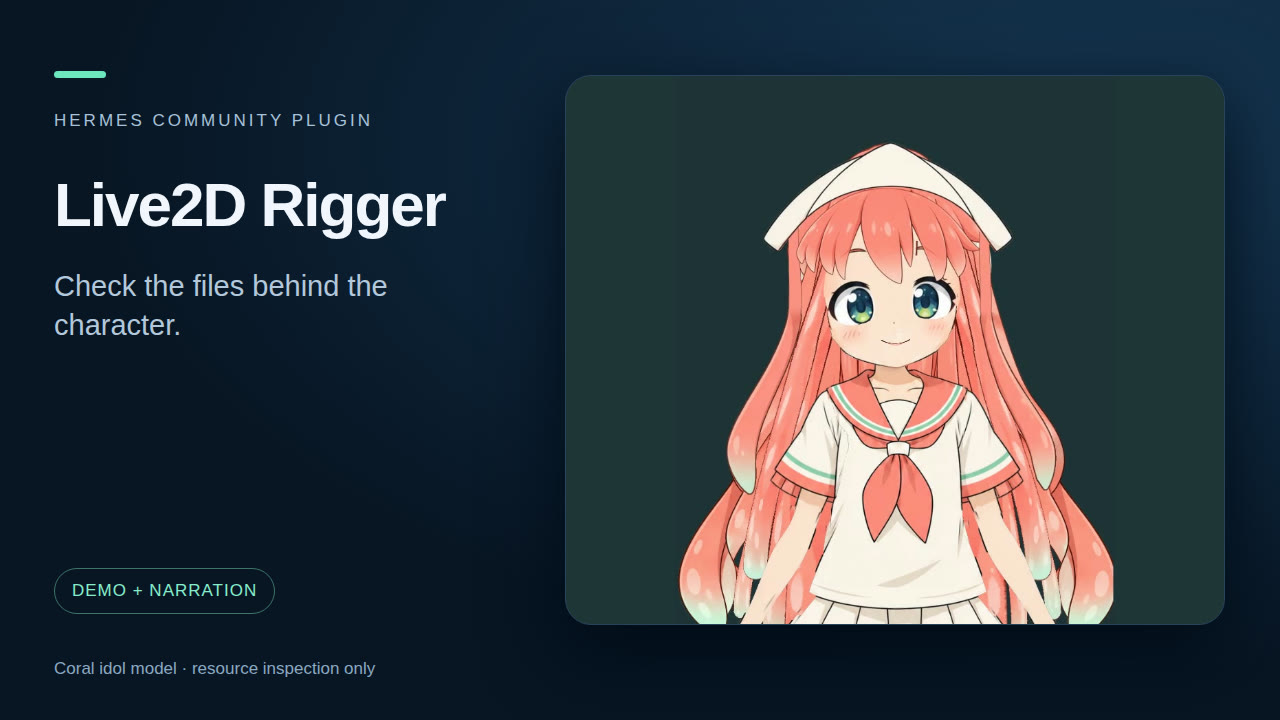
Create a provisional Live2D character from a brief with complete image parts, local cutout, placement, an experimental Umamo/JDK rig and Core motion review; also inspect and adjust a copy of an existing model. XY head turns, independent limbs and polished eyes are not provided. Disclosure — runs the Java (JDK) and Kotlin/Umamo classpath, the Python with Playwright and the Cubism SDK viewer folder that you set in the plugin settings (the model cannot name a program, classpath or command), plus FFmpeg and a local headless browser against a viewer served only on a temporary loopback port, each with a minimal environment; on first use it scans PATH and the hardware (read-only) and asks which routes to use; opening an existing model copies its folder into the plugin's data directory; on request it downloads official Live2D sample archives from cubism.live2d.com after you agree to Live2D's licence; the host image tool may use its configured provider; no Cubism SDK, Core, viewer, sample model, layers or textures are bundled, and the catalog thumbnail contains character artwork.

flabanabba81Toolsv0.6.3Updated 5 days ago

About

Create a provisional Live2D character from a brief with complete image parts, local cutout, placement, an experimental Umamo/JDK rig and Core motion review; also inspect and adjust a copy of an existing model. XY head turns, independent limbs and polished eyes are not provided. Disclosure — runs the Java (JDK) and Kotlin/Umamo classpath, the Python with Playwright and the Cubism SDK viewer folder that you set in the plugin settings (the model cannot name a program, classpath or command), plus FFmpeg and a local headless browser against a viewer served only on a temporary loopback port, each with a minimal environment; on first use it scans PATH and the hardware (read-only) and asks which routes to use; opening an existing model copies its folder into the plugin's data directory; on request it downloads official Live2D sample archives from cubism.live2d.com after you agree to Live2D's licence; the host image tool may use its configured provider; no Cubism SDK, Core, viewer, sample model, layers or textures are bundled, and the catalog thumbnail contains character artwork.

Live2D Rigger

Live2D Rigger: describe a character and Hermes creates and rigs her

Describe a character and Hermes makes her as a Live2D model: it draws her as separate complete parts, cuts them out, lays them out on one canvas, rigs them, compiles a MOC3 with your own toolchain, and shows you a clip of her moving. You say what looks wrong; Hermes fixes that one thing and renders the same motion again so you can compare. It also opens a model you already have and works on a copy.

Status: the built-in rig is experimental. Read what you get today before planning a finished VTuber model around it.

Install

hermes plugins install flabanabba8/live2d-rigger
hermes plugins enable live2d-rigger

Needs Hermes 0.22 or newer on Linux (the tested platform), Pillow and NumPy. To build a model you also need your own JDK 21+ and Umamo; to see her move you need your own Cubism SDK web viewer folder, a Python with Playwright, and ffmpeg. The plugin installs none of these and bundles no Cubism Core, SDK, viewer or sample model. You accept Live2D's licence yourself.

Creating a character

Ask in plain words, for example: "Make me a Live2D character: a fox girl with short silver hair and a red scarf, for streaming."

  1. Scan and ask (live2d_setup). The plugin looks at this computer (Java, Umamo, image tools, GPU, which image-service keys exist as yes or no) and lists your options with prices, licences and limits:

    • where the art comes from: a hosted image service, a local image model that fits your GPU, or art you already have;
    • which cutout tool removes backgrounds;
    • which rigging toolchain to use: Umamo (free, GPL-3.0, alpha), Live2D Cubism Editor FREE or PRO, Inochi2D or nijigenerate.

    The plugin never picks for you. It asks what the character is for, whether online services are OK, your budget and what you already own, and refuses combinations the sources rule out (for example Cubism FREE for commercial use above 10 million yen of annual sales, or a rig that exceeds FREE's limits of 1 texture, 100 ArtMeshes, 30 parts and 50 deformers). Nothing is installed, downloaded or generated without your yes. Facts older than 30 days are flagged as stale, and Hermes researches current ones online only if you agree.

  2. Brief (live2d_begin_model). Saves the character description, the intended expressions and motion, and the choices from step 1.

  3. Artwork as complete parts (live2d_model_layer). Each part (face, front hair, back hair, eye whites, irises, mouth, torso and so on) is generated on its own with Hermes's image tools, as an edit of one approved full-figure reference so every part keeps its place on the same canvas, and painted complete, including what the neutral pose hides. A flat portrait sliced into pieces is not accepted. Parts drawn on a flat key colour are cut out, and you get a before and after preview with the removed areas tinted to review.

  4. Layout (live2d_arrange_layers, live2d_place_layer, live2d_set_canvas, live2d_default_layout, live2d_remove_layer). Order the parts back to front and move or scale one without redrawing it.

  5. Rig (live2d_model_rig, live2d_check_rig_domains). source="prototype-roll" applies the built-in experimental rig; without a source you get a static layered model with no controls.

  6. Build (live2d_configure_umamo, live2d_build_model). Compiles a MOC3 package through your Umamo and JDK. For another toolchain, set your own trusted authoring_command in the plugin settings.

  7. Watch her move (live2d_render_model_motion). Renders a clip and a contact sheet through the official Cubism Core in your own viewer folder.

  8. Tell Hermes what is wrong. "Her hair comes off her head when she tilts", "the scarf is too big". Hermes makes one targeted fix, keeps the earlier build (live2d_rebuild_prototype, live2d_clone_model) and renders the same motion so the two compare frame for frame. live2d_model_status shows where a project stands.

The full recipe, the part contract and the review rules are in the task guide, the skill and the creation routes (every option with its source link and the date it was read).

What you get today

The built-in rig supplies head roll, basic body sway, breathing, a simple blink, approximate gaze, mouth opening and one back-hair physics group, when the matching parts exist. It does not supply left-right or up-down head turns, independent arms or legs, polished eyes, mouth shapes, or a native editable Cubism Editor document. Separately generated parts can drift out of alignment, so every part and every clip needs your eyes. A successful build is not proof that she looks right.

What was actually run is listed in VERIFICATION.md: a model built from layers with the real Umamo 0.5.0 release and rendered with the official Cubism Core. Image generation through the listed services, the Cubism Editor routes and a polished finished character have not been tested.

A character you already have

Give Hermes the folder of a .model3.json. The original is never changed.

  • live2d_open_model copies her into a project.
  • live2d_inspect_model explains how she is put together: parts, controls and their ranges, expressions, motions, and what makes her hair or skirt swing.
  • live2d_adjust_physics changes how loose parts swing.
  • live2d_write_motion writes a new idle motion from plain curve descriptions (breathing, sway, head turns, blinks) on her real parameters.
  • live2d_render_clip renders a labelled clip through the Cubism Core, so before and after compare frame for frame.

Reference samples

live2d_reference_samples lists five official free Live2D samples (Hiyori, Haru, Mark, Mao, Ren) and summarises one that is present. live2d_fetch_reference_sample downloads one from Live2D's own sample-data host, only after you accept Live2D's terms. They are structure references only; sample artwork must never be copied into your model. See references.

File checks

live2d_inspect_resources reads a model3.json and reports missing, invalid or unsafe paths (model, textures, physics, pose, expressions, motions, sounds). live2d_check_motion checks a motion file's structure and compares its targets with a display-info file. Both only read files; they do not load or render the model, so a clean report is not proof of a usable rig.

Settings

Set by you in the plugin settings; the model cannot change them.

SettingWhat it is
javaYour Java (JDK 21+) executable, for Umamo
umamo_classpath_fileA JSON file with compiler and runtime arrays of your installed Umamo and Kotlin library paths
viewer_dirYour Cubism SDK web viewer folder (index.html, viewer.js, core.min.js, framework/Shaders)
render_pythonA Python that has Playwright, used for rendering
authoring_commandOptional: your own trusted build command, with {project} and {output}
motion_commandOptional: your own trusted motion renderer

Licence and disclosure

GPL-3.0-or-later. Umamo is a separate GPL-3.0 project. The thumbnail contains character artwork; no character model, layers or textures are bundled. If you pick a hosted image service, your prompts and reference images are sent to that service. This plugin was made with AI assistance.

README from the reviewed commit 06a6706; it updates when the author re-pins.

More by flabanabba8

6 plugins by flabanabba8 in the catalog.

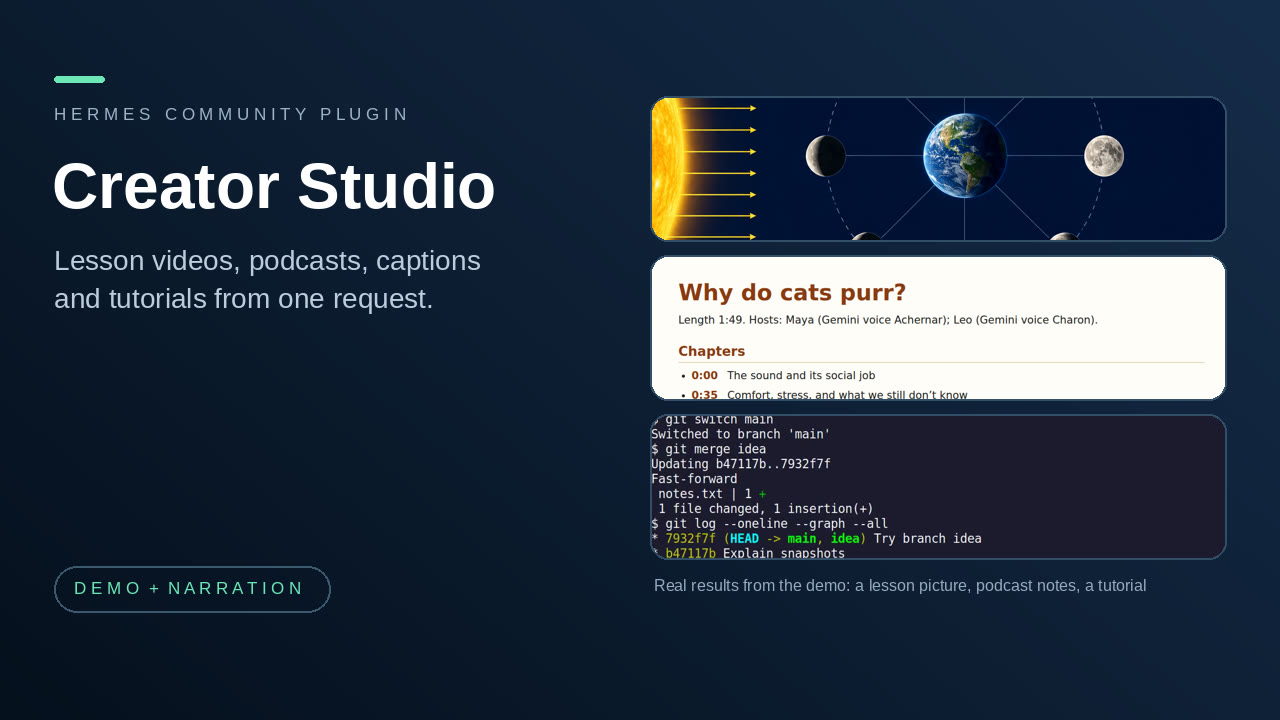
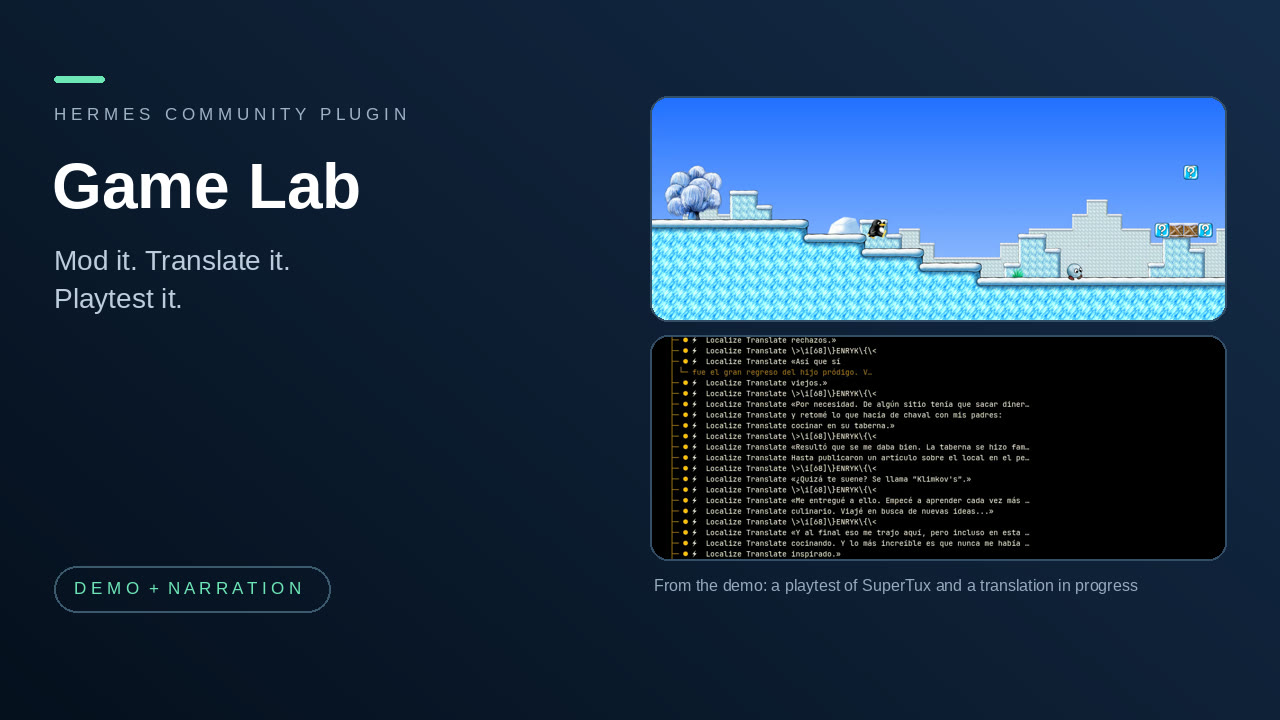
flabanabba8case-trailTrace case-history and treatment research to actual opinion passages; analyze supplied sources without a required repository. Disclosure — Sends case search queries and Justia page URLs through the web search/extract provider you configured in Hermes, and can fetch one public OpenJurist case page you select after a robots.txt check (OpenJurist sees the URL and your IP). Reads local opinion files at paths given in chat, refusing kernel and device files, the Hermes home and key stores; the plugin setting opinion_folders can limit it to folders you list. Stores fetched text, review receipts and rendered pages privately in its plugin data folder. Novelty research tool, not legal advice; unaffiliated with Justia or OpenJurist.Communitywebflabanabba8creator-studioMake media with Hermes from one request: researched lesson videos, two-host podcast episodes, captions for any recording, narrated step-by-step tutorials, and clips cut from a YouTube video or stream by reading its transcript. Bundles five plugins (YouTube Studio, Podcast Studio, Caption Studio, Tutorial Creator, Clip Studio) into one entry. Disclosure — Research pages are fetched through the Camoufox browser you set in the plugin settings, in a fresh anonymous profile (public addresses only). On first use it lists the voices and speech recognizers this computer has and asks you which to use; it never picks one for you. If you choose Gemini narration, each spoken line is sent to Google, either to Vertex AI (aiplatform.googleapis.com) with a Google sign-in that Hermes holds for your own OAuth client (hermes auth add creator-studio:google; the plugin never sees the token), or to generativelanguage.googleapis.com with the Gemini API key in this plugin's settings (GEMINI_API_KEY, the same variable Hermes' own Gemini provider uses), behind a spend guard (default 0.50 USD). To find speech servers it sends read-only GET requests (/v1/models, /openapi.json) to 127.0.0.1 only, on ports 2022, 5000, 5002, 7860, 8000, 8001, 8020, 8080, 8880 and 9000, plus any loopback address you set. Caption Studio runs the recognizer command you set in the plugin settings, or uploads audio to the HTTPS speech service you set (public addresses only) or to Groq (api.groq.com) with your key, only when you allow uploads; the model cannot set commands, endpoints, keys or upload consent. Programs it starts get a minimal environment (paths, locale, display/audio session and proxy settings), never your provider keys. Clip Studio runs the yt-dlp you installed (or set in the plugin settings) and makes requests to YouTube only when you give it a link: the video page and one caption track, then the audio track if you ask for speech recognition, the sections you choose to cut, and, if you ask what chat reacted to, the public chat replay of a finished stream (other people's messages and display names; kept in private plugin storage, the raw download deleted once counted, names kept only for paid messages). It never uses browser cookies or a YouTube sign-in. Recognizing a whole recording continues in a background thread inside Hermes until its pieces are done. Clips, joined videos, titles, descriptions and thumbnails are written to plugin storage. Runs FFmpeg and ffprobe, an installed speech program if you choose one (espeak-ng, flite, piper), and for screen tutorials xwininfo, xprop, xdotool, pactl and xclip; the recorder starts one detached FFmpeg worker per take, and tutorial steps click and type through Hermes computer_use, so its approvals apply. Stores projects privately in plugin storage. Nothing is published.Communitytoolsflabanabba8game-labGame Lab combines ModLab, Game Localization Studio, Sprites and experimental Playtest Pilot. ModLab works on a private game copy and invokes separately installed tools; localization drafts and exports RPG Maker MV/MZ text and the text of Unity Mono builds (JSON text assets, script-component strings and Assembly-CSharp string literals; patched copies of changed files only, the game folder is never written); localization companions estimate width and row budgets, merge and audit translation data, and proofread English; Sprites inspects and previews character sheets. Playtest Pilot uses approved X11 input, captures screen pixels within the selected window, stores private evidence frames and returns reduced previews and optional local OCR hints; for a failed check it can build a short captioned MP4 from those frames with your FFmpeg, or cut one from a recording file you point to (that asks for approval). On first use ModLab reads Steam's library list and app manifests to find installed games, lists the files in the chosen game folder, runs read-only hardware checks, and asks which modding route to use. It never fills a disk: a free-space reserve, a total cap, pruning of old revisions and a confirm-first cleanup tool. The Universal Modder and REA programs are the ones you set in the plugin settings or find on PATH (the model cannot name a program), and each toolkit call and each playtest check asks for your approval. Every program it starts gets a minimal environment, never your provider keys. The plugin makes no network calls of its own. Disclosure — Playtest Pilot sends synthetic key presses and clicks to the X11 window you select (via xdotool and Hermes computer_use, each check or batch approved), captures that window's pixels and stores evidence frames in the plugin's data folder; ModLab reads your Steam library and app-manifest files to list installed games, copies the game folder you choose into plugin data (with a disk cap), Game Localization Studio reads the RPG Maker data file or Unity game folder you point it at and copies the files that hold text into plugin data, writes a JSONL units file into the draft folder, and reads translations back from the JSONL file path named in the tool call (absolute path; symlinks, credential folders and the Hermes home are refused); and, after your approval of each call, runs the Universal Modder / REA programs set in the plugin settings or found on PATH.Communitytoolsflabanabba8pagecast-directorEditable cast narration with locked voices, source passage IDs, resumable synthesis and selective regeneration. Disclosure — Stores books and generated audio privately in its plugin data. On first use it lists the speech options on this computer and asks which to use; it never picks one for you, and online engines are blocked if you say no online services. To find local speech servers it sends GET /v1/models only to this computer's loopback address (ports 8000, 8880, 5002, 8020 and 8080, plus any local address you set; no redirects, 1 second timeout). Every program it starts gets a minimal environment (PATH, HOME, LANG), never your provider keys. Voices are local (an installed speech program such as espeak-ng, Flite, Piper or say, or a speech server already running on this computer) unless you choose hosted Inworld, ElevenLabs or Google Gemini, which send passage text and voice choices to that provider with your own key and use your credits; the optional Gemini Vertex route uses a Google sign-in that Hermes holds for your own OAuth client (hermes auth add pagecast-director:google; the plugin never sees the token), sent only to aiplatform.googleapis.com. Can render a short captioned video clip (audiogram) of a finished chapter span into plugin data, with a cover image you point to. Runs local FFmpeg/ffprobe and adb; mpv only plays a preview aloud when you approve it. The optional Android tools check the author's GitHub releases (flabanabba8/PageCast) for the PageCast app and can download the latest APK (checked against that release's own SHA256SUMS); installing it on a phone with adb, replacing a locked voice and playing a preview aloud each ask for your approval (one pre_tool_call hook). No background processes beyond a render or preview you start.Communityvoice

Developer Mode

Explore built-in Hermes toolsets and actions.

HermesAgent

Developer?

Create a Hermes extension for Desktop or agent workflows.

Developer Section